 flip
flipPiernik — Keeping Honey Gingerbread
Piernik — Keeping Honey Gingerbread
Why this dish? Polish gingerbread (piernik, famous from Toruń) kept for months, even aging with time — the ideal sweet to take into exile or offer at gatherings of the diaspora evoked in Mickiewicz's life. A taste of the homeland that travels and lasts.
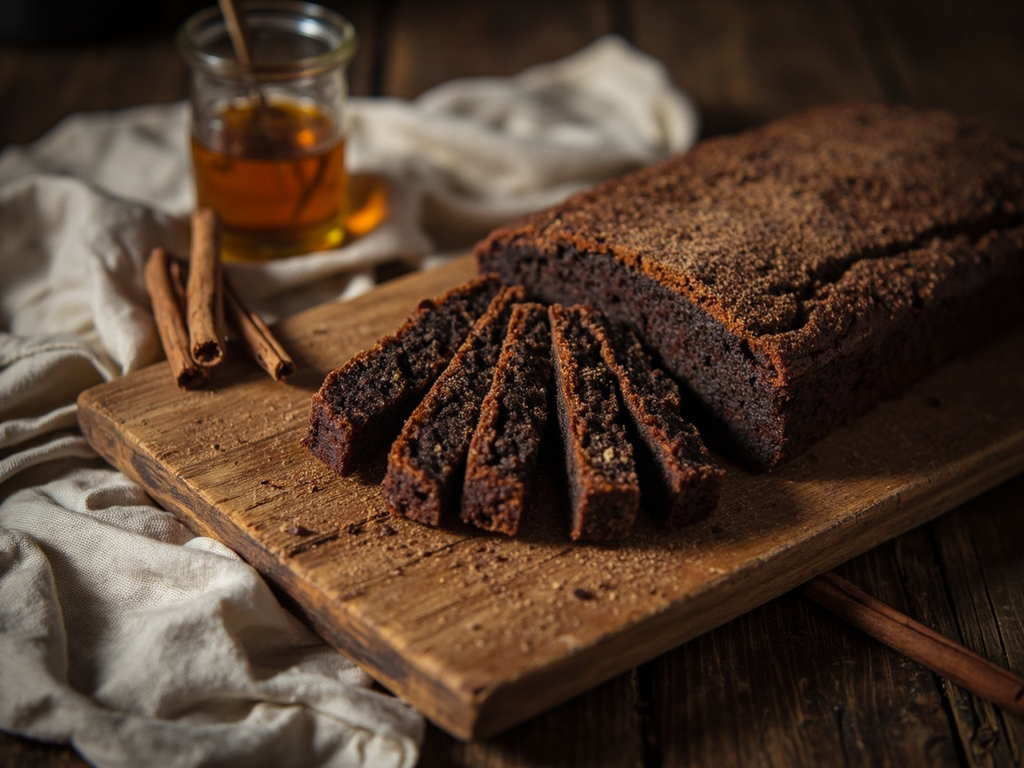
A dense, dark bread, bound with honey and loaded with brown spices, which improves as it ages under a cloth. It is cut into thin slices for coffee or tea during evening gatherings.
Piernik, you see, does not like haste: you bind the dough with honey and spices, then you forget it in the cool for a whole moon before baking it, and the longer it waits, the better it becomes. It is the sweet of exiles: it does not spoil, it keeps in the trunk and is shared among brothers on feast days. Cut me a thin slice, dip it in hot tea, and taste the patience of an entire country.
- •Honey — abundant (sugar and preserving binder)
- •Rye and wheat flour — as needed (structure)
- •Brown spices (clove, cinnamon, ginger, anise, nutmeg) — generously (soul of piernik)
- •Eggs — a few (binder)
- •Potash pearls (ancient leavening) — a little (leavening)
Piernik — Keeping Honey Gingerbread
A dense, dark bread, bound with honey and loaded with brown spices, which improves as it ages under a cloth. It is cut into thin slices for coffee or tea during evening gatherings.
Why this dish? Polish gingerbread (piernik, famous from Toruń) kept for months, even aging with time — the ideal sweet to take into exile or offer at gatherings of the diaspora evoked in Mickiewicz's life. A taste of the homeland that travels and lasts.
Piernik, you see, does not like haste: you bind the dough with honey and spices, then you forget it in the cool for a whole moon before baking it, and the longer it waits, the better it becomes. It is the sweet of exiles: it does not spoil, it keeps in the trunk and is shared among brothers on feast days. Cut me a thin slice, dip it in hot tea, and taste the patience of an entire country.
Ingredients (period version)
- Honey — abundant (sugar and preserving binder)
- Rye and wheat flour — as needed (structure)
- Brown spices (clove, cinnamon, ginger, anise, nutmeg) — generously (soul of piernik)
- Eggs — a few (binder)
- Potash pearls (ancient leavening) — a little (leavening)
Ingredients
- Honey — 250 g (sweetness and preservation)
- Rye flour — 150 g (dense structure)
- Wheat flour — 200 g (structure)
- Gingerbread spice mix (cinnamon, clove, ginger, anise, nutmeg) — 2 tbsp (signature spices)
- Eggs — 2 (binder)
- Butter — 60 g (tenderness)
- Baking soda — 1 tsp (leavening)
- Milk — 60 ml (dough adjustment)
Method
- Gently heat the honey with the butter until fluid, let cool.
- Mix flours, spices and baking soda; add the warm honey mixture, beaten eggs and milk to obtain a thick dough.
- Ideally, cover and let the dough rest in the cool for several days (tradition: up to several weeks) to develop the aromas.
- Pour into a buttered and floured loaf pan.
- Bake at 170 °C for about 45-50 minutes, until a skewer comes out clean.
- Unmold, let cool, then wrap in a cloth: piernik improves over a few days before being sliced thinly.
How it was made : Toruń, Copernicus's birthplace, was the capital of piernik since the Middle Ages; recipes, jealously guarded by guilds, relied on honey (a natural preservative) and imported spices. The dough was sometimes aged for weeks, and the loaves could keep for months — hence their role as gifts and travel provisions. No chocolate or refined sugar in the old versions: honey reigned alone.
The contemporary twist : Glaze with a thin lemon sugar icing and cut into thin biscotti-like slices, to dip in the warm krupnik from the previous recipe.
Sources : Maria Dembińska, Food and Drink in Medieval Poland (1999) · Documented traditions of Toruń piernik
Adam Mickiewicz · Charactorium