 flip
flipLentils with Oil, Vinegar, and Herbs
Lentils with Oil, Vinegar, and Herbs
Why this dish? Lentil soup (*phakê*) was the quintessential popular dish of Athens, so much so that it became a proverb: "everything is in the lentils." For Agnodice, a physician close to the people who championed women's access to care, this simple and cheap stew embodies the daily table she shared.
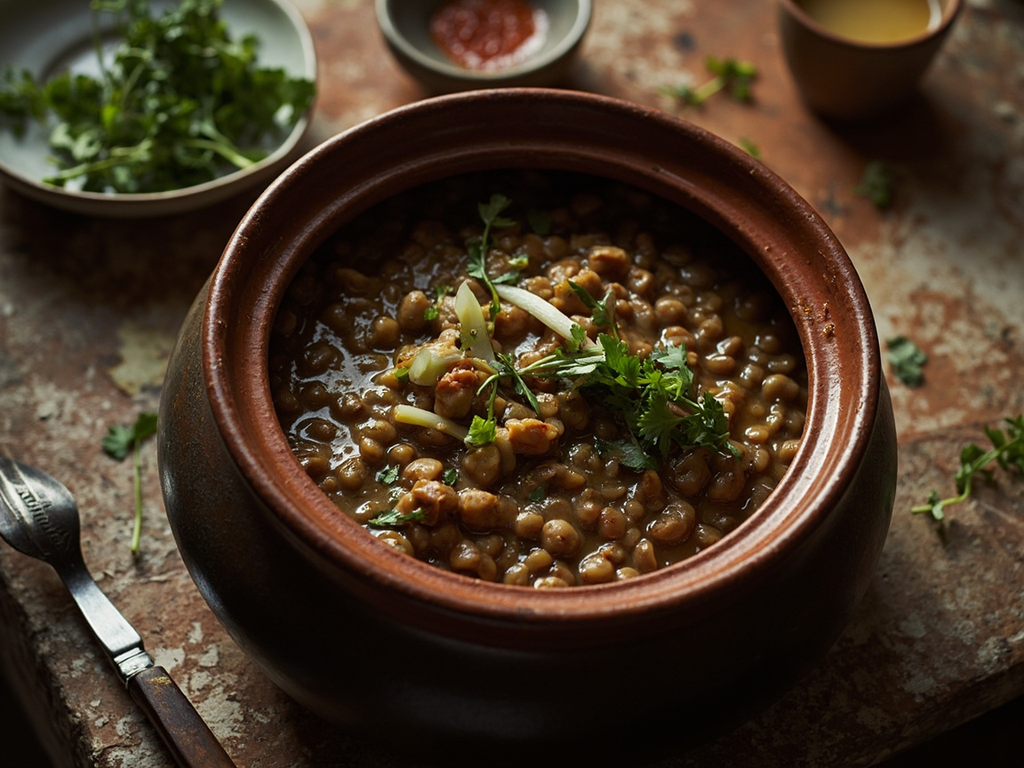
A thick stew of lentils simmered with leek and herbs, brightened with a dash of wine vinegar and a generous drizzle of olive oil. The comfort food of the ordinary Athenian, warm and soothing in the evening.
People sometimes mock me because I love *phakê*, the poor man's lentil pottage. But tell me: what is better, in the evening, than a bowl of melting lentils, with a leek and herbs thrown in, seasoned with a dash of vinegar and drenched with a full spoonful of oil? Do not be stingy with vinegar or oil — that is the whole secret. This is what warms the body when you return, lamp in hand, from a long day with the sick.
- •Lentils — a good measure (base of the stew)
- •Leek — one (aromatic)
- •Water — as needed (cooking liquid)
- •Olive oil — generously (binder and flavor)
- •Wine vinegar — a dash (acidity)
- •Coriander and fresh herbs — a handful (aroma)
- •Salt — to taste (seasoning)
Lentils with Oil, Vinegar, and Herbs
A thick stew of lentils simmered with leek and herbs, brightened with a dash of wine vinegar and a generous drizzle of olive oil. The comfort food of the ordinary Athenian, warm and soothing in the evening.
Why this dish? Lentil soup (*phakê*) was the quintessential popular dish of Athens, so much so that it became a proverb: "everything is in the lentils." For Agnodice, a physician close to the people who championed women's access to care, this simple and cheap stew embodies the daily table she shared.
People sometimes mock me because I love *phakê*, the poor man's lentil pottage. But tell me: what is better, in the evening, than a bowl of melting lentils, with a leek and herbs thrown in, seasoned with a dash of vinegar and drenched with a full spoonful of oil? Do not be stingy with vinegar or oil — that is the whole secret. This is what warms the body when you return, lamp in hand, from a long day with the sick.
Ingredients (period version)
- Lentils — a good measure (base of the stew)
- Leek — one (aromatic)
- Water — as needed (cooking liquid)
- Olive oil — generously (binder and flavor)
- Wine vinegar — a dash (acidity)
- Coriander and fresh herbs — a handful (aroma)
- Salt — to taste (seasoning)
Ingredients
- Green or brown lentils — 250 g (base)
- Leek — 1, sliced (aromatic)
- Onion — 1, chopped (aromatic)
- Water or vegetable broth — 1 liter (cooking liquid)
- Extra virgin olive oil — 4 tbsp (binder and flavor)
- Red wine vinegar — 1 to 2 tbsp (final acidity)
- Fresh coriander (and a pinch of ground cumin) — 1 handful + 1 pinch (aroma)
- Salt and bay leaf — to taste + 1 leaf (seasoning)
Method
- Rinse the lentils. Sauté the leek and onion in 2 tbsp oil until softened.
- Add the lentils, water or broth, bay leaf, and cumin. Bring to a boil, then reduce heat.
- Simmer for 30 to 40 minutes, until the lentils are very tender and the broth has thickened. Season with salt at the end.
- Off the heat, stir in the vinegar and taste: the acidity should lift without dominating.
- Serve hot in bowls, drizzled with a generous amount of raw olive oil and sprinkled with fresh coriander.
How it was made : *Phakê* was the symbol of frugal, democratic food. Athenian comedies mention it constantly, and the physician-cook of the tradition advised salting the legume only at the end of cooking so it would soften properly. Neither tomato nor potato was known: the body of the dish came from lentils, leek, oil, and vinegar.
The contemporary twist : Served in a deep bowl with a soft-boiled egg on top and a veil of coriander, *phakê* becomes an ancient "bowl" perfectly on trend.
Agnodice · Charactorium