 flip
flipMoretum — everyday herbed cheese spread
Moretum — everyday herbed cheese spread
Why this dish? Even in a grand house on the Palatine, one ate simply during the day. This fresh cheese pounded with herbs, spread on bread, was the familiar snack shared without ceremony — the quiet counterpart to Clodia's glamorous life.
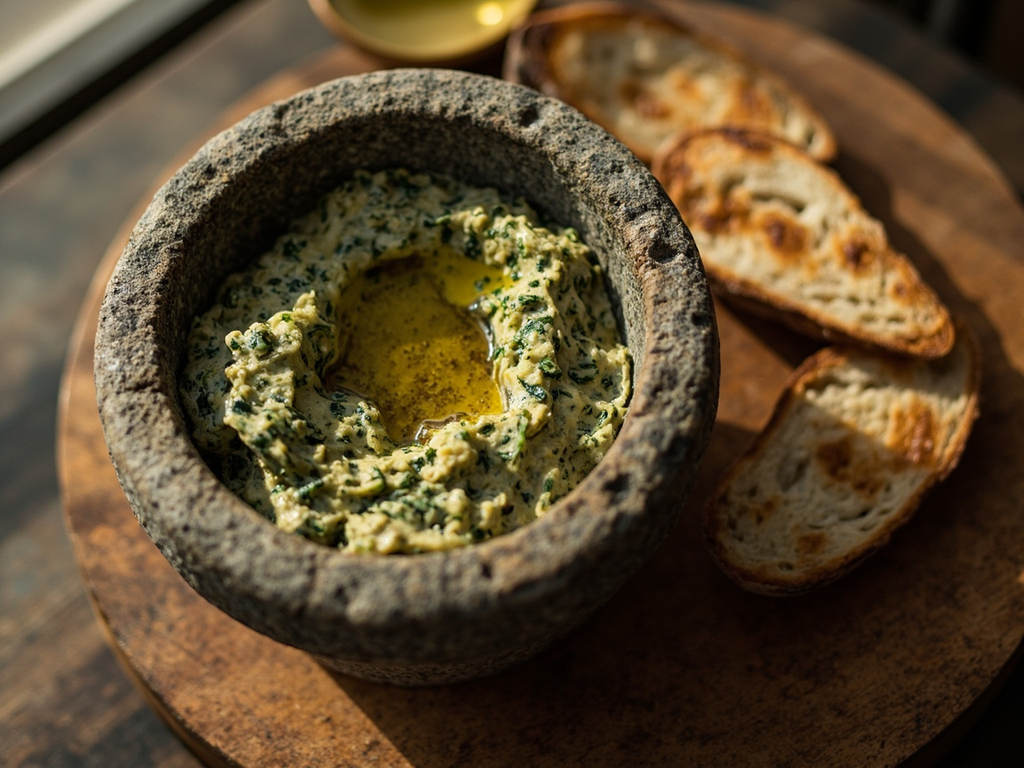
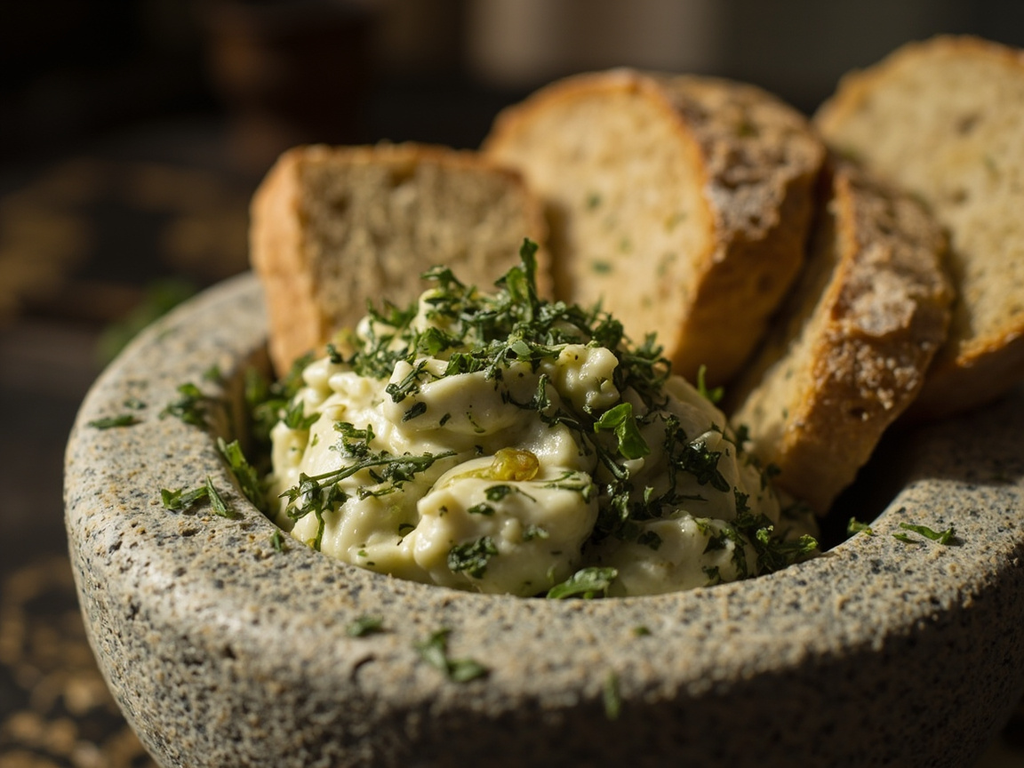
A fresh, tangy paste of cheese pounded in a mortar with garlic, herbs, vinegar, and oil: green, lively, to be spread on warm bread.
Not everything is banquets and flatterers, believe me. By day, when the house empties of smooth talkers, I content myself with what my grandmothers called moretum: you pound fresh cheese in a mortar with garlic, coriander, rue, and celery, bind it with a little vinegar and oil until it forms a green, pungent ball. You spread it on warm bread, and that's all. A Roman matron knows that true elegance also lies in knowing how to make a meal of next to nothing.
- •Fresh sheep's milk cheese — a lump (base)
- •Garlic — a few cloves (aromatic)
- •Herbs (coriander, celery, rue, savory) — a handful (freshness)
- •Vinegar — a drizzle (acidity)
- •Olive oil — enough (binder)
- •Salt — a pinch (seasoning)
Moretum — everyday herbed cheese spread
A fresh, tangy paste of cheese pounded in a mortar with garlic, herbs, vinegar, and oil: green, lively, to be spread on warm bread.
Why this dish? Even in a grand house on the Palatine, one ate simply during the day. This fresh cheese pounded with herbs, spread on bread, was the familiar snack shared without ceremony — the quiet counterpart to Clodia's glamorous life.
Not everything is banquets and flatterers, believe me. By day, when the house empties of smooth talkers, I content myself with what my grandmothers called moretum: you pound fresh cheese in a mortar with garlic, coriander, rue, and celery, bind it with a little vinegar and oil until it forms a green, pungent ball. You spread it on warm bread, and that's all. A Roman matron knows that true elegance also lies in knowing how to make a meal of next to nothing.
Ingredients (period version)
- Fresh sheep's milk cheese — a lump (base)
- Garlic — a few cloves (aromatic)
- Herbs (coriander, celery, rue, savory) — a handful (freshness)
- Vinegar — a drizzle (acidity)
- Olive oil — enough (binder)
- Salt — a pinch (seasoning)
Ingredients
- Fresh sheep's milk cheese (or fresh pecorino, mild feta) — 200 g (base)
- Garlic — 1 to 2 cloves (aromatic)
- Fresh coriander and celery leaves — 1 handful (freshness)
- Wine vinegar — 1 tsp (acidity)
- Olive oil — 2 tbsp (binder)
- Salt — 1 pinch (seasoning)
- Country bread — to serve (base)
Method
- Peel the garlic and pound it in a mortar with a pinch of salt until it forms a paste.
- Add the chopped herbs and pound again to release the aromas.
- Incorporate the cheese and mash until smooth and homogeneous.
- Loosen with the vinegar, then drizzle in the olive oil while working the mixture until it reaches a soft, green consistency.
- Shape into a ball and serve spread on warm bread.
How it was made : The moretum is described in an ancient poem of the same name (long attributed to Virgil): the farmer Simylus pounds cheese, garlic, and herbs in a mortar for his morning meal. It is one of the few Roman popular dishes documented in detail, the distant ancestor of pesto and herb cheeses.
The contemporary twist : Serve as a 'Roman apéritif' in quenelles on grilled toasts, with a rare herb (rue is hard to find — substitute with a hint of peppery arugula).
Sources : Appendix Vergiliana, Moretum
Clodia Metella · Charactorium