 flip
flipTecuitlatl Cakes (Lake Spirulina)
Tecuitlatl Cakes (Lake Spirulina)
Why this dish? The Ahuizotl haunts precisely the waters of Lake Texcoco where, each morning, women skimmed this 'green mud' from the surface. It is the food that literally comes from its territory: the everyday staple wrested from the water where it lies in wait.
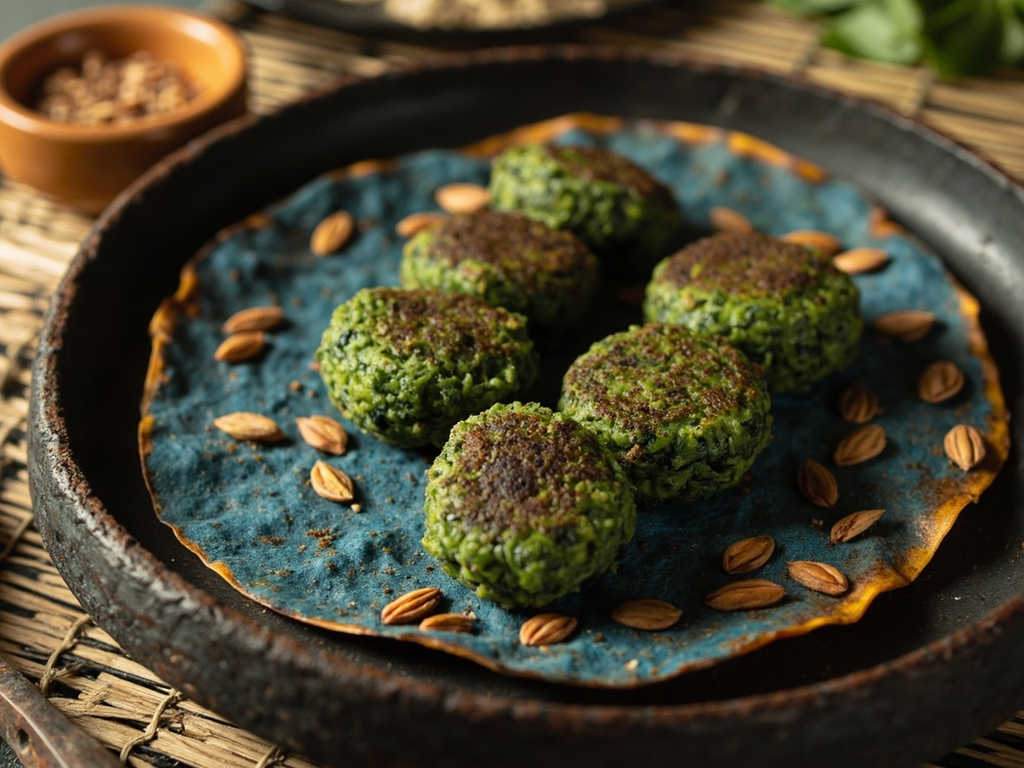
An alga (spirulina) that thrived on the lake's surface, sun-dried into small blue-green cakes and eaten like cheese, placed on a warm tortilla. Deeply umami, slightly salty from the lake water. Bernal Díaz and Sahagún describe it as a commodity sold at the great market of Tlatelolco.
Draw near the shore, walker — but not too close. When dawn glides over Texcoco, the women skim from my water's surface this green mud that the gods cause to grow: tecuitlatl. They press it into cakes, dry them in the sun on mats, and break them over the warm tlaxcalli like a cheese of the lakes. I, lurking beneath the reeds, watch their hands dip into my water... and I wait.
- •Tecuitlatl (fresh spirulina skimmed from the lake) — two handfuls (base, source of umami and protein)
- •Texcoco salt — a pinch (seasoning and preservation)
- •Corn husks (totomochtli) — a few (mold and drying support)
- •Tlaxcalli (nixtamalized corn tortilla) — as needed (serving base)
Tecuitlatl Cakes (Lake Spirulina)
An alga (spirulina) that thrived on the lake's surface, sun-dried into small blue-green cakes and eaten like cheese, placed on a warm tortilla. Deeply umami, slightly salty from the lake water. Bernal Díaz and Sahagún describe it as a commodity sold at the great market of Tlatelolco.
Why this dish? The Ahuizotl haunts precisely the waters of Lake Texcoco where, each morning, women skimmed this 'green mud' from the surface. It is the food that literally comes from its territory: the everyday staple wrested from the water where it lies in wait.
Draw near the shore, walker — but not too close. When dawn glides over Texcoco, the women skim from my water's surface this green mud that the gods cause to grow: tecuitlatl. They press it into cakes, dry them in the sun on mats, and break them over the warm tlaxcalli like a cheese of the lakes. I, lurking beneath the reeds, watch their hands dip into my water... and I wait.
Ingredients (period version)
- Tecuitlatl (fresh spirulina skimmed from the lake) — two handfuls (base, source of umami and protein)
- Texcoco salt — a pinch (seasoning and preservation)
- Corn husks (totomochtli) — a few (mold and drying support)
- Tlaxcalli (nixtamalized corn tortilla) — as needed (serving base)
Ingredients
- Spirulina powder — 4 tbsp (about 30 g) (replaces fresh lake algae)
- Nixtamalized corn masa (or rehydrated masa harina) — 100 g (binder to form the cake)
- Water — 5 to 7 tbsp (hydrates the dough)
- Fine salt — 1/2 tsp (seasoning)
- Corn tortillas — 4 to 6 (serving base)
Method
- Mix the spirulina, masa, and salt, then add water little by little until you get a soft, almost sticky dough.
- Shape small flat cakes about 4-5 cm in diameter, like patties.
- Dry/firm them on a comal (or dry skillet) over low heat for 8-10 minutes, flipping, without browning: they should remain green.
- Let cool so they hold together like fresh cheese.
- Serve crumbled or sliced on a warm tortilla, with a dash of chīlli sauce if desired.
How it was made : Sahagún (Florentine Codex) and Bernal Díaz del Castillo report that the Mexica harvested this 'scum' from the lake with fine nets, dried it into bricks, and sold it at market. Rich in protein, it compensated for a cuisine lacking large livestock. It was eaten simply with the corn tortilla, sometimes spiced with chīlli.
The contemporary twist : Serve the cakes warm on a blue corn tortilla, sprinkled with toasted pumpkin seeds and a veil of smoked sea salt: a 'lake toast' riding today's spirulina wave.
Sources : Bernardino de Sahagún, Historia general de las cosas de Nueva España (Codex de Florence), Book XI · Bernal Díaz del Castillo, Historia verdadera de la conquista de la Nueva España
Ahuizotl · Charactorium