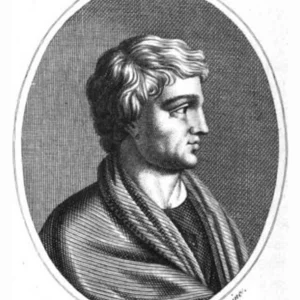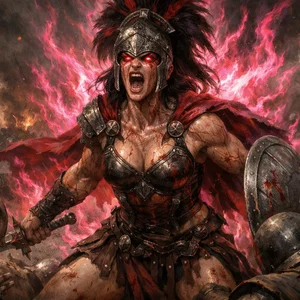

Ajax, son of Telamon, king of Salamis, is one of the greatest Greek heroes of the Trojan War. Renowned for his colossal size and strength, he is considered, after Achilles, the finest warrior in the Achaean camp.
Ajax
Ajax
6 min read
Frequently asked questions
Key Facts
- Son of Telamon, king of Salamis, he leads his warriors against Troy in the Homeric legend
- Portrayed in the Iliad as the largest and strongest of the Achaeans after Achilles
- Fights the Trojan hero Hector in single combat, with neither man gaining the upper hand
- Protects the body of the fallen Achilles and defends the Greek ships
- According to tradition (notably Sophocles), he takes his own life after the arms of Achilles are awarded to Odysseus rather than to him
Works & Achievements
A memorable single combat that ends in a draw, proving that Ajax is the only Achaean able to stand up to the Trojan champion.
Ajax single-handedly repels the Trojan assault and prevents the burning of the fleet, saving the Greek army from disaster.
He shields the body of Patroclus with his shield and makes it possible to wrest it from the Trojans.
After the death of Achilles, Ajax carries his body out of the fray while Odysseus holds off the enemy.
He is among the chiefs sent to persuade Achilles to return to battle, delivering a short and frank speech.
Honored as a founding hero, Ajax gives his name to an Athenian tribe (the Aiantids) and receives an official cult.
Anecdotes
When the Greek leaders draw lots to decide who will face Hector in single combat, it is Ajax's token that leaps from the helmet. The fight lasts until dusk with no victor, and the two heroes, full of mutual admiration, exchange gifts: Hector offers his sword, Ajax his purple belt.
Ajax is often called “the bulwark of the Achaeans” by Homer, for he alone protects an entire portion of the Greek camp. When the Trojans hurl fire at the ships, it is he who, standing on the decks with a long pike, holds off the assault the longest.
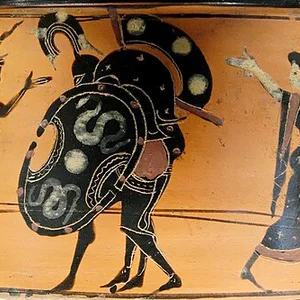
His most famous weapon is an immense shield made of seven layers of oxhide covered with a plate of bronze, crafted by the artisan Tychios. This shield “like a tower” is the emblem of his strength and of his role as protector.
After the death of Achilles, it is decided that his divine armor should be awarded to the most deserving. The contest pits Ajax against Odysseus, and it is the latter who wins thanks to his eloquence. Mad with rage and humiliation, Ajax descends into madness and takes his own life.
In legend, from the spilled blood of Ajax springs a flower, the hyacinth, whose petals bear the letters “AI,” read as the hero's cry of grief. The Greeks saw in this a sign that nature itself wept for his tragic end.
Primary Sources
Ajax came forward, like a rampart, bearing his shield like a tower, made of bronze and seven oxhides.
Now I am going where I must go. As for you, do quickly what I say: know that I am saved, perhaps, from my woes.
The earth, reddened by his blood, brought forth upon the green turf a purple flower, the same that once before had sprung from the blood of Hyacinthus.
Over the arms of Achilles a dispute arose between Ajax and Odysseus; Odysseus prevailed, and Ajax, his mind unhinged, took his own life.
Key Places
Island in the Saronic Gulf ruled by Telamon, the father of Ajax. It is the hero's homeland, from which he leads his warriors to Troy.
City of Asia Minor besieged for ten years by the Greeks. It is where Ajax performs his great deeds and meets his death.
The makeshift rampart and the row of vessels hauled up onto the beach, which Ajax defends single-handedly against the Trojan fire.
Port in Boeotia where the Greek fleet gathers before setting sail for Troy. The starting point of the expedition in which Ajax takes part.
A revered burial mound on the coast of the Troad where ancient tradition places the hero's grave. Greek and Roman travelers came there to pay their respects.
Typical Objects

An immense shield made of seven layers of ox leather backed by a plate of bronze, crafted by the artisan Tychios. It covered Ajax entirely and symbolized his role as the bulwark of the Achaeans.

A long bronze pike that Ajax wielded across the decks of the ships to drive back the Trojans. It is his main offensive weapon in the defense of the camp.

A silver-hilted blade received from Hector at the end of their duel, as a token of mutual esteem. The tragic tradition makes it the weapon of his suicide.

A bronze helmet topped with a horsehair crest, worn by the Achaean warriors. It protects the head and marks the rank of the fighter.

A purple-dyed baldric that Ajax offered to Hector after their combat. The exchange sealed the respect between the two adversaries.

A metal breastplate protecting the hero's torso in battle. Together with the greaves and the shield, it forms the complete armor of the legendary hoplite.
School Curriculum
Vocabulary & Tags
Key Vocabulary
Tags
Daily Life
Morning
At the camp before Troy, Ajax's day begins at daybreak: he dons his bronze armor, adjusts his great shield, and joins the assembly of leaders around Agamemnon. There they discuss battle plans and the omens observed by the seers.
Afternoon
The afternoon is devoted to fighting on the plain or defending the rampart. Ajax advances on the front line, shielding his companions with his tower-shield, and withstands the fiercest assaults without yielding.
Evening
In the evening, the warriors gather around the fires, share a meal, and listen to the bards sing of the heroes' exploits. It is also the time for libations to the gods and for the vigil at arms before the next day's battles.
Food
The diet of the Homeric warriors consists of roasted meats (beef, mutton, pork), barley bread, cheese, and wine mixed with water. Feasts follow the sacrifices: the gods' portion burns on the altar, the rest feeds the men.
Clothing
Beneath his armor, Ajax wears a belted wool tunic (*chiton*). In battle, he puts on a bronze breastplate, greaves, a horsehair-crested helmet, and his immense shield; out of his armor, a wool cloak (*chlaina*) protects him from the cold.
Housing
During the siege, he lodges in a tent of wood and cloth pitched near his ships drawn up on the beach. In his kingdom of Salamis, he resides in the palace of his father Telamon, a vast stone dwelling adorned with weapons.
Historical Timeline
Period Vocabulary
Liens externes & ressources
Références
Œuvres
Duel contre Hector
An 10 de la guerre
Défense des navires
An 10 de la guerre
Sauvetage du corps de Patrocle
An 10 de la guerre
Sauvetage du corps d'Achille
An 10 de la guerre
Participation à l'ambassade auprès d'Achille
An 10 de la guerre
Culte héroïque à Salamine et à Athènes
Antiquité