 flip
flipTai no shioyaki — Salt-Grilled Sea Bream
Tai no shioyaki — Salt-Grilled Sea Bream
Why this dish? Sea bream (tai) is the fish of great occasions in Japan — births, weddings, New Year — because of a pun on "medetai" (happy, auspicious). In a literary family like Akiko's, it crowned festive meals and the happy milestones of a mother of eleven children.
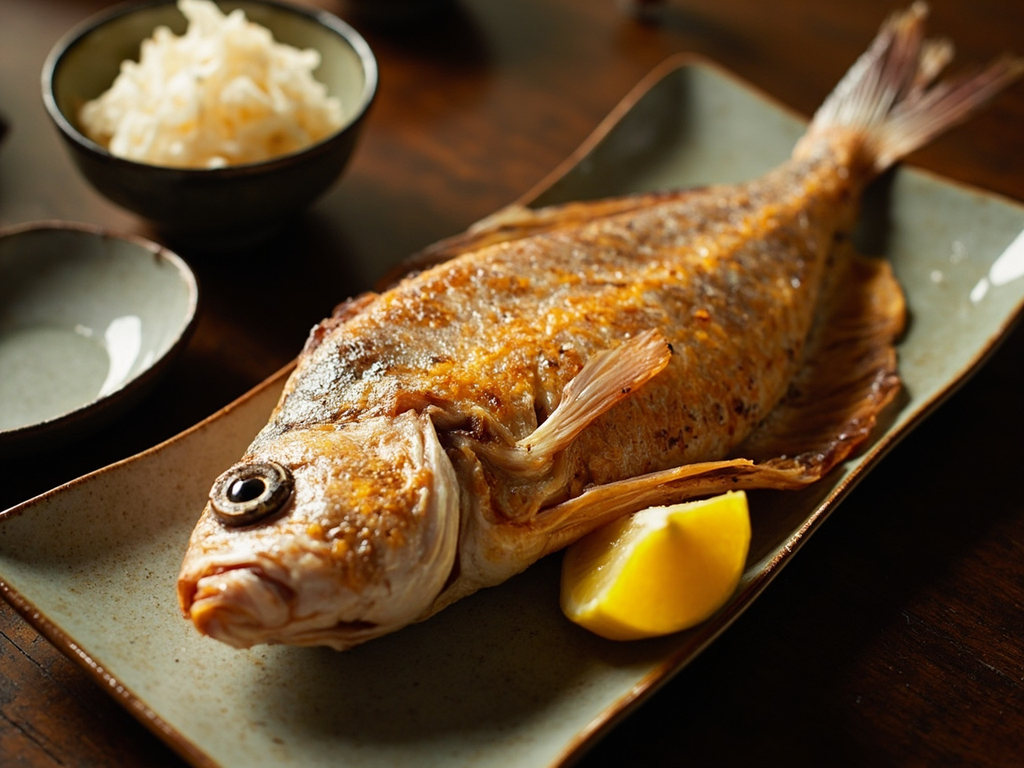
A whole sea bream sprinkled with salt and grilled until the skin crackles and turns golden, while the flesh remains pearly and tender. The most emblematic celebratory dish of Japan, dazzling in its simplicity.
When the house had a reason to rejoice — a child, a finished book, a turning season — I wanted the whole tai on the tray, for its very name calls forth happiness. You salt it with a high hand, so that the grains fall in an even rain, and you raise the tail with a little extra salt so it won't burn and stays beautiful to look at. The fire must be lively but patient: the skin sings when it is ready. Serve it facing left, head to the left: thus the table requires, and thus the eye rejoices before the mouth.
- •Whole sea bream — a fine specimen (heart of the dish)
- •Salt — enough to cover the skin in a fine rain (seasoning and crust)
Tai no shioyaki — Salt-Grilled Sea Bream
A whole sea bream sprinkled with salt and grilled until the skin crackles and turns golden, while the flesh remains pearly and tender. The most emblematic celebratory dish of Japan, dazzling in its simplicity.
Why this dish? Sea bream (tai) is the fish of great occasions in Japan — births, weddings, New Year — because of a pun on "medetai" (happy, auspicious). In a literary family like Akiko's, it crowned festive meals and the happy milestones of a mother of eleven children.
When the house had a reason to rejoice — a child, a finished book, a turning season — I wanted the whole tai on the tray, for its very name calls forth happiness. You salt it with a high hand, so that the grains fall in an even rain, and you raise the tail with a little extra salt so it won't burn and stays beautiful to look at. The fire must be lively but patient: the skin sings when it is ready. Serve it facing left, head to the left: thus the table requires, and thus the eye rejoices before the mouth.
Ingredients (period version)
- Whole sea bream — a fine specimen (heart of the dish)
- Salt — enough to cover the skin in a fine rain (seasoning and crust)
Ingredients
- Whole sea bream (gutted, scaled) — 1 piece, 400–600 g (heart of the dish)
- Fine salt — 2 teaspoons (seasoning)
- Salt for tail and fins — 1 teaspoon (protection and presentation)
- Lemon (or sudachi) — 1/2 (table accompaniment)
- Grated daikon radish — 2 tablespoons (fresh accompaniment)
Method
- Pat the sea bream dry, make two shallow cuts on each side.
- Salt evenly, holding your hand high above the fish; pack a little extra salt on the tail and fins to prevent burning.
- Let rest for 15 minutes, then wipe off any moisture that beads up.
- Grill under the broiler (or on a grate over coals) for 8–12 minutes per side, depending on thickness, until the skin is golden and crispy.
- Serve head to the left, with grated daikon and a lemon wedge.
How it was made : Shioyaki (salt grilling) is the oldest Japanese way to cook fish: once over charcoal embers (sumibi) with metal skewers inserted to give the fish a "swimming" posture. The salt on the tail, called "keshōjio" (makeup salt), is both technical and aesthetic.
The contemporary twist : Insert two thin skewers to curve the fish into a wave, as if it were leaping out of water — the classic pose of banquet cooks.
Sources : Naomichi Ishige, The History and Culture of Japanese Food, 2001
Akiko Yosano · Charactorium