 flip
flipHatsugatsuo — The First Bonito of the Season, as Sashimi
Hatsugatsuo — The First Bonito of the Season, as Sashimi
Why this dish? The Edokko — native-born Edoites, including Hokusai — were crazy about the "first bonito" of spring, which they paid a fortune for out of pure city pride. Tasting hatsugatsuo was the gourmet event of the year, the only luxury that even a penniless artist of Honjo allowed himself in the fever of the season.
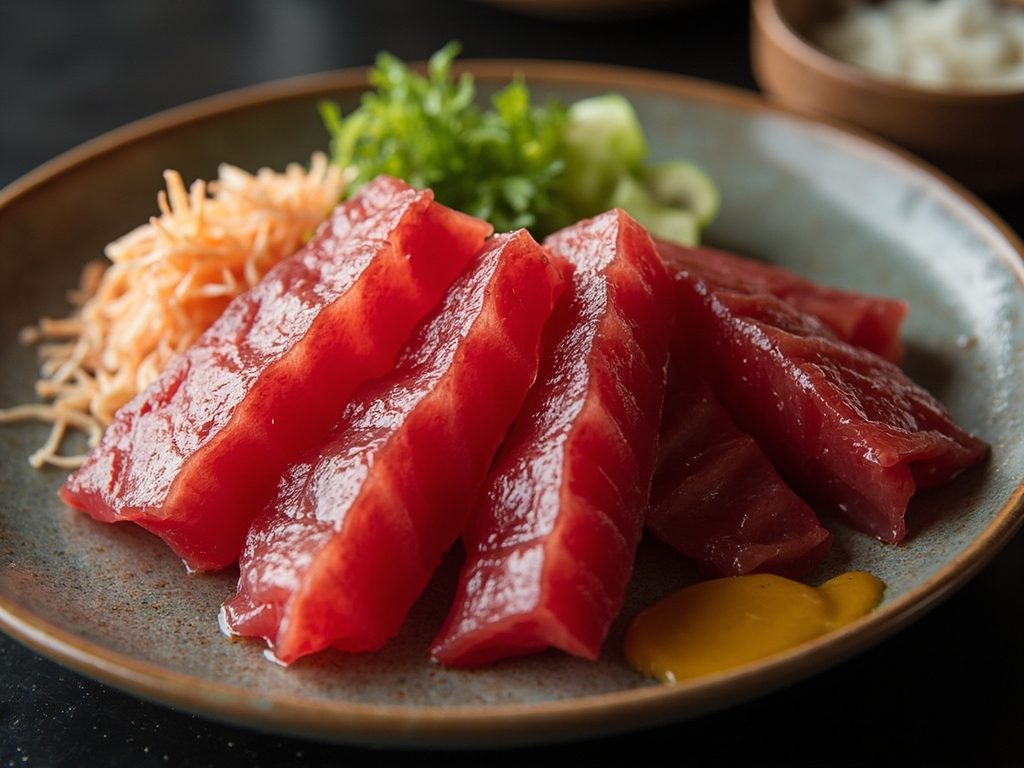
Thin slices of deep red raw bonito, served with soy sauce, ginger, and scallion. The great festive indulgence of Edo: a peak-season fish, bursting with freshness and sea umami.
"Pledge your wife if you must, but eat the first bonito!" — so spoke the madmen of Edo, and I was one of them. When the first katsuo of the year arrived at the market, we would ruin ourselves without shame for a slice of that flesh red as lacquer. You eat it raw, with a little mustard or ginger and a dash of shoyu, nothing else: such a fish needs no makeup. That was my only extravagance of the year, I who drew the waves from which this fish came.
- •Very fresh bonito (katsuo) — a beautiful fillet (heart of the dish)
- •Soy sauce (shoyu) — for dipping (seasoning)
- •Fresh ginger — grated (fresh condiment)
- •Japanese mustard (karashi) — a dab (period kick)
- •Edo scallion — sliced (garnish)
Hatsugatsuo — The First Bonito of the Season, as Sashimi
Thin slices of deep red raw bonito, served with soy sauce, ginger, and scallion. The great festive indulgence of Edo: a peak-season fish, bursting with freshness and sea umami.
Why this dish? The Edokko — native-born Edoites, including Hokusai — were crazy about the "first bonito" of spring, which they paid a fortune for out of pure city pride. Tasting hatsugatsuo was the gourmet event of the year, the only luxury that even a penniless artist of Honjo allowed himself in the fever of the season.
"Pledge your wife if you must, but eat the first bonito!" — so spoke the madmen of Edo, and I was one of them. When the first katsuo of the year arrived at the market, we would ruin ourselves without shame for a slice of that flesh red as lacquer. You eat it raw, with a little mustard or ginger and a dash of shoyu, nothing else: such a fish needs no makeup. That was my only extravagance of the year, I who drew the waves from which this fish came.
Ingredients (period version)
- Very fresh bonito (katsuo) — a beautiful fillet (heart of the dish)
- Soy sauce (shoyu) — for dipping (seasoning)
- Fresh ginger — grated (fresh condiment)
- Japanese mustard (karashi) — a dab (period kick)
- Edo scallion — sliced (garnish)
Ingredients
- Very fresh sashimi-grade bonito (katsuo) — 300 g fillet (base)
- Soy sauce — for serving (dipping)
- Fresh grated ginger — 1 tbsp (condiment)
- Japanese mustard (karashi) or wasabi — a dab (kick)
- Scallion / green onion — 2 stalks, sliced (garnish)
Method
- Choose impeccable sashimi-grade bonito (freshness is everything — failing that, very fresh tuna or yellowtail).
- With a sharp knife, trim the fillet and slice it on the bias into half-centimeter thick pieces.
- Arrange the slices in a fan on a plate, nicely packed.
- Garnish with sliced scallion, place the grated ginger and a dab of mustard alongside.
- Serve chilled with a bowl of soy sauce for dipping, and a bowl of white rice on the side.
How it was made : The Edo proverb "pawn your wife to eat the first bonito" tells of the extravagance of this craze: the first katsuo of the year fetched insane sums. Without refrigeration, they were eaten raw as close to the market as possible, or lightly seared over a straw flame (tataki) to preserve them a bit — a gesture that remains famous in Japanese cuisine.
The contemporary twist : Quickly sear the surface of the fillet with a blowtorch before slicing (tataki style): the flesh remains raw at the center but takes on a smoky flavor, echoing the straw flames of Edo fishermen.
Sources : Eric C. Rath, Food and Fantasy in Early Modern Japan, University of California Press, 2010 · Theodore C. Bestford, Tsukiji: The Fish Market at the Center of the World, University of California Press, 2004
Hokusai · Charactorium