 flip
flipSamanid Fermented Milk Flatbread
Samanid Fermented Milk Flatbread
Why this dish? Al-Biruni, an itinerant scholar at courts across Central Asia, shared the everyday fare of Khwarezm: flatbread baked against the wall of a clay oven served as plate, spoon, and staple. Kneaded with fermented milk, it accompanied each of his days of calculation and observation.
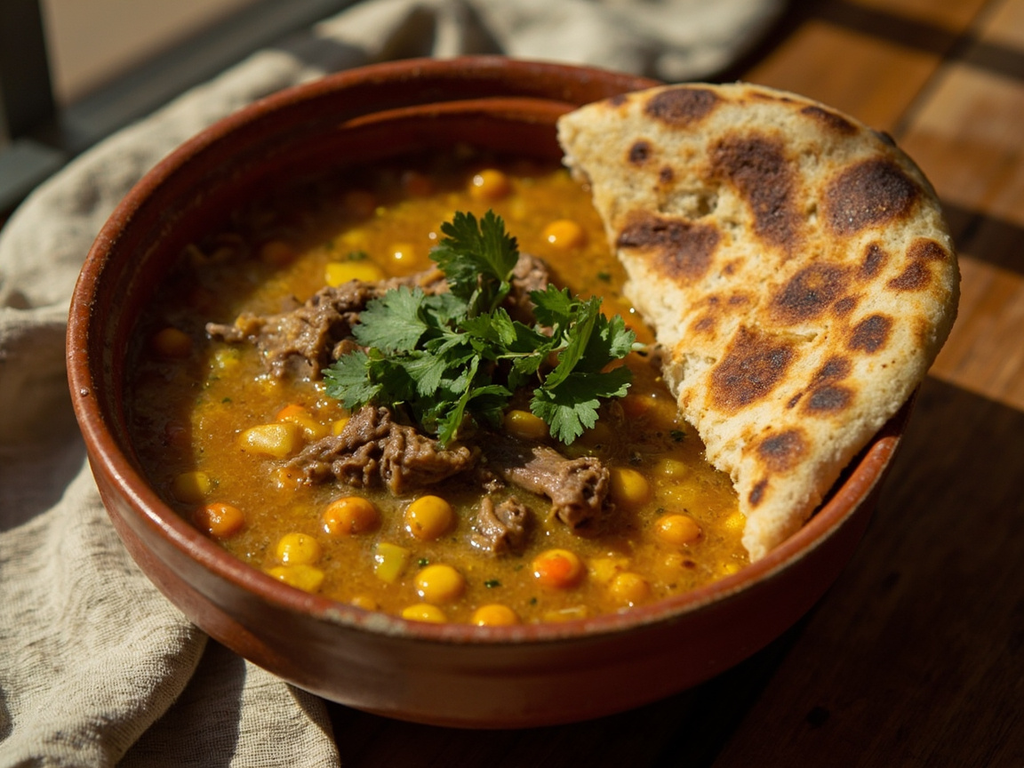
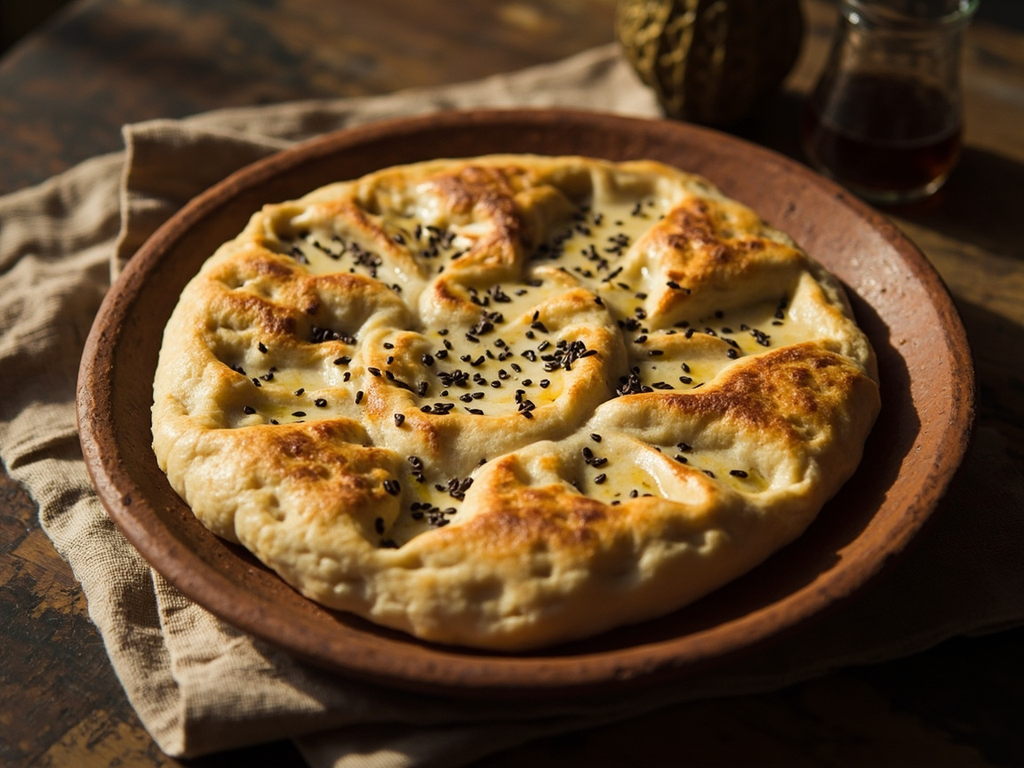
A soft, slightly tangy flatbread, golden and blistered, perfumed with black nigella seeds. It is the daily bread, torn to scoop up the rest of the meal.
See, stranger: before tracing a single astronomical table, a man must break his bread. In Khwarezm we kneaded the flour with yesterday's sour milk — nothing is wasted by one who knows how to observe the course of things. The dough rests for the time of a prayer, then is slapped against the burning wall of the clay oven; it swells, blisters, and is dotted with black grains like a starry sky. Eat it warm, and let the simplicity of this bread remind you that the greatest sciences are born from a pacified belly.
- •Wheat flour — a large bowlful (base)
- •Fermented milk (a kind of kefir) — enough to soften the dough (natural leavening and softness)
- •Starter from the previous batch — a handful (fermentation)
- •Salt — a pinch (seasoning)
- •Nigella seeds — to sprinkle (aroma)
Samanid Fermented Milk Flatbread
A soft, slightly tangy flatbread, golden and blistered, perfumed with black nigella seeds. It is the daily bread, torn to scoop up the rest of the meal.
Why this dish? Al-Biruni, an itinerant scholar at courts across Central Asia, shared the everyday fare of Khwarezm: flatbread baked against the wall of a clay oven served as plate, spoon, and staple. Kneaded with fermented milk, it accompanied each of his days of calculation and observation.
See, stranger: before tracing a single astronomical table, a man must break his bread. In Khwarezm we kneaded the flour with yesterday's sour milk — nothing is wasted by one who knows how to observe the course of things. The dough rests for the time of a prayer, then is slapped against the burning wall of the clay oven; it swells, blisters, and is dotted with black grains like a starry sky. Eat it warm, and let the simplicity of this bread remind you that the greatest sciences are born from a pacified belly.
Ingredients (period version)
- Wheat flour — a large bowlful (base)
- Fermented milk (a kind of kefir) — enough to soften the dough (natural leavening and softness)
- Starter from the previous batch — a handful (fermentation)
- Salt — a pinch (seasoning)
- Nigella seeds — to sprinkle (aroma)
Ingredients
- All-purpose wheat flour (T65) — 500 g (base)
- Milk kefir (or yogurt thinned with warm water) — 280 ml (hydration and softness)
- Active dry yeast — 5 g (fermentation)
- Salt — 8 g (seasoning)
- Nigella seeds — 1 tsp (aroma (to sprinkle))
Method
- Mix the flour, salt, and yeast. Pour in the lukewarm kefir and knead for 10 minutes until a supple dough forms.
- Cover and let rise in a warm place for 1.5 hours, until doubled.
- Divide into 4 balls, roll into disks about 1 cm thick, and press the center with your fingertips.
- Brush with salted water and sprinkle with nigella seeds.
- Bake on a hot stone or baking sheet at 240 °C (475 °F) for 8–10 minutes, until the bread blisters and turns golden.
- Wrap in a cloth right out of the oven to keep it soft.
How it was made : Bread (*nan*) was baked in a *tandûr*, a clay oven heated with wood, against whose walls the flatbreads were slapped. The flour was often coarse, and yesterday's dried bread was soaked in broth. Fermented milk was commonly used as the kneading liquid in Central Asia.
The contemporary twist : As a nod to the scholar, mark the dough with small, regular dots like the graduations of an astrolabe before baking.
Al-Biruni · Charactorium