 flip
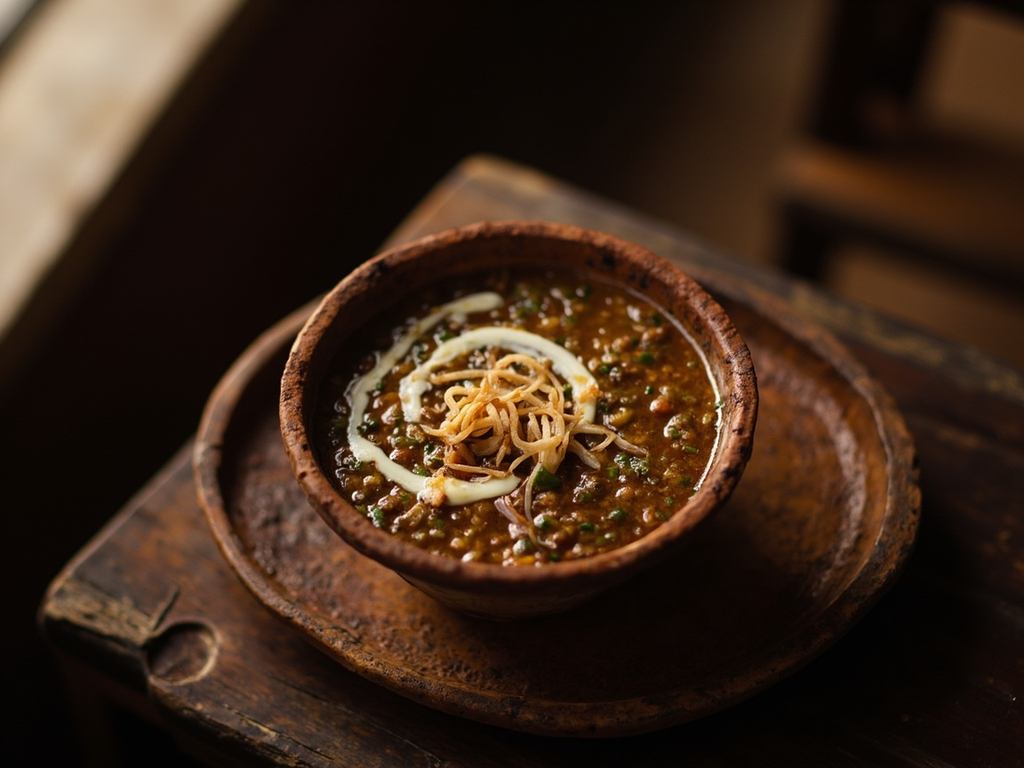
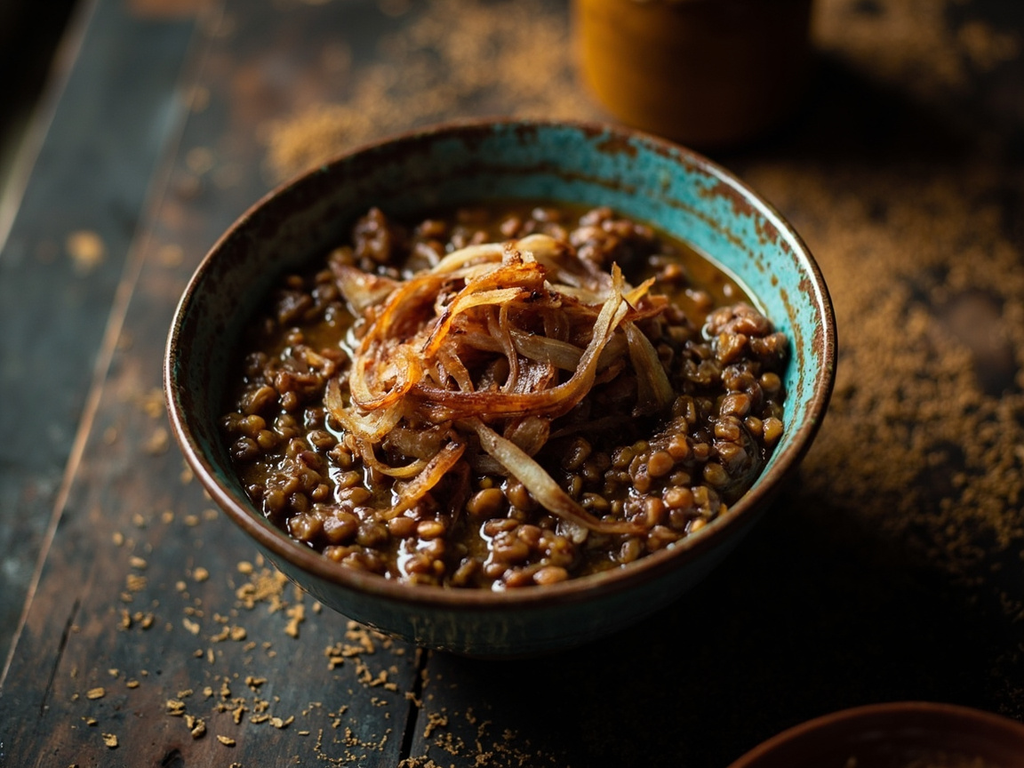
flipAdas mujaddar — lentils and bulgur with murrî
Adas mujaddar — lentils and bulgur with murrî
Why this dish? Al-Jazari spent his days in the workshops of the Amid palace, bent over his water clocks and chain pumps. A dish of lentils with cracked barley, nourishing and cheap, was the ordinary fare of artisans and scholars in the Jazira: the simple fuel for a day of calculations and brass filing.
Brown lentils melted with bulgur, perfumed with cumin and murrî, crowned with onions slowly browned until almost sweet. A humble, comforting dish, sopped up with bread and keeping the body going from morning to evening.
Know, you who read me, that before adjusting the float of a clock, one must have a tranquil stomach. On my table, this bowl of lentils and barley came back almost every day: inexpensive, quickly assembled, but it is only appreciated on condition that the onions are left to brown very gently, until they turn to honey — that is the skill, like adjusting a cogwheel piece by piece. A spoonful of murrî on top, a little cumin, and the humble seed becomes a scholar's meal.
- •Brown lentils — two handfuls (nourishing base)
- •Bulgur (cracked wheat) — one handful (staple grain)
- •Onions — two (golden garnish, sweetness)
- •Murrî (barley fermented condiment) — a dash (umami fermented signature)
- •Cumin and coriander seeds — a pinch each (aroma)
- •Olive oil or sheep's tail fat — as needed (cooking)
Adas mujaddar — lentils and bulgur with murrî
Brown lentils melted with bulgur, perfumed with cumin and murrî, crowned with onions slowly browned until almost sweet. A humble, comforting dish, sopped up with bread and keeping the body going from morning to evening.
Why this dish? Al-Jazari spent his days in the workshops of the Amid palace, bent over his water clocks and chain pumps. A dish of lentils with cracked barley, nourishing and cheap, was the ordinary fare of artisans and scholars in the Jazira: the simple fuel for a day of calculations and brass filing.
Know, you who read me, that before adjusting the float of a clock, one must have a tranquil stomach. On my table, this bowl of lentils and barley came back almost every day: inexpensive, quickly assembled, but it is only appreciated on condition that the onions are left to brown very gently, until they turn to honey — that is the skill, like adjusting a cogwheel piece by piece. A spoonful of murrî on top, a little cumin, and the humble seed becomes a scholar's meal.
Ingredients (period version)
- Brown lentils — two handfuls (nourishing base)
- Bulgur (cracked wheat) — one handful (staple grain)
- Onions — two (golden garnish, sweetness)
- Murrî (barley fermented condiment) — a dash (umami fermented signature)
- Cumin and coriander seeds — a pinch each (aroma)
- Olive oil or sheep's tail fat — as needed (cooking)
Ingredients
- Brown or green lentils — 200 g (nourishing base)
- Coarse bulgur — 100 g (staple grain)
- Onions — 2 large (golden garnish)
- Light soy sauce OR diluted miso paste (to evoke murrî) — 1 tbsp (substitute fermented umami)
- Ground cumin — 1 tsp (aroma)
- Ground coriander — 1/2 tsp (aroma)
- Olive oil — 4 tbsp (cooking)
- Salt — to taste (seasoning)
Method
- Rinse the lentils and cook in simmering water for 15 minutes, without salt for now.
- Meanwhile, finely slice the onions and sauté in oil over low heat for 20 to 25 minutes, until mahogany-colored and almost sweet. Reserve half for the top.
- Add the bulgur, cumin, and coriander to the lentils, add a little water, and let swell covered for 12 to 15 minutes.
- Stir in half the caramelized onions and the umami sauce (miso or soy); salt sparingly.
- Serve in a bowl, top with the reserved onions and a drizzle of oil.
How it was made : Mujaddar is attested very early in the cuisines of medieval Iraq as a dish for the modest and for fast days. Murrî, a liquid fermented condiment made from moldy barley paste and salt, played the role that today's bouillon cube or soy sauce has: it was added everywhere for depth of flavor. Lacking authentic murrî, miso or soy sauce gives a faithful idea.
The contemporary twist : Serve the mujaddar arranged in a regular spiral, like a gear of al-Jazari's water clock, with the caramelized onions placed like a toothed crown.
Sources : Charles Perry (trans.), A Baghdad Cookery Book: The Book of Dishes (Kitāb al-Ṭabīkh) of al-Baghdādī, Prospect Books, 2005 · Nawal Nasrallah, Annals of the Caliphs' Kitchens: Ibn Sayyār al-Warrāq's Tenth-Century Baghdadi Cookbook, Brill, 2007
Al-Jazari · Charactorium