 flip
flipOsh-i Marghinani (Festive Pilaf)
Osh-i Marghinani (Festive Pilaf)
Why this dish? Pilaf has been the royal dish of the Ferghana Valley for centuries. Al-Marghinani, a respected jurist hosting students and colleagues, would have presided over festive dastarkhans where lamb and dried fruit osh marked the end of Ramadan and graduation ceremonies (khatm).
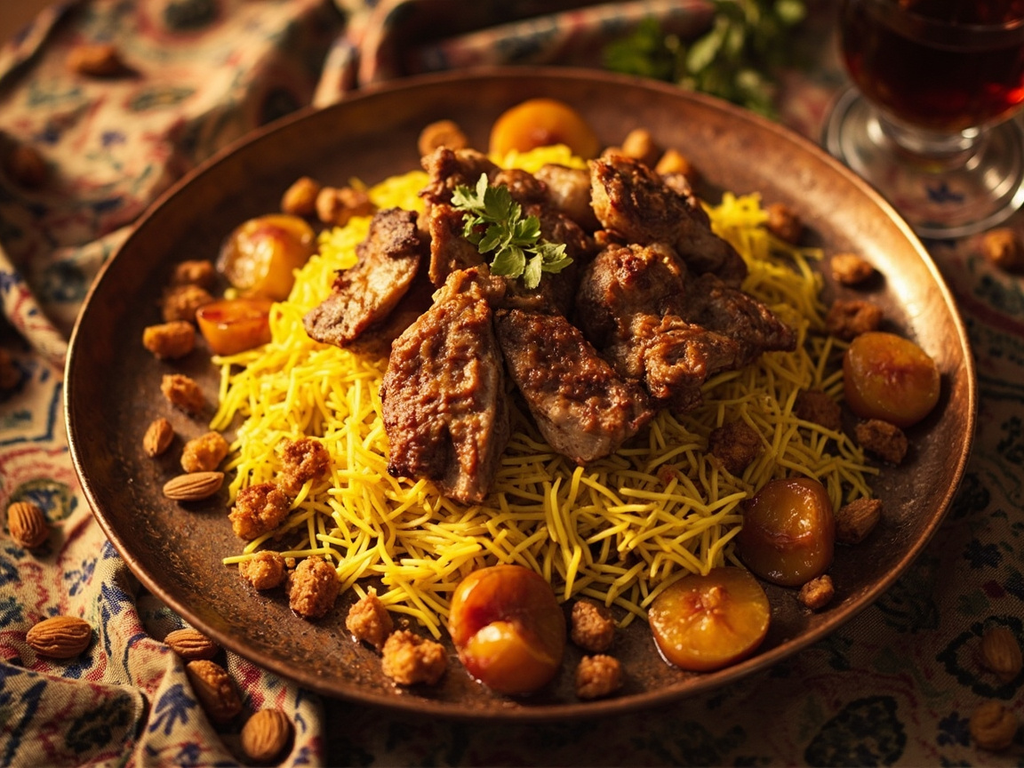
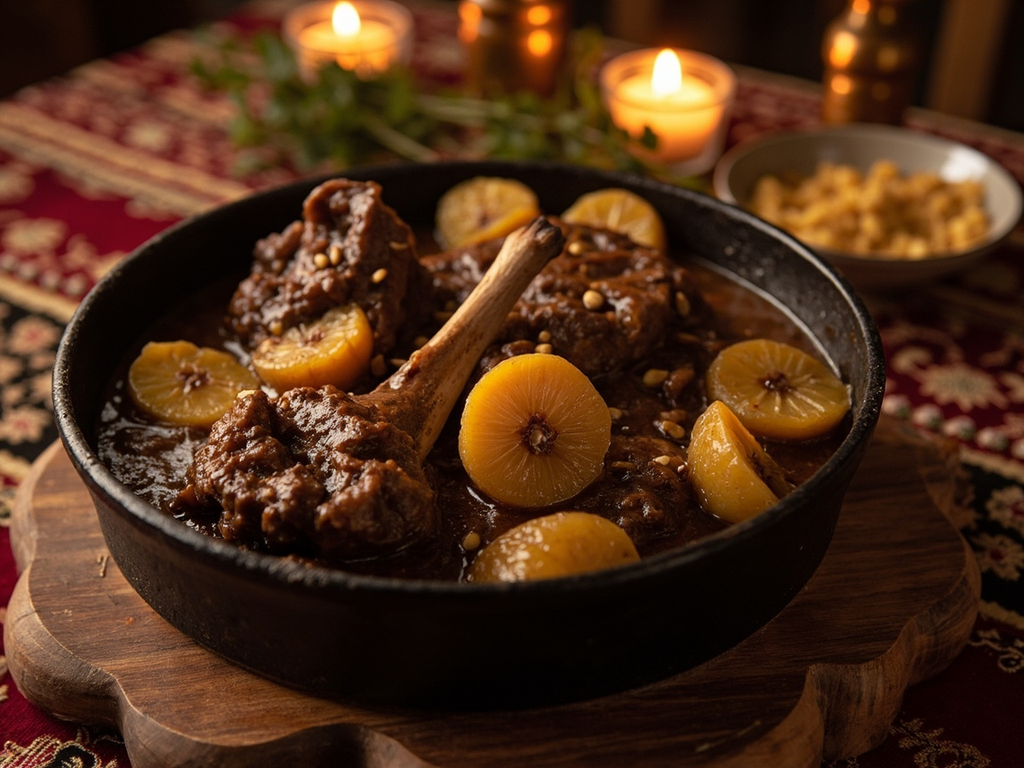
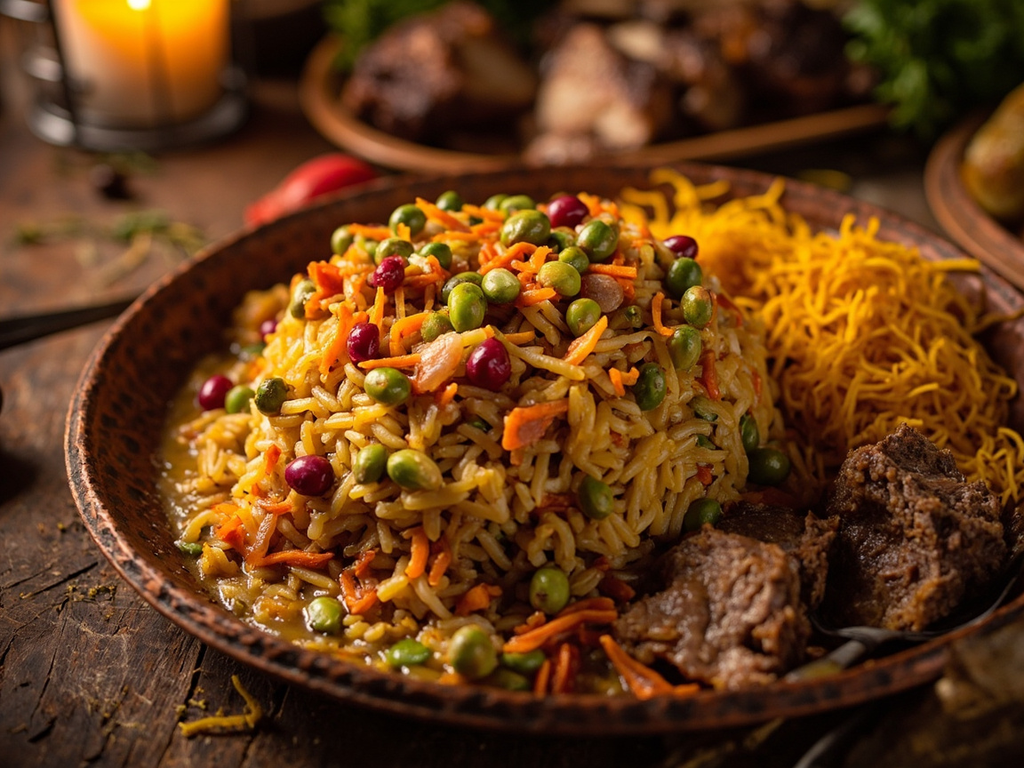
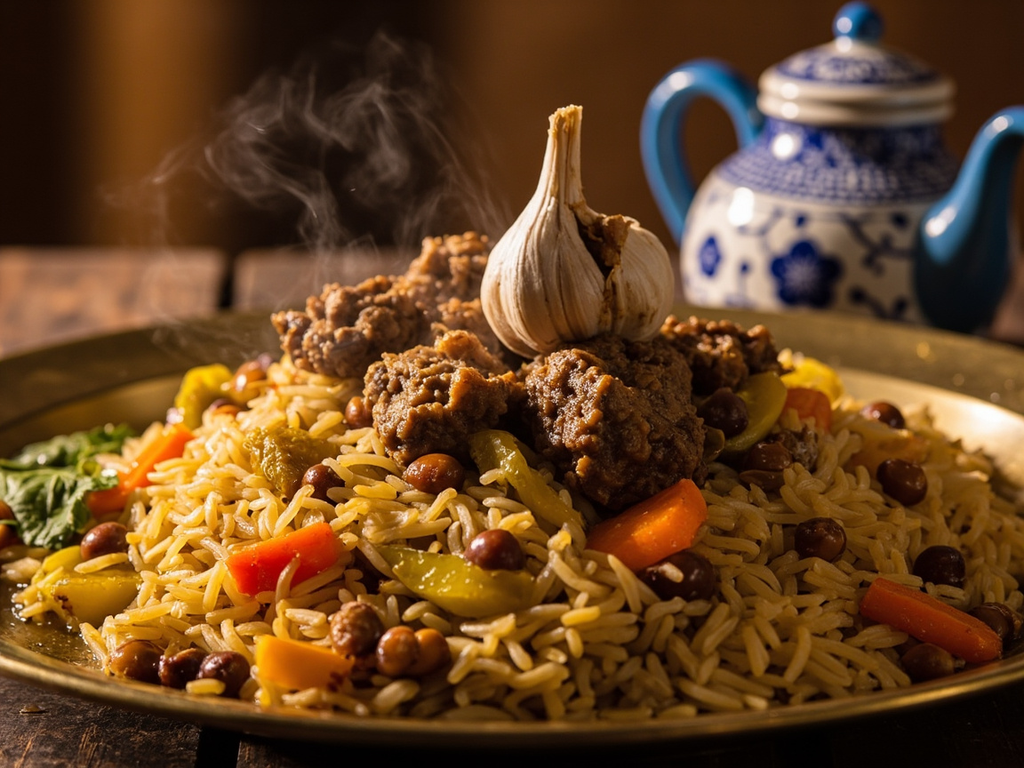
Lamb pilaf with yellow carrots, chickpeas, and raisins, perfumed with cumin and barberries. Osh is the heart of the Central Asian feast, prepared in a large kazan (cauldron) to feed the community.
When a student completes the study of Al-Hidaya — and it is an ordeal, believe me, for I have put all the science of the Hanafites into it — we set the dastarkhan and the kazan sings. The lamb must first sear in the smoking fat, then the yellow carrots of Ferghana, long as a finger, golden as saffron. The rice is poured on top without stirring — that is the secret — and the fire does the rest. Each grain must remain separate, oiled, perfumed with zira. Thus is good fiqh: each rule distinct, but the whole forms a coherent edifice.
- •Ferghana rice (devzira or equivalent) — Four handfuls (Pilaf base)
- •Lamb shoulder — A good piece with bone (Festive meat)
- •Yellow carrots — As much as the rice by volume (Sweetness and color)
- •Onions — Two large (Zirvak base)
- •Dried chickpeas (soaked) — One handful (Protein richness)
- •Raisins — One handful (Sweetness)
- •Whole cumin (zira) — One spoon (Main spice)
- •Barberries (zereshk) — One small handful (Acidity)
- •Sheep tail fat (dumba) — A good piece (Fat)
- •Salt — To taste (Seasoning)
- •Garlic (whole head) — One (Buried aroma)
Osh-i Marghinani (Festive Pilaf)
Lamb pilaf with yellow carrots, chickpeas, and raisins, perfumed with cumin and barberries. Osh is the heart of the Central Asian feast, prepared in a large kazan (cauldron) to feed the community.
Why this dish? Pilaf has been the royal dish of the Ferghana Valley for centuries. Al-Marghinani, a respected jurist hosting students and colleagues, would have presided over festive dastarkhans where lamb and dried fruit osh marked the end of Ramadan and graduation ceremonies (khatm).
When a student completes the study of Al-Hidaya — and it is an ordeal, believe me, for I have put all the science of the Hanafites into it — we set the dastarkhan and the kazan sings. The lamb must first sear in the smoking fat, then the yellow carrots of Ferghana, long as a finger, golden as saffron. The rice is poured on top without stirring — that is the secret — and the fire does the rest. Each grain must remain separate, oiled, perfumed with zira. Thus is good fiqh: each rule distinct, but the whole forms a coherent edifice.
Ingredients (period version)
- Ferghana rice (devzira or equivalent) — Four handfuls (Pilaf base)
- Lamb shoulder — A good piece with bone (Festive meat)
- Yellow carrots — As much as the rice by volume (Sweetness and color)
- Onions — Two large (Zirvak base)
- Dried chickpeas (soaked) — One handful (Protein richness)
- Raisins — One handful (Sweetness)
- Whole cumin (zira) — One spoon (Main spice)
- Barberries (zereshk) — One small handful (Acidity)
- Sheep tail fat (dumba) — A good piece (Fat)
- Salt — To taste (Seasoning)
- Garlic (whole head) — One (Buried aroma)
Ingredients
- Basmati or long-grain rice — 400 g (Pilaf base)
- Boneless lamb shoulder — 500 g (Meat)
- Carrots — 500 g (Sweetness and color)
- Yellow onions — 2 large (Zirvak base)
- Canned chickpeas (drained) — 150 g (Richness)
- Golden raisins — 50 g (Sweetness)
- Whole cumin — 1 tbsp (Main spice)
- Dried barberries — 2 tbsp (Acidity (or dried cranberries))
- Vegetable oil — 80 ml (Fat)
- Whole garlic head — 1 (Aroma)
- Salt — 2 tsp (Seasoning)
- Hot water — 600 ml (Cooking liquid)
Method
- Rinse the rice several times and soak in warm salted water for 30 minutes. Drain.
- Cut lamb into 3 cm pieces, carrots into 5 mm sticks, onions into half-moons.
- In a heavy pot (or wok), heat oil over high heat. Sear lamb pieces until browned. Remove.
- In the same oil, brown the onions, then add carrots and cook 5 minutes.
- Return meat, add cumin, chickpeas, raisins, and barberries. Season with salt.
- Pour in hot water, bring to a boil, and simmer covered for 30 minutes (this is the zirvak).
- Spread the drained rice in an even layer over the zirvak WITHOUT stirring. Press the whole garlic head into the center.
- Add hot water if needed (liquid should just cover the rice by 1 cm). Cover tightly.
- Cook over low heat for 25 minutes without lifting the lid. Turn off heat and let rest 10 minutes.
- Invert the pilaf onto a large platter: rice on top, meat and carrots as a crown. Serve with the confit garlic.
How it was made : Pilaf (osh, palov) is documented in medieval Persian and Arabic sources. Ibn Sina, Al-Marghinani's Central Asian compatriot, mentions the benefits of rice cooked in fat. The zirvak technique (meat and vegetable base under the rice) is specific to Central Asia and has remained unchanged since the Middle Ages. Devzira, the amber rice of Ferghana, has been used for centuries.
The contemporary twist : Present as an inverted dome on a brass platter, sprinkled with fresh pomegranate seeds and crushed pistachios to evoke Samarkand mosaics.
Sources : Charles Perry, 'The Seljuq Campaign against the Fatimids and the Making of the Pilaf' (Oxford Symposium on Food and Cookery) · Nawal Nasrallah, 'Annals of the Caliphs' Kitchens' (Kitāb al-Ṭabīkh by al-Warrāq, pilaf recipes)
Al-Marghinani · Charactorium