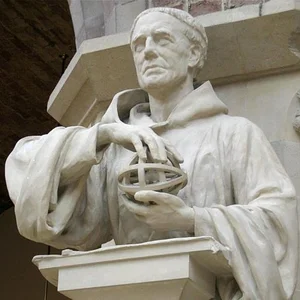

Roger Bacon, nicknamed Doctor Mirabilis, was a 13th-century English Franciscan friar, philosopher, and scholar. A pioneer of the experimental method, he championed observation and mathematics as the foundations of knowledge, long before modern science.
Roger Bacon(1220 — 1292)
Roger Bacon
royaume d'Angleterre
6 min read
Frequently asked questions
Key Facts
- Born around 1220 in England, studies and teaches at Oxford and then in Paris
- Joins the Franciscan order around 1257
- Writes the Opus Majus, the Opus Minus, and the Opus Tertium around 1267 at the request of Pope Clement IV
- Pioneer in the study of optics and the refraction of light
- Dies around 1292, leaving behind a body of work that advocates experience (scientia experimentalis)
Works & Achievements
Bacon's masterwork, a vast summa addressing the causes of error, languages, mathematics, optics, and experimental science, written for Pope Clement IV.
A summary and complement to the Opus majus, in which Bacon stresses the obstacles to truth and the reform of studies.
A third part addressed to the pope, presenting his ideas and defending the importance of mathematics and experience.
A treatise on optics and natural philosophy explaining how light and influences propagate through space.
A famous letter foretelling flying machines, ships, and self-propelled vehicles, and denying the reality of magic in favor of art and nature.
A scathing critique of the teaching, the ignorance of languages, and the morals of the clergy of his time.
Reflections on mathematics and astronomy, pointing out the errors of the Julian calendar long before the Gregorian reform.
Anecdotes
Roger Bacon taught at the University of Paris and then at Oxford, where he was one of the first to comment in detail on Aristotle's scientific works, newly translated from Arabic and Greek. He insisted that his students learn the original languages rather than rely on poor translations.
Fascinated by optics, Bacon studied the refraction of light, how the eye works, and the formation of the rainbow. He described the magnifying effect of convex lenses, which later earned him the (partly legendary) reputation of having invented eyeglasses.
Around 1266, Pope Clement IV, intrigued by his reputation, asked Bacon to send him his ideas. Bacon then hastily wrote his *Opus Majus*, a veritable encyclopedia of knowledge, but the pope died shortly afterward without having been able to support the project.
Bacon knew the composition of gunpowder, which he described in a text in a partially coded form (an anagram), perhaps to conceal the secret. In it he mentions the “thunderous noise” and the “flash” produced by this mixture.
His intellectual boldness and his criticism of the scholars of his day brought him trouble: according to one tradition, he was watched over and even imprisoned by his own Franciscan order for ideas deemed suspect or too innovative.
Primary Sources
There are two modes of knowing: by reasoning and by experience. Reasoning draws a conclusion and makes us grant the conclusion, but it does not give certainty nor remove doubt, unless the mind meets it by way of experience.
Mathematics is the gate and key of the sciences; those who are ignorant of it cannot know the other sciences nor the things of this world.
Machines may be built for sailing without rowers, and chariots that move without any animal to draw them, with an inestimable force.
Four chief obstacles prevent us from reaching the truth: frail authority, custom, the opinion of the crowd, and the concealment of our own ignorance beneath a show of knowledge.
Key Places
Region of England where Roger Bacon is said to have been born around 1220, into a relatively well-off family.
A major center of learning where Bacon studied and taught; there he came under the influence of Robert Grosseteste and pursued his research on optics.
A great intellectual hub of Europe where Bacon taught the arts and lectured on Aristotle during the 1240s and 1250s.
House of the Order of Friars Minor where Bacon lived after joining the Franciscans, subject to the order's rule and supervision.
Italian city where Pope Clement IV often resided, the recipient of Bacon's major writings sent around 1267-1268.
Typical Objects

Bacon studied curved lenses able to enlarge letters and aid eyesight. His observations on refraction paved the way for the invention of eyeglasses.

An astronomical instrument used to measure the position of the stars and calculate the time. Bacon used it for his work in astronomy and on the calendar.

The medium of medieval knowledge, copied by hand onto sheep or calf skin. Bacon recorded his treatises in it and read Aristotle and the Arab scholars from it.

An explosive mixture whose composition Bacon described in coded form. He spoke of the “thunder” and “lightning” produced by its combustion.

A concave mirror able to concentrate the sun's rays to produce heat or fire. Bacon studied its geometry in his work on optics.

A coarse wool habit, brown or gray, tied with a three-knotted cord. Bacon wore it as a Friar Minor, a sign of poverty and humility.
School Curriculum
Vocabulary & Tags
Key Vocabulary
Tags
Daily Life
Morning
Woken before dawn by the bells, Brother Bacon takes part in the religious offices of the community. After a prayer and a light meal, he heads to his cell or the library to read Aristotle and the Arab scholars by the light of the breaking day.
Afternoon
The afternoon is devoted to study and experimentation: observing light through glass lenses, working through mathematical calculations, dissecting an eye to understand vision. He sometimes dictates his treatises to a copyist or teaches a few chosen disciples.
Evening
As day falls, he again attends the offices with his brothers. In the evening, by candlelight, he rereads his notes, corrects his manuscripts, or observes the stars with his astrolabe before a brief sleep.
Food
Like every Franciscan, Bacon eats frugally: brown bread, vegetables, legumes, sometimes fish and a little wine watered down. Meat is rare, and fasting days are many according to the religious rule.
Clothing
He wears the brown or grey homespun robe of the Friars Minor, cinched with a cord of three knots symbolizing his vows. His feet are shod in plain sandals, and his head is sometimes covered with a hood.
Housing
He lives in a plain cell in a Franciscan friary, in Oxford or Paris: a bare room with a bed, a work table, a few manuscripts, and his scientific instruments, sharing the refectory and the chapel with his brothers.
Historical Timeline
Period Vocabulary
Liens externes & ressources
Références
Œuvres
Opus majus
vers 1267
Opus minus
vers 1267
Opus tertium
vers 1267
De multiplicatione specierum (De la multiplication des espèces)
vers 1262
Epistola de secretis operibus artis et naturae
vers 1260
Compendium studii philosophiae
vers 1272
Communia mathematica et travaux sur le calendrier
vers 1267