 flip
flipMadeira and West Indian Rum Punch
Madeira and West Indian Rum Punch
Why this dish? Every political dinner in the young Republic was punctuated by toasts; the punch bowl, made of West Indian rum and Madeira, passed from hand to hand. For Hamilton, it was the meeting of his two worlds: the rum of his Caribbean childhood and the Madeira of Federalist salons in Philadelphia.
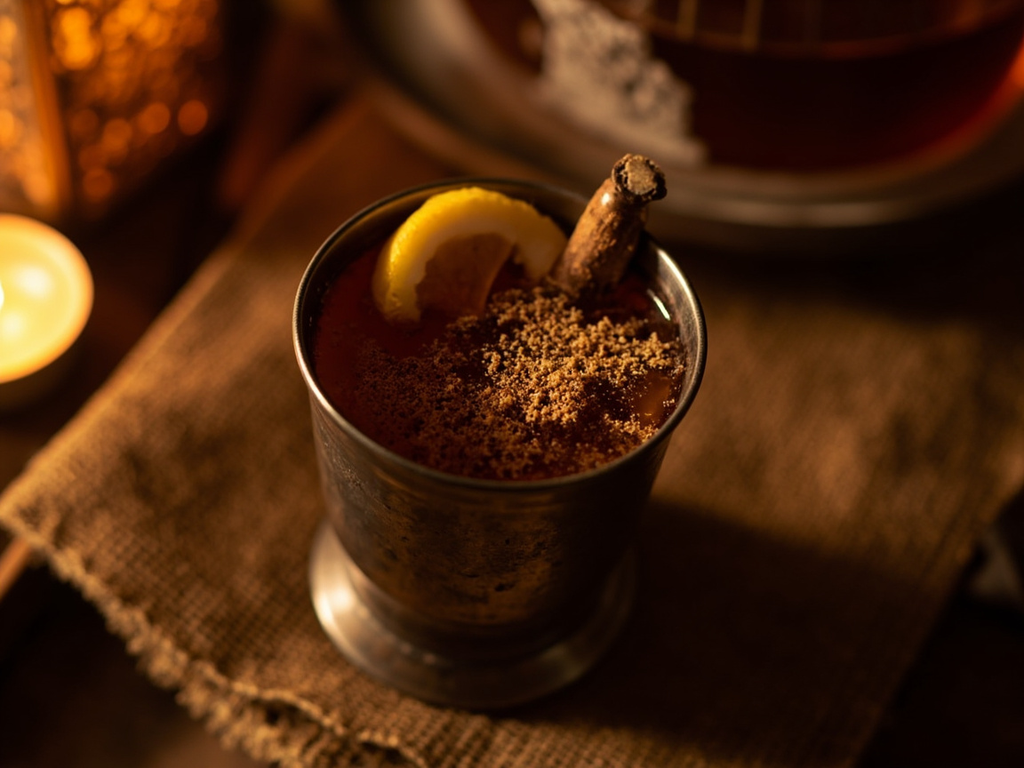
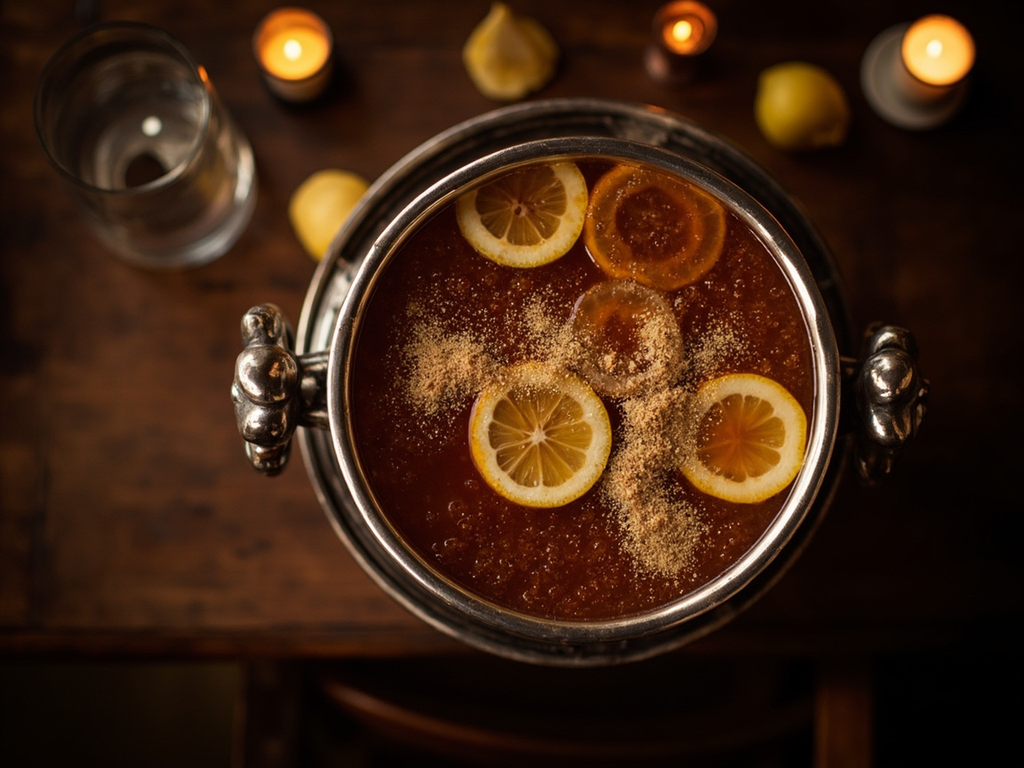
A festive punch served from a large bowl: rum and Madeira sweetened with sugar, enlivened with lemon juice, lengthened with water, and topped with grated nutmeg. Sweet and tangy, fragrant—the quintessential convivial drink of the 18th-century Atlantic world. (Alcoholic: a non-alcoholic version is given as a nod.)
Bring the bowl closer, sir, and let each man fill his glass! Here is a punch such as they serve at all the fine tables of Philadelphia: rum from the West Indies, where I first saw the light of day, married to Madeira that fears neither sea nor heat. We squeeze lemon for liveliness, we sugar for pleasure, and we grate nutmeg on top. A punch, you see, is composed like a good government: strong, sweet, sour, and water, each ingredient tempering the other. I raise my glass: to the Union, and to its credit!
- •West Indian rum — one part (base spirit)
- •Madeira wine — one part (roundness and aroma)
- •Lemon juice — juice of several (acidity)
- •Cane sugar — to dissolve (sweetness)
- •Spring water — to lengthen (balance)
- •Nutmeg — grated on top (aroma)
Madeira and West Indian Rum Punch
A festive punch served from a large bowl: rum and Madeira sweetened with sugar, enlivened with lemon juice, lengthened with water, and topped with grated nutmeg. Sweet and tangy, fragrant—the quintessential convivial drink of the 18th-century Atlantic world. (Alcoholic: a non-alcoholic version is given as a nod.)
Why this dish? Every political dinner in the young Republic was punctuated by toasts; the punch bowl, made of West Indian rum and Madeira, passed from hand to hand. For Hamilton, it was the meeting of his two worlds: the rum of his Caribbean childhood and the Madeira of Federalist salons in Philadelphia.
Bring the bowl closer, sir, and let each man fill his glass! Here is a punch such as they serve at all the fine tables of Philadelphia: rum from the West Indies, where I first saw the light of day, married to Madeira that fears neither sea nor heat. We squeeze lemon for liveliness, we sugar for pleasure, and we grate nutmeg on top. A punch, you see, is composed like a good government: strong, sweet, sour, and water, each ingredient tempering the other. I raise my glass: to the Union, and to its credit!
Ingredients (period version)
- West Indian rum — one part (base spirit)
- Madeira wine — one part (roundness and aroma)
- Lemon juice — juice of several (acidity)
- Cane sugar — to dissolve (sweetness)
- Spring water — to lengthen (balance)
- Nutmeg — grated on top (aroma)
Ingredients
- Amber rum — 200 ml (base spirit)
- Madeira — 200 ml (roundness)
- Fresh lemon juice — 120 ml (acidity)
- Sugar — 100 g (sweetness)
- Cold water (or weak tea) — 400 ml (dilution)
- Nutmeg — to grate (aroma)
- Non-alcoholic version: grape juice + tea + lemon — in equal parts (family-friendly alternative)
Method
- In a large bowl, dissolve the sugar in the lemon juice (this is the "oleo" base of the punch).
- Pour in the rum and Madeira, stir well.
- Add cold water to achieve the desired balance: neither too strong nor too diluted.
- Taste and adjust sugar/lemon—the punch should be both bright and round.
- Serve chilled with a ladle, grating a little nutmeg over each glass.
- For young guests: replace rum and Madeira with grape juice and weak tea, keep lemon, sugar, and nutmeg.
How it was made : Punch (from Hindi pañc, "five," for its five elements) was the social drink of the 18th-century Anglo-Atlantic world. Rum, a byproduct of West Indian molasses, and Madeira were the most common spirits in the colonies and then the United States. It was prepared in a large bowl for assemblies, clubs, and political dinners.
The contemporary twist : Serve it in a large salad bowl with a disk of ice garnished with lemon slices: the "Treasury Punch," to be shared by the ladle.
Sources : Tradition documentée du punch anglo-atlantique au XVIIIe siècle · Commerce du Madère dans les colonies américaines
Alexander Hamilton · Charactorium