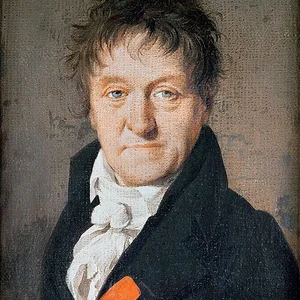

French mathematician and general, Lazare Carnot earned the nickname "The Organizer of Victory" for his role on the Committee of Public Safety. He restructured the republican armies, contributing to the victories of revolutionary France, and left a notable mathematical legacy in geometry.
Lazare Carnot(1753 — 1823)
Lazare Carnot
France
8 min read
Frequently asked questions
Key Facts
- Born on 13 May 1753 in Nolay (Burgundy), trained as a military engineer
- Member of the Committee of Public Safety (1793–1794): organized and restructured 14 armies of the Republic
- Nicknamed "The Organizer of Victory" for his decisive role in the Revolutionary Wars
- Published landmark works in geometry: *Géométrie de position* (1803) and *Mémoire sur la relation des figures de géométrie*
- Exiled after the Bourbon Restoration, he died in Magdeburg (Prussia) on 2 August 1823
Works & Achievements
Carnot's first major scientific work, in which he lays the foundations of machine mechanics and introduces the concept of mechanical work. A seminal text that foreshadows the thermodynamics his son Sadi Carnot would develop in the following century.
A tribute to the great military engineer Vauban, written for an academic competition, which reveals Carnot's admiration for the art of fortification and established his reputation as a military theorist even before the Revolution.
A philosophical and mathematical treatise on the foundations of differential and integral calculus. Carnot attempts to clarify the logical underpinnings of the calculus invented by Newton and Leibniz, in a rigorous and pedagogical spirit that would long be used in teaching.
A major mathematical work that lays the foundations of projective and synthetic geometry. It would directly influence Poncelet and Chasles, making Carnot one of the fathers of modern nineteenth-century geometry.
A landmark military treatise on fortification and defensive strategy for cities. Adopted by European military academies, it synthesizes the experience Carnot accumulated during the Revolutionary Wars.
Although never published as a single work, the reorganization of the Republic's armies represents Carnot's greatest practical achievement: promotion by merit, revolutionized logistics, offensive strategy. It enabled France to repel the European coalitions.
Anecdotes
In August 1793
Lazare Carnot was the architect of the *levée en masse*
the decree that mobilized the entire French nation for war:
Young men shall go to battle, married men shall forge weapons…" Within a few months, he organized fourteen armies and transformed a besieged France into a formidable military power, earning him the title of "Organizer of Victory.
During the siege of Antwerp in 1814, Carnot — appointed governor of the city at over 60 years of age — held out against the allied armies for several months. He surrendered the city only after learning of Napoleon's abdication, refusing to capitulate as long as any chance of resistance remained. His courage impressed even his adversaries.
An accomplished mathematician, Carnot wrote his scientific works in the rare moments left to him by his military and political duties. His treatise on geometry, published in 1803, laid the foundations of a synthetic geometry that would influence the entire field throughout the 19th century, notably the work of Poncelet.
Although a regicide — he voted for the death of Louis XVI in January 1793 — Carnot firmly opposed Napoleon Bonaparte's coup d'état of 18 Brumaire Year VIII (1799). Later, in 1804, he was one of the very few members of the Tribunate to vote against the establishment of the Empire, displaying a rare fidelity to the republican ideals that had drawn him into the Revolution.
Primary Sources
Victory is certain if one knows how to organize the forces of the Republic with method and resolve. Every soldier must know why he fights; liberty is no empty word when one defends it arms in hand.
Infinitely small quantities are merely quantities whose value is assumed to be as small as one wishes; they have reality only in their relationship to the finite quantities whose variations they express.
This geometry, considered in its full extent, encompasses the relations that exist between figures in space, independently of any measurement. It grounds its proofs in the intrinsic properties of figures, without recourse to coordinates.
A well-defended fortress is never useless: it halts the enemy, forces delays upon him, and allows the field army to regroup. A governor who capitulates without exhausting every available resource fails in his duty.
I served France under all its forms of government because I believed I was serving my country. My mistakes, if I made any, were always those of a citizen who placed the public interest above all private interest.
Key Places
Small town in Burgundy where Lazare Carnot was born on May 13, 1753. His father was a royal notary, and the region shaped his intellectual development and his attachment to the values of the provincial bourgeoisie.
Prestigious military engineering school (now Charleville-Mézières) where Carnot trained between 1771 and 1773. There he studied alongside Monge and absorbed the foundations of descriptive geometry that would inform his future mathematical work.
From the Tuileries Palace, seat of the revolutionary government, Carnot directed the Republic's military operations between 1793 and 1795, managing armies, supplies, and the appointment of generals.
Fortified city of which Carnot was appointed governor in 1814. He led a heroic defense against Allied forces for several months — a symbol of his loyalty to the Republic even in the face of Napoleonic defeat.
Prussian city where Carnot died in exile on August 2, 1823, having been banished from France by the Bourbon Restoration. His remains were solemnly repatriated to the Panthéon in Paris in 1889, during the centenary of the Revolution.
Typical Objects

Fundamental instruments of the military engineer, used to draft fortification plans and campaign maps. Carnot wielded them with mastery from his training at the École du génie de Mézières.

Hand-annotated topographic map showing terrain, enemy positions, and supply routes. Carnot relied on it constantly to coordinate the republican armies from Paris.

Everyday writing tools of the revolutionary and the scholar, used to draft decrees, military reports, and mathematical treatises. Carnot's pen was as formidable as the sabers of his generals.

A blue, white, and red fabric badge worn as a sash by members of the Convention dispatched to the armies. For Carnot, it embodied the Republic's authority over its generals and symbolized his republican convictions.

A reference work inherited from the great military engineer Vauban, studied at Mézières and constantly consulted by Carnot. He drew on it to defend republican strongholds and to write his own treatise in 1810.

The standard sidearm of a republican officer, a symbol of his rank and his mission among the troops. Although primarily a civilian strategist on the Committee, Carnot carried arms during his visits to the front lines.
School Curriculum
Vocabulary & Tags
Key Vocabulary
Daily Life
Morning
Carnot rose at dawn, a habit forged in the army. At the Committee of Public Safety, his mornings began with reading the military dispatches that had arrived overnight from the various fronts. He would annotate them, write replies, and dictate orders to the staff officers who filed in and out of his office at the Tuileries.
Afternoon
Afternoons were devoted to Committee sessions, often stormy and decisive. Carnot spoke on military matters, defended his generals against political accusations, and mediated conflicts between representatives on mission and army commanders. During quieter periods, he found time for his mathematical research.
Evening
Evenings allowed Carnot to spend time with his family or work on his scientific writings, sometimes late into the night. He had a reputation for discipline and sobriety, shunning the noisy revolutionary celebrations in favor of work and reading.
Food
Carnot ate simply, in keeping with the republican values he championed. His diet consisted of modest bourgeois fare — soup, roasted meats, vegetables — far removed from the extravagance of the Ancien Régime. During military campaigns, he shared ordinary rations without setting himself apart from junior officers.
Clothing
As a civilian representative, Carnot wore the dress of the revolutionary bourgeoisie: a dark frock coat, breeches, white stockings, and the distinctive tricolor sash worn by members of the Convention. He adopted neither the sartorial flamboyance of some sans-culottes nor the luxury favored by men of the Directory.
Housing
In Paris, Carnot lived in a modest apartment, very different from the grand townhouses of the aristocracy. He made no effort to enrich himself through his position — a notable fact in a regime where corruption was commonplace — and lived in keeping with his republican convictions of frugality and equality.
Historical Timeline
Period Vocabulary
Liens externes & ressources
Références
Œuvres
Essai sur les machines en général
1783
Éloge de M. le maréchal de Vauban
1784
Réflexions sur la métaphysique du calcul infinitésimal
1797
Géométrie de position
1803
De la défense des places fortes
1810
Organisation des quatorze armées républicaines
1793-1795
Rechercher
See also
Related Characters
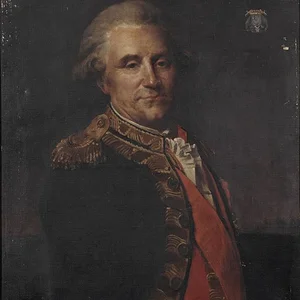
Antoine-Jean-Marie Thévenard
1733 — 1815
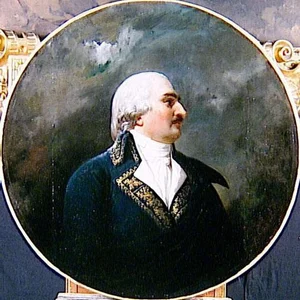
Auguste Marie Henri Picot de Dampierre
1756 — 1793
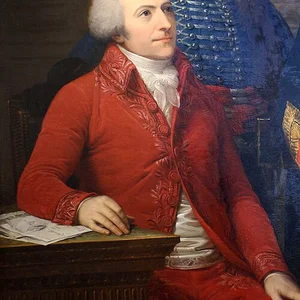
Claude-Louis Petiet
1749 — 1806
Gaspard Monge
1746 — 1818
Justin Bonaventure Morard de Galles
1741 — 1809
Annabella Milbanke
1792 — 1860