
Italian general, engineer, and statesman of the 19th century. He is best known for writing in 1842 a memoir on Charles Babbage's analytical engine, which Ada Lovelace translated and extensively annotated.
Luigi Menabrea
Luigi Federico Menabrea
royaume d'Italie, royaume de Sardaigne
9 min read
Frequently asked questions
Key Facts
- Born on 4 September 1809 in Turin, died on 24 May 1896 in Saint-Cassin (Savoy)
- In 1842, he wrote in French a memoir on Babbage's analytical engine, published in the Bibliothèque universelle de Genève
- This memoir was translated and annotated by Ada Lovelace, whose notes contain the first algorithm intended to be processed by a machine
- He served as Prime Minister of the Kingdom of Italy from 1867 to 1869
- As a general of the engineering corps, he played a military role during the wars of the Risorgimento
Works & Achievements
A memoir published in French in the Bibliothèque Universelle de Genève, the first systematic account of the workings of Babbage's Analytical Engine intended for a European scientific audience. This text gained considerable historical importance when Ada Lovelace translated and annotated it in 1843, adding to it the first computer algorithm in history.
A work in structural mechanics in which Menabrea states the principle of minimum work in statically indeterminate elastic structures. This theorem, later developed by Castigliano, remains a fundamental tool in civil engineering and the study of the strength of materials.
A work in pure mathematics in which Menabrea deepens the concept of symbolic calculus, in direct connection with the ideas he had drawn from Babbage's Analytical Engine. He explores how algebraic operations can be formalized and mechanized.
A military document illustrating Menabrea's career as a military engineer in the service of the Piedmontese army. Alpine defensive works were a strategic priority for the Kingdom of Piedmont-Sardinia in its policy of independence from Austria.
A collection of parliamentary positions and government documents drafted during Menabrea's presidency of the Council. These texts bear witness to his leadership of the third government of the young Kingdom of Italy, particularly on the Roman question, taxation, and diplomatic affairs.
Anecdotes
In 1840, Charles Babbage was invited to give lectures in Turin to present his analytical engine. Menabrea, a young military engineer with a passion for mathematics, attended the sessions and took meticulous notes. Two years later, he published a detailed account of the machine in French, becoming the first scientific popularizer of Babbage's invention on the European continent.
In 1843, British mathematician Ada Lovelace translated Menabrea's memoir into English. But she did not stop at translation: she added her own annotations, three times longer than the original text, in which she described an algorithm for calculating Bernoulli numbers. These notes are today considered the first computer program in history, making Menabrea's memoir indirectly famous in the history of computing.
Menabrea pursued two seemingly opposite careers in parallel: that of a man of war and that of a scholar. A general in the Piedmontese army, he took part in the campaigns of the Risorgimento for Italian unification, while publishing works on structural mechanics. In 1858, he formulated a fundamental principle on the distribution of stresses in elastic systems, known as the “Menabrea theorem,” which was later extended by Alberto Castigliano.
Having become an influential political figure after Italian unification, Menabrea was appointed President of the Council of Ministers in October 1867, a position he held until December 1869. His government had to confront the difficult question of Rome, still under papal control, and manage tensions with Napoleon III’s France. The man who had once summarized an imaginary calculating machine now found himself steering the affairs of a young nation-state still taking shape.
After his retirement from politics, Menabrea was appointed Italian ambassador to London, then to Paris. In the British capital, he was able to move among scientific circles that knew his name so well thanks to the memoir translated by Ada Lovelace. He who had described Babbage’s analytical engine without ever truly believing in its practical realization died in 1896, never knowing that his early writings would become a founding reference in the history of computing.
Primary Sources
Mr. Babbage's analytical engine is designed to supplement the faculties of human intelligence in the execution of a large class of mathematical operations. It is not, like ordinary calculating machines, limited to performing the four elementary operations of arithmetic, but is suited to carrying out an unlimited sequence of operations derived one from another.
In any elastic system in equilibrium under the action of external forces, the sum of the virtual work done by the internal stresses is a minimum for real deformations, compared to all deformations compatible with the conditions of equilibrium.
Italian unity cannot be complete so long as the natural capital of the nation remains under a sovereignty foreign to the State. The King's government intends to reach Rome through negotiation and law, not through force.
I had followed with the keenest attention the explanations that Mr. Babbage gave of his machine. It seemed to me that this invention, if it were ever to be realized, would constitute a revolution in the art of calculation, and I considered it my duty to set out its principles with all the clarity I could muster.
Key Places
Menabrea's birthplace, then the capital of the Duchy of Savoy within the Kingdom of Piedmont-Sardinia. He spent his childhood there and died there in 1896, following the annexation of Savoy by France in 1860.
The city where Menabrea studied at the Military Academy and where he taught mathematics and mechanics. Turin was the intellectual and political heart of the Risorgimento, and Menabrea attended Babbage's lectures there in 1840.
As President of the Council of Ministers (1867–1869), Menabrea made Rome the central issue of his policy. It was under his successor that Italian troops entered the city in 1870, making it the capital of the unified kingdom.
Menabrea was appointed Italian ambassador to London, where he moved in British diplomatic and scientific circles. It was in that same city, three decades earlier, that the memoir he had written on Babbage's machine had been translated and annotated by Ada Lovelace.
A decisive battle of the Second Italian War of Independence (1859) in which Menabrea took part as an engineering officer. This Franco-Piedmontese victory over Austria was a major milestone on the road to Italian unification.
Typical Objects

Indispensable tools of the army engineer officer in the nineteenth century, the compass and slide rule allowed field calculations of material resistance and fortification layouts. Menabrea used them daily in his role as a military engineer.

Menabrea was only able to see a partial model of the Analytical Engine during Babbage's lectures in Turin in 1840. The diagrams and engravings describing the machine's architecture were his primary working reference when writing his 1842 memoir.

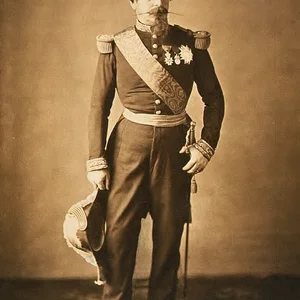
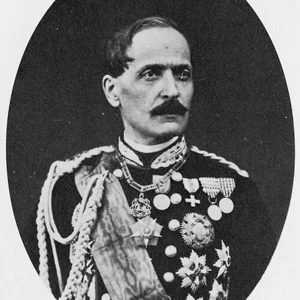
Menabrea rose through every military rank, from lieutenant to general, in the service of the House of Savoy. His uniform, adorned with decorations including the cross of the Order of Saints Maurice and Lazarus, symbolized his dual belonging to the world of arms and that of power.

The works of Lagrange and Cauchy on analytical mechanics formed the theoretical foundation upon which Menabrea built his own research. These volumes, annotated in his hand, bear witness to his rigorously mathematical approach to engineering.

As President of the Council and later ambassador, Menabrea produced a voluminous diplomatic correspondence and official reports. The quill, and later the metal pen, was his instrument of governance as much as of scholarship.

As a military engineer trained in the art of fortification and field campaigns, Menabrea worked with topographic maps to plan defensive positions and engineering works during the Italian Wars of Independence.
School Curriculum
Vocabulary & Tags
Key Vocabulary
Daily Life
Morning
Menabrea rose early, at military hours — a habit he kept throughout his life. His mornings were devoted to intellectual work: drafting scientific papers, reviewing courses for students at the Turin Military Academy, or corresponding with European scholars. Writing and calculation filled the coolest hours of the day.
Afternoon
His afternoons varied depending on the period of his life: in Turin, he supervised the practical exercises of future military engineers or attended sessions of the Academy of Sciences. During the Risorgimento military campaigns, he oversaw engineering works — fortifications, bridges, access roads — essential to the advance of troops. Later, as minister and then ambassador, his afternoons were consumed by audiences, councils, and diplomatic receptions.
Evening
Menabrea's evenings reflected the scholarly sociability of nineteenth-century Piedmont: he frequented Turin's intellectual circles, the salons of the liberal nobility, and the Masonic lodges to which many Italian patriots belonged. Reading was sometimes supplemented by epistolary exchanges with correspondents in Paris or London, particularly after the publication of his memoir on Babbage's machine.
Food
Piedmontese cuisine formed the basis of Menabrea's daily fare: polenta, risotto, braised meats, and seasonal vegetables. Like any senior officer, he enjoyed a decent table, often shared with his subordinates or political guests. Local wine — notably Barolo from the nearby Langhe hills — accompanied important meals.
Clothing
On duty, Menabrea wore the regulation uniform of the Piedmontese, and later Italian, army: a dark blue coat with golden epaulettes, a braided kepi, a sabretache, and decorations. In civilian life, he adopted the dark frock coat and stiff white collar typical of Second Empire notables. His ambassador's wardrobe included the embroidered dress coat and official orders worn at royal audiences and diplomatic ceremonies.
Housing
In Turin, Menabrea lived in a bourgeois apartment near the Military Academy, in the city's historic quarters. His roles as ambassador brought him to prestigious residences in London and Paris, staffed by their full diplomatic personnel. Until the end of his life he retained a deep attachment to Chambéry and the Savoyard region, even after the annexation of Savoy to France in 1860.
Historical Timeline
Period Vocabulary
Liens externes & ressources
Références
Œuvres
Notions sur la machine analytique de M. Babbage
1842
Nouveau principe sur la distribution des tensions dans les systèmes élastiques
1858
Rapport sur les travaux de fortification du col du Mont-Cenis
1855
Discours et rapports ministériels (1867-1869)
1867-1869