 flip
flipSchalet aux pruneaux (Alsatian cholent)
Schalet aux pruneaux (Alsatian cholent)
Why this dish? Schalet is THE Shabbat dish of Alsatian Jews: since no fire can be lit on Saturday, it is slid into the oven on Friday evening and left to simmer until noon the next day. This is Dreyfus's home cooking, where religious fidelity dictated even how to keep a dish warm.
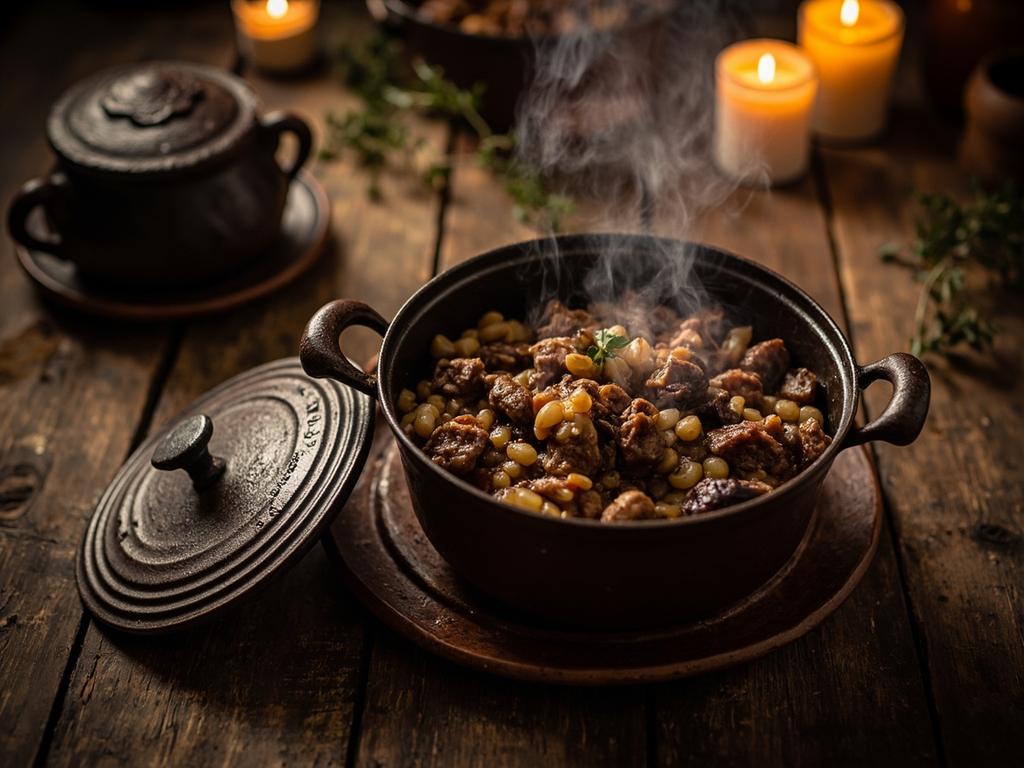
A slow pot of beef, barley and beans, sweetened with prunes and flavored with onion: the long cooking melts everything into a tender, savory-sweet dish that patiently awaits the end of the service.
Here, sir, is the dish of our rest. On Friday, as night fell, we entrusted it to the baker's oven or the hearth covered with ashes, and no one touched it thereafter: the Law forbids us to kindle any flame on the day of Shabbat. The next day, upon returning from the synagogue, we lifted the lid and there was the whole service, melting, fragrant with onion and prune. It was humble and sacred at once.
- •Beef (brisket, shin) — a piece (heart of the dish)
- •Pearl barley — a good handful (nourishing grain)
- •Dried beans — a ladleful (filling legume)
- •Prunes — about ten (fruity sweetness)
- •Onions — several (aromatic base)
- •Goose fat — a spoonful (kosher fat)
Schalet aux pruneaux (Alsatian cholent)
A slow pot of beef, barley and beans, sweetened with prunes and flavored with onion: the long cooking melts everything into a tender, savory-sweet dish that patiently awaits the end of the service.
Why this dish? Schalet is THE Shabbat dish of Alsatian Jews: since no fire can be lit on Saturday, it is slid into the oven on Friday evening and left to simmer until noon the next day. This is Dreyfus's home cooking, where religious fidelity dictated even how to keep a dish warm.
Here, sir, is the dish of our rest. On Friday, as night fell, we entrusted it to the baker's oven or the hearth covered with ashes, and no one touched it thereafter: the Law forbids us to kindle any flame on the day of Shabbat. The next day, upon returning from the synagogue, we lifted the lid and there was the whole service, melting, fragrant with onion and prune. It was humble and sacred at once.
Ingredients (period version)
- Beef (brisket, shin) — a piece (heart of the dish)
- Pearl barley — a good handful (nourishing grain)
- Dried beans — a ladleful (filling legume)
- Prunes — about ten (fruity sweetness)
- Onions — several (aromatic base)
- Goose fat — a spoonful (kosher fat)
Ingredients
- Beef brisket or chuck — 800 g (braising meat)
- Pearl barley — 100 g (grain)
- Dried white beans (soaked overnight) — 150 g (legume)
- Pitted prunes — 10 to 12 (sweet note)
- Onions — 3 (aromatic)
- Goose fat — 1 tbsp (kosher cooking fat)
- Salt, pepper, 1 tsp sweet paprika — to taste (seasoning)
Method
- Sauté the sliced onions in goose fat, add the meat and brown on all sides.
- In a heavy pot, layer the meat, barley, drained beans and prunes.
- Season with salt, pepper and paprika, then cover generously with boiling water (3 cm above).
- Bring to a simmer, cover tightly, then bake at 110-120 °C for 8 to 12 hours (overnight).
- In the morning, check that a little liquid remains; do not stir, serve as is, piping hot, with the meat shredded.
How it was made : Unable to cook on Saturday, the pot was often taken to the baker's still-warm oven on Friday evening; each family recognized its own by a mark. The very low, long heat is what makes the meat tender.
The contemporary twist : A cast-iron pot in the oven overnight, or an electric slow cooker on 'low': the 19th-century schalet becomes the ideal comfort dish for a rainy Sunday.
Sources : Joan Nathan, Quiches, Kugels and Couscous (cuisine juive de France) · Freddy Raphaël, Le judaïsme alsacien
Alfred Dreyfus · Charactorium