 flip
flipOsh-e Heravi (Herat Saffron Pilaf)
Osh-e Heravi (Herat Saffron Pilaf)
Why this dish? Navoi held sumptuous literary gatherings (majlis) in Herat where poets, musicians, and scholars came together around a princely dastarkhan. Pilaf, the quintessential Timurid royal dish, sat at the center of these banquets. The saffron rice with dried fruits reflects the refinement of a patron who wanted his table to be as beautiful as his poetry.
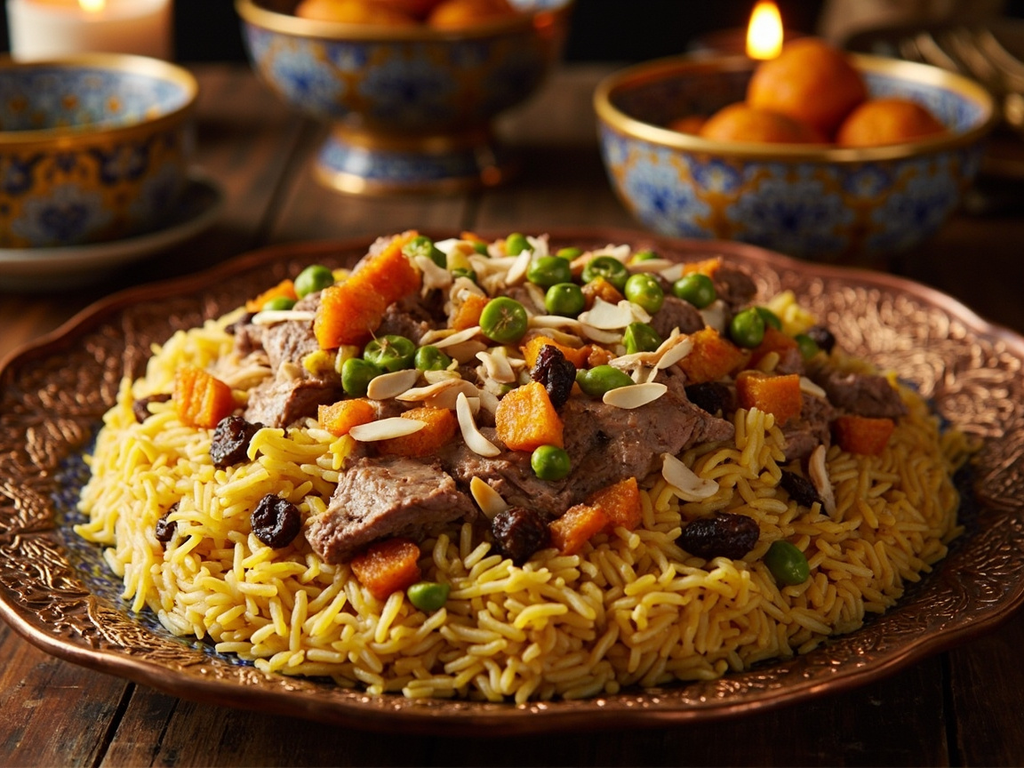
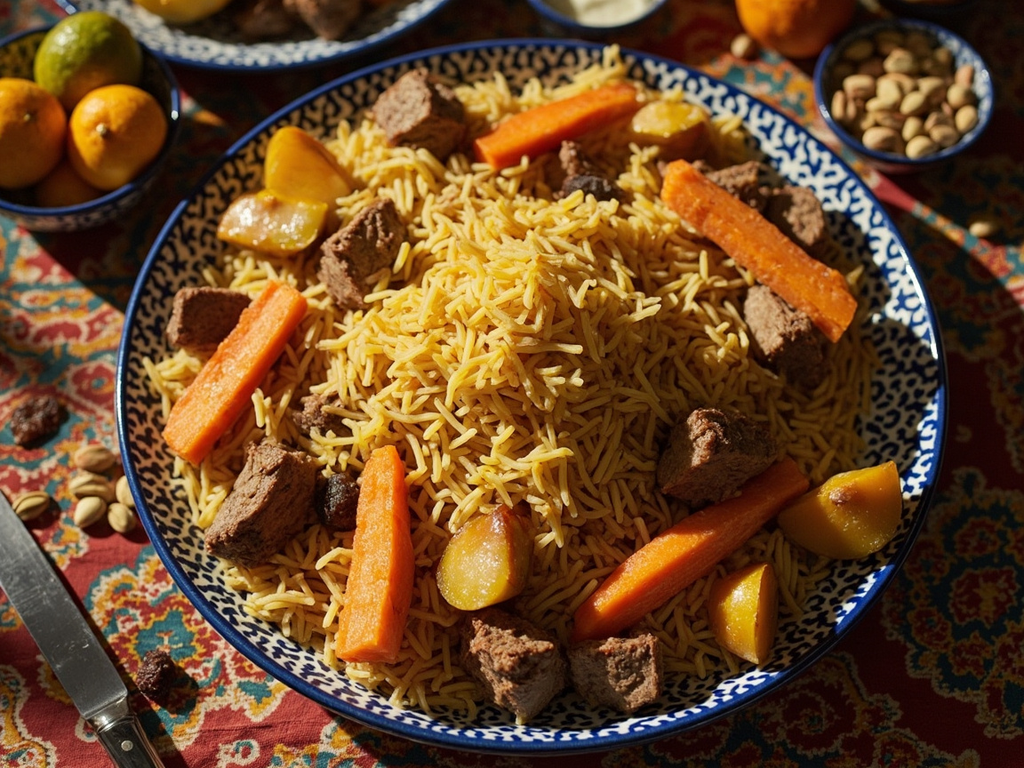
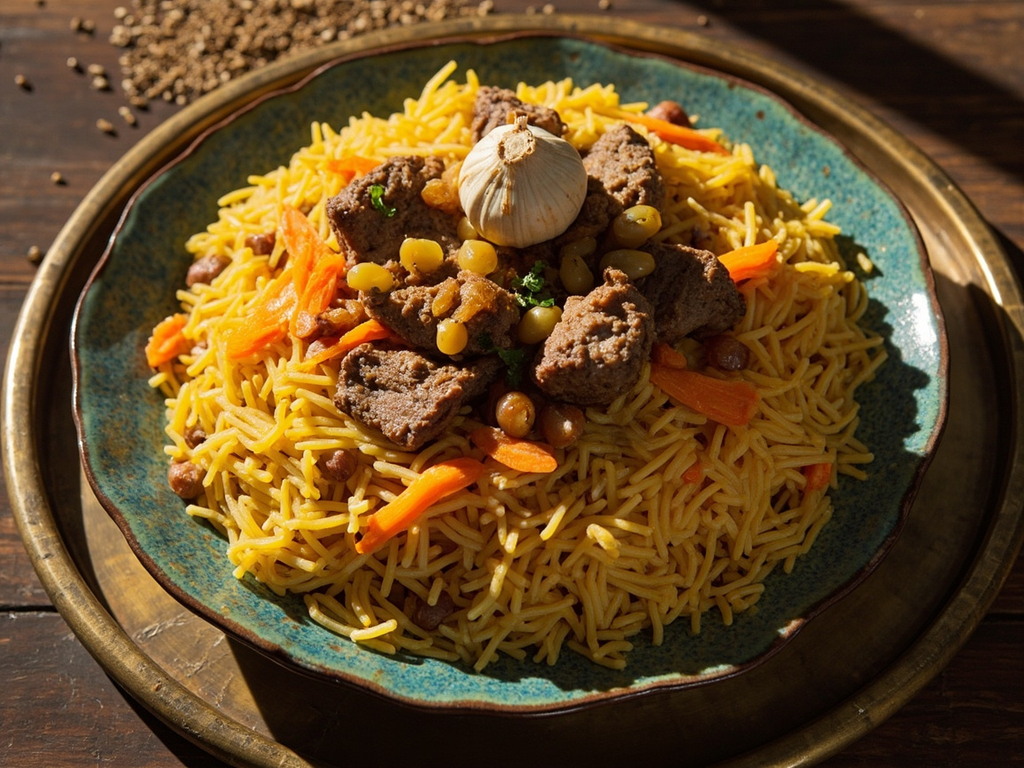
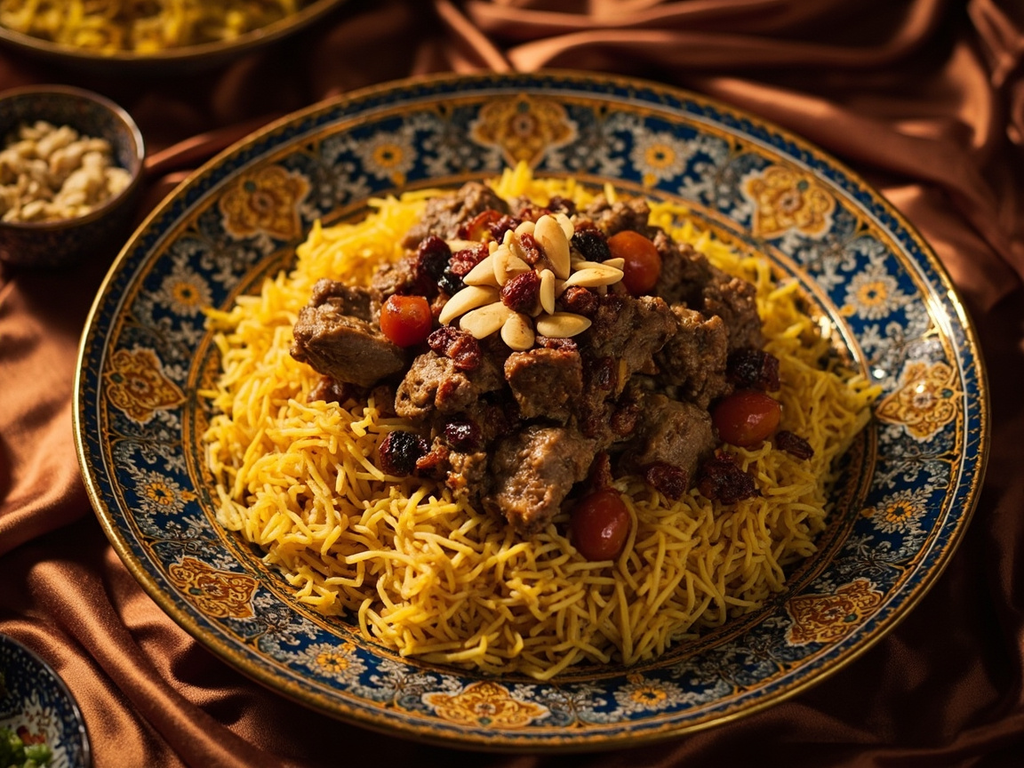
A ceremonial pilaf in the Herat style: long-grain rice steamed in its own juices, colored with saffron, topped with tender lamb, golden carrots, raisins, and toasted almonds. The zirvak (simmered base) infuses every grain.
O you who cross the threshold of my house, know that no gathering in Herat could be held without an osh worthy of the name. My cook grinds the saffron in a marble mortar, and when the rice opens to that golden dye, it is as though the blank page finally receives the poet's ink. I have seen Sultan Husayn himself close his eyes in contentment before this pilaf — and believe me, pleasing him at table is nearly as hard as pleasing him in verse. I have the almonds and raisins arranged in a crown: the beauty of the dish honors the one who receives it.
- •Khorasan long-grain rice — a generous measure (Base of the pilaf)
- •Shoulder of lamb — a good piece with the bone (Main meat)
- •Yellow and orange carrots — in abundance (Sweet-savory garnish)
- •Saffron threads — a princely pinch (Noble color and aroma)
- •Raisins — a handful (Sweetness within the rice)
- •Whole almonds — a handful (Crunchy garnish)
- •Onion — two large (Base of the zirvak)
- •Sheep's tail fat — a piece (Cooking fat)
- •Cumin, coriander seeds, salt — to taste (Zirvak spices)
Osh-e Heravi (Herat Saffron Pilaf)
A ceremonial pilaf in the Herat style: long-grain rice steamed in its own juices, colored with saffron, topped with tender lamb, golden carrots, raisins, and toasted almonds. The zirvak (simmered base) infuses every grain.
Why this dish? Navoi held sumptuous literary gatherings (majlis) in Herat where poets, musicians, and scholars came together around a princely dastarkhan. Pilaf, the quintessential Timurid royal dish, sat at the center of these banquets. The saffron rice with dried fruits reflects the refinement of a patron who wanted his table to be as beautiful as his poetry.
O you who cross the threshold of my house, know that no gathering in Herat could be held without an osh worthy of the name. My cook grinds the saffron in a marble mortar, and when the rice opens to that golden dye, it is as though the blank page finally receives the poet's ink. I have seen Sultan Husayn himself close his eyes in contentment before this pilaf — and believe me, pleasing him at table is nearly as hard as pleasing him in verse. I have the almonds and raisins arranged in a crown: the beauty of the dish honors the one who receives it.
Ingredients (period version)
- Khorasan long-grain rice — a generous measure (Base of the pilaf)
- Shoulder of lamb — a good piece with the bone (Main meat)
- Yellow and orange carrots — in abundance (Sweet-savory garnish)
- Saffron threads — a princely pinch (Noble color and aroma)
- Raisins — a handful (Sweetness within the rice)
- Whole almonds — a handful (Crunchy garnish)
- Onion — two large (Base of the zirvak)
- Sheep's tail fat — a piece (Cooking fat)
- Cumin, coriander seeds, salt — to taste (Zirvak spices)
Ingredients
- Basmati rice — 400 g (Base of the pilaf)
- Boneless lamb shoulder — 500 g, in large pieces (Main meat)
- Carrots — 3, cut into batons (Garnish)
- Saffron — 0.5 g (a good pinch), steeped in 3 tbsp warm water (Color and aroma)
- Golden raisins — 60 g (Sweetness)
- Whole almonds — 40 g (Garnish)
- Onions — 2, sliced (Base of the zirvak)
- Vegetable oil or ghee — 4 tbsp (Cooking fat)
- Ground cumin — 1 tsp (Spice)
- Ground coriander — 1 tsp (Spice)
- Salt — to taste (Seasoning)
- Water — about 600 ml (Cooking the rice)
Method
- Rinse the basmati rice in cold water until the water runs clear, then soak for 30 minutes. Drain.
- In a heavy pot (or kazan), heat the ghee over high heat. Sear the lamb pieces until well browned, then set aside.
- In the same pot, sauté the sliced onions until golden. Add the cumin and coriander, stir for 1 minute.
- Return the lamb to the pot, add the carrot batons, raisins, salt, and cover with water (about 400 ml). Simmer 40 minutes over low heat: this is the zirvak.
- Gently spread the drained rice over the zirvak without stirring. Pour the remaining water (about 200 ml) and the saffron infusion in a thin stream over the rice.
- Bring to a boil, then reduce to the lowest heat, cover tightly (a cloth under the lid helps). Steam for 25 minutes without opening.
- Meanwhile, dry-toast the almonds in a pan.
- To serve, turn the pilaf out onto a large platter to reveal the golden zirvak beneath, and arrange the toasted almonds in a crown.
How it was made : Pilaf is the prestige dish of all Timurid Central Asia. Chroniclers such as Babur in the Baburnama describe banquets in Herat and Samarkand where saffron rice accompanied by meat and dried fruit held the place of honor. Sheep's tail fat (dunba) was the standard cooking fat, and the rice was steamed over a simmered base (zirvak), a technique documented throughout the region.
The contemporary twist : Mold the pilaf into a dome on an individual plate using an upturned bowl, and sprinkle with saffron threads and dried rose petals to evoke Timurid illuminations.
Sources : Babur, Baburnama (The Memoirs of Babur), early 16th century — descriptions of Timurid feasts · Charles Perry, Medieval Arab Cookery, Prospect Books, 2001 · Nawal Nasrallah, Annals of the Caliphs' Kitchens (trans. of al-Baghdadi's Kitab al-Tabikh), Brill, 2007
Alisher Navoi · Charactorium