 flip
flipKabuli Osh (Royal Pilaf with Quince and Carrots)
Kabuli Osh (Royal Pilaf with Quince and Carrots)
Why this dish? Pilaf is the king dish of the Timurid table. The Baburnama describes Babur's victory feasts, especially after the capture of Kabul in 1504, where osh would have been served in abundance. The Kabuli version with quince and carrots reflects Babur's taste for fruit mixed with savory dishes, a trait he mentions with nostalgia.
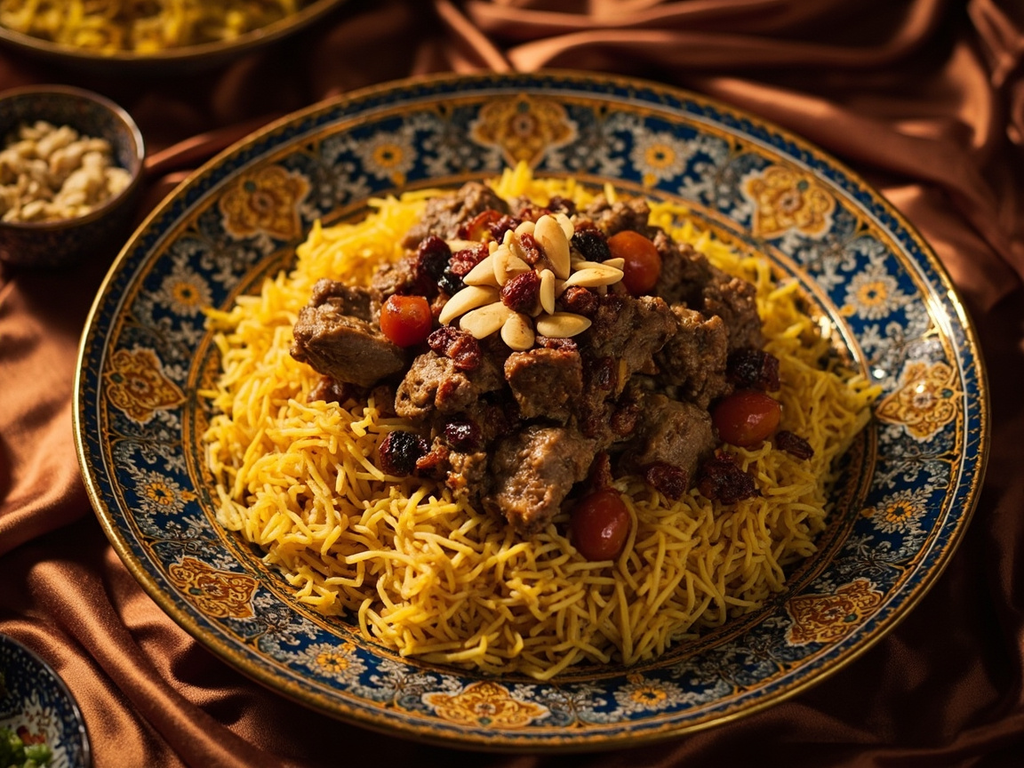
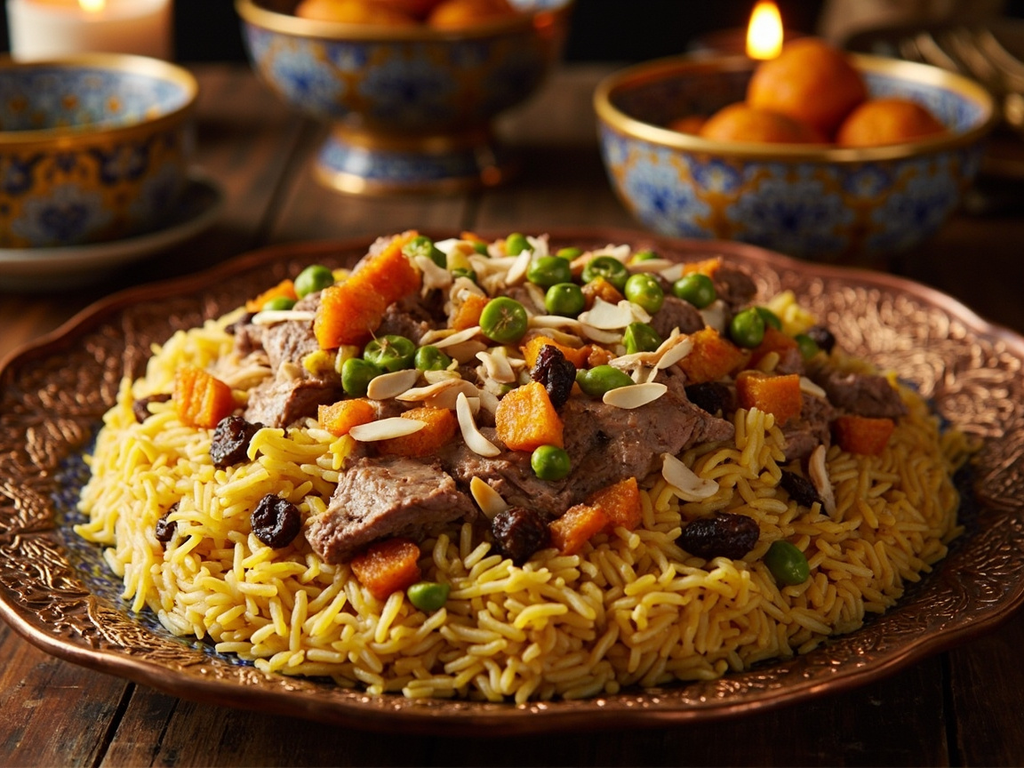
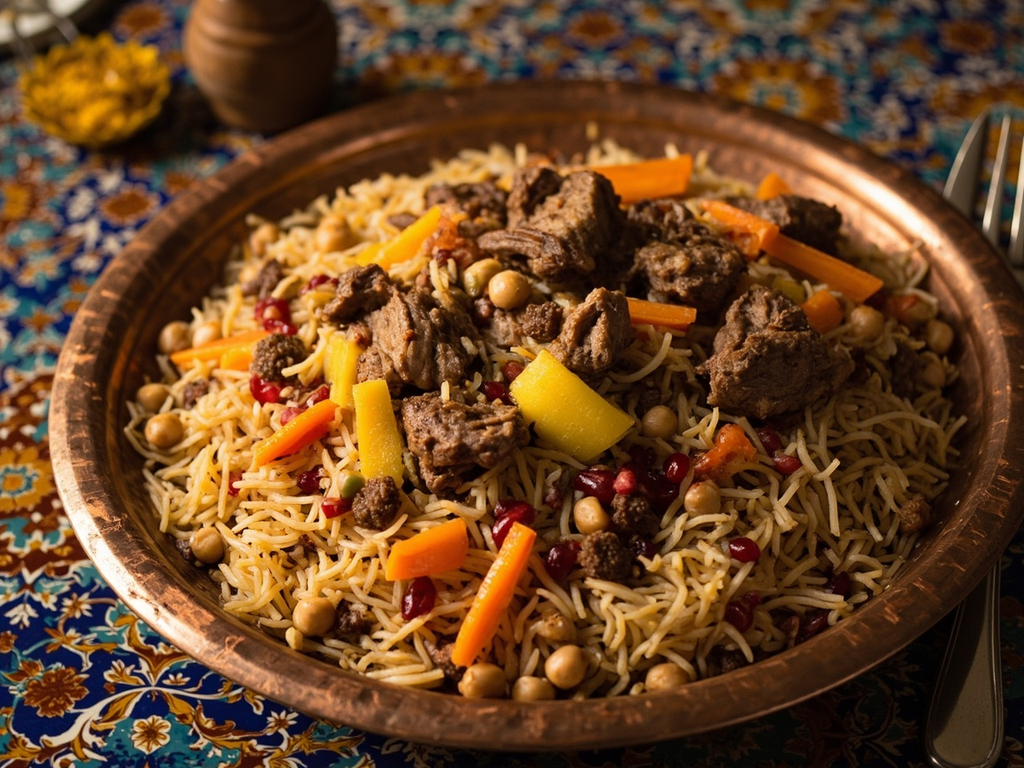
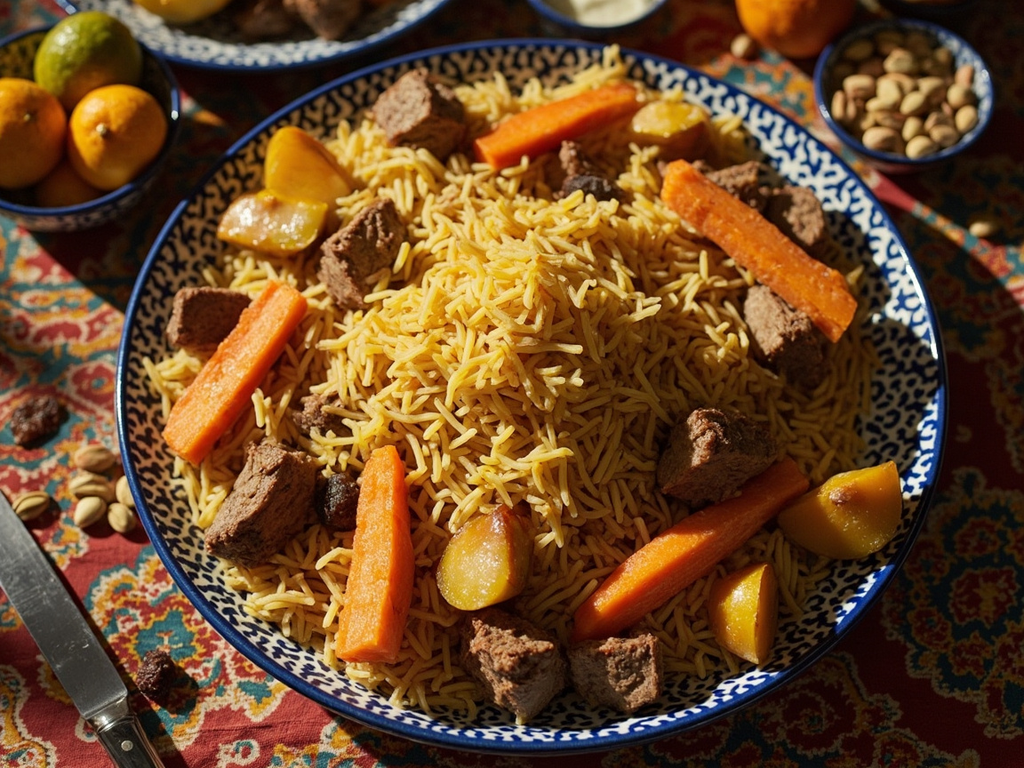
A sumptuous pilaf where basmati rice is cooked in a cumin-scented lamb broth, enriched with tail fat, then topped with golden carrots, melting quince, and raisins. Each grain is separate, glossy, and fragrant.
Know that a prince of Ferghana judges a cook by his osh, and nothing else. When I took Kabul and snow covered the Hindu Kush, my men had empty bellies and weary hearts — a good pilaf with valley quinces, well-melted dumba, and rice gilded with cumin, that is what restored their pride. The secret is the zirvak: you fry the meat and carrots in fat until everything is caramelized, then lay the rice on top without ever stirring. If you stir, you lose everything. My cook in Kabul knew this, and that is why I kept him all the way to India.
- •Long-grain rice — a large measure (about 4 handfuls) (base of the pilaf)
- •Lamb shoulder — a good piece with bone (meat and broth)
- •Fat-tailed sheep tail fat (dumba) — a fist-sized piece (main cooking fat)
- •Yellow and orange carrots — as much as the rice (sweet garnish)
- •Quinces — two fruits (fruity garnish)
- •Raisins — a handful (sweetness)
- •Onion — two large (base of the zirvak)
- •Cumin seeds — a spoonful (main spice)
- •Salt — to taste (seasoning)
Kabuli Osh (Royal Pilaf with Quince and Carrots)
A sumptuous pilaf where basmati rice is cooked in a cumin-scented lamb broth, enriched with tail fat, then topped with golden carrots, melting quince, and raisins. Each grain is separate, glossy, and fragrant.
Why this dish? Pilaf is the king dish of the Timurid table. The Baburnama describes Babur's victory feasts, especially after the capture of Kabul in 1504, where osh would have been served in abundance. The Kabuli version with quince and carrots reflects Babur's taste for fruit mixed with savory dishes, a trait he mentions with nostalgia.
Know that a prince of Ferghana judges a cook by his osh, and nothing else. When I took Kabul and snow covered the Hindu Kush, my men had empty bellies and weary hearts — a good pilaf with valley quinces, well-melted dumba, and rice gilded with cumin, that is what restored their pride. The secret is the zirvak: you fry the meat and carrots in fat until everything is caramelized, then lay the rice on top without ever stirring. If you stir, you lose everything. My cook in Kabul knew this, and that is why I kept him all the way to India.
Ingredients (period version)
- Long-grain rice — a large measure (about 4 handfuls) (base of the pilaf)
- Lamb shoulder — a good piece with bone (meat and broth)
- Fat-tailed sheep tail fat (dumba) — a fist-sized piece (main cooking fat)
- Yellow and orange carrots — as much as the rice (sweet garnish)
- Quinces — two fruits (fruity garnish)
- Raisins — a handful (sweetness)
- Onion — two large (base of the zirvak)
- Cumin seeds — a spoonful (main spice)
- Salt — to taste (seasoning)
Ingredients
- Basmati rice — 400 g (base of the pilaf)
- Lamb shoulder with bone — 500 g (meat and broth)
- Vegetable oil or ghee — 80 ml (replaces dumba (or find sheep fat at a halal butcher))
- Carrots — 400 g, cut into batons (sweet garnish)
- Quinces — 2, cut into wedges (fruity garnish)
- Golden raisins — 50 g (sweetness)
- Onions — 2 large, sliced (base of the zirvak)
- Cumin seeds — 1 tbsp (main spice)
- Salt — to taste (seasoning)
- Hot water — 700 ml (cooking the rice)
Method
- Rinse the basmati rice in cold water until clear, then soak for 30 minutes. Drain.
- In a large heavy-bottomed pot (or a kazan if available), heat the ghee over high heat. Sear the lamb pieces on all sides until golden brown. Set aside.
- In the same fat, sauté the sliced onions until well browned, almost caramelized (10-12 min).
- Return the meat, add the carrot batons, quince wedges, cumin, and salt. Sauté for 5 minutes, stirring: this is the zirvak.
- Pour hot water to just cover the zirvak, bring to a boil, then reduce heat and simmer covered for 30 minutes.
- Spread the drained rice in an even layer over the zirvak WITHOUT STIRRING. Scatter the raisins. Add more hot water if needed so the rice is just covered by about 1 cm.
- Cover tightly, cook over low heat for 25 minutes without lifting the lid.
- Turn off the heat and let rest for 10 minutes. Gently invert the pilaf onto a large platter so that the meat and carrots end up on top.
How it was made : Central Asian pilaf was cooked in a kazan (cast-iron cauldron) over a wood or dried dung fire. Dumba (fat-tail sheep fat) was the exclusive fat. Each region of the Ferghana Valley had its variant; Babur, originally from Andijan, would have known an osh with the typical yellow carrots of the region. Quince, a Persian fruit prized in Timurid cuisine, was added for banquets.
The contemporary twist : Mound the pilaf into a dome, with caramelized quince wedges visible on top, and garnish with crushed pistachios and a pinch of saffron threads to evoke Mughal splendor.
Sources : Baburnama (Memoirs of Babur), trans. A.S. Beveridge, 1922 — passages on feasts and Central Asian fruits · Zubaida, Sami & Tapper, Richard, A Taste of Thyme: Culinary Cultures of the Middle East, I.B. Tauris, 2000
Babur · Charactorium