
Daughter of Chief Powhatan, leader of the Algonquian confederacy of Virginia, Pocahontas (c. 1596–1617) is a central figure in the encounter between the Powhatan peoples and the English settlers of Jamestown. Her story, passed down through colonial written sources and her people's oral tradition, symbolizes both the dialogue and the tensions between two worlds.
Pocahontas(1596 — 1617)
Pocahontas
royaume d'Angleterre, Tsenacommacah
8 min read
Frequently asked questions
Key Facts
- Born around 1596 within the Powhatan Confederacy in Virginia, daughter of the paramount chief Wahunsenacah (known as Powhatan)
- Around 1607, played a mediating role during the first contacts with the English settlers of Jamestown, according to the written accounts of John Smith (colonial sources, not corroborated by oral tradition)
- Captured by the English in 1613 and held hostage at Henrico, Virginia
- Converted to Christianity, took the name Rebecca, and married English settler John Rolfe in 1614
- Died in England at Gravesend in 1617, during a voyage to London organized as a colonial propaganda venture
Works & Achievements
An informal diplomatic agreement made possible by Pocahontas's marriage to John Rolfe, securing several years of peace between the Powhatan Confederacy and the Jamestown colony. This peace allowed the colony to survive and grow.
Baptized under the name Rebecca, Pocahontas was the first Native American of high birth to publicly convert to Anglican Christianity. This act was presented in England as proof of colonization's civilizing mission.
Funded by the Virginia Company, this voyage aimed to promote English colonization in Virginia. Pocahontas, presented as living proof of the colonial project's success, met King James I and the Bishop of London.
The memory of Matoaka is preserved and claimed by her descendants of the Pamunkey Nation, recognized as a federal tribe in 2015. This oral heritage provides a counterweight to the colonial narrative of her history.
Anecdotes
Pocahontas, whose real name was Amonute, also carried a secret name: Matoaka. The nickname 'Pocahontas' means 'the playful one' or 'she who plays with vivacity' in Algonquian, reflecting her lively and curious nature from childhood. Europeans only recorded this detail in their accounts much later.
In 1607, Captain John Smith claimed in his memoirs that Pocahontas saved his life by placing her head over his at the moment her father was about to execute him. Historians still debate this episode: it may have been an adoption ritual rather than an actual execution, misinterpreted by Smith due to his lack of knowledge of Powhatan culture.
In 1613, Pocahontas was captured by the colonist Samuel Argall, who intended to use her as a hostage to negotiate the release of English prisoners held by her father. During her captivity at Henrico, she received a Christian education and learned English — a transformation that would profoundly alter her fate.
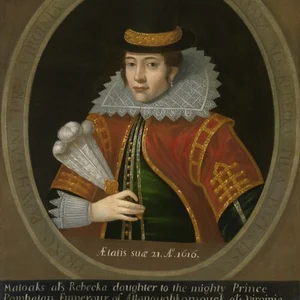
In 1616, Pocahontas traveled to England with her husband John Rolfe and their son Thomas. She was presented at the court of King James I as a 'converted savage princess.' Her portrait was engraved and widely circulated, making her one of the first Native American women whose likeness was reproduced in Europe.
Pocahontas died at Gravesend, England, in 1617, at around 21 years of age, just as she was preparing to return to Virginia. The cause of her death remains uncertain — pneumonia, tuberculosis, and poisoning have all been suggested. Her son Thomas grew up in England before returning to Virginia, carrying on her lineage.
Primary Sources
Pocahontas, the King's most deare and wel-beloved daughter, being but a child of twelve or thirteen years of age, whose compassionate pitiful heart gave me much cause to respect her, got his head in her armes, and laid her owne upon his to save him from death.
It is Pocahontas, to whom my hearty and best thoughts are, and have a long time bin so entangled, and inthralled in so intricate a laborinth, that I was even awearied to unwinde my selfe thereout.
Pocahontas, the nonpareil of his kingdome... at the instant of our men's departure, she came accidentally to our fort... where she was kindly entertained and brought to Sir Thomas Dale.
In the memory of the elders, Matoaka was a courageous young woman who sought to maintain peace between her people and the strangers who came from the sea, at the risk of her own freedom.
The people... are governed by their Kings, which they call Werowances... The great King is called Powhatan... He hath as many women as he will, whereof when he is weary of them, he bestoweth them on those that best deserve them.
Key Places
Capital of the Powhatan Confederacy and home of the paramount chief Wahunsenacah, Pocahontas's father. According to colonial accounts, this is where the foundational encounter between Pocahontas and John Smith took place.
The first permanent English settlement in North America, founded in 1607 on Powhatan lands. Pocahontas visited the colony regularly in its early years, bringing food and information.
The English colonial settlement where Pocahontas was held captive in 1613, baptized under the name Rebecca, and instructed in the Christian faith. It was here that she met John Rolfe, whom she married in 1614.
Pocahontas stayed here in 1616–1617, was received at the royal court, and met English aristocracy. Her presence generated considerable interest in London society.
An English port on the Thames where Pocahontas died in March 1617, before she could board a ship to return to Virginia. She is buried there in St. George's Church.
Typical Objects

A typical garment worn by Powhatan women, decorated with wampum beads and symbolic embroidery. Pocahontas wore this type of clothing during ceremonies and diplomatic meetings with the colonists.

Beads carved from white and purple shells, used as currency, ornamentation, and a medium of memory in Algonquian culture. Wampum belts were used to seal agreements and pass down historical narratives.

Powhatan women crafted and used these baskets to store and carry food, seeds, and everyday items. This craft was central to the domestic and economic life of the village.

A hunting tool and weapon of war ubiquitous in Powhatan culture, made from flexible wood and animal sinew string. Though primarily reserved for men, it symbolizes a way of life built around hunting and the defense of territory.

A ritual object used during major Powhatan council gatherings to seal alliances and invoke the spirits. Its presence during encounters with the English reflects the attempts at diplomatic dialogue.

In 1616, a Dutch engraver made a portrait of Pocahontas in European dress, calling her 'Rebecca.' This iconographic document — unique for a Native American woman of the time — circulated widely in Europe and contributed to her posthumous fame.
School Curriculum
Vocabulary & Tags
Key Vocabulary
Tags
Daily Life
Morning
At sunrise, Pocahontas took part in the communal tasks assigned to women: lighting the central hearth fire, fetching water from the river in ceramic jars, and preparing the morning meal of corn porridge (hominy). On spring and summer mornings, she helped weed the fields of corn, beans, and squash — the "Three Sisters" of Native American agriculture.
Afternoon
Afternoons were devoted to craftwork: weaving baskets, tanning deerskins, embroidering wampum beads onto clothing, and preparing medicinal plants. As the chief's daughter, Pocahontas also took part in council discussions and the preparations for diplomatic ceremonies with leaders of allied tribes.
Evening
In the evening, the community gathered around the village's central fire to share the main meal, listen to the elders recount the founding stories of the Powhatan people, and join in ritual songs and dances. On full moon nights, ceremonies such as the Huskanaw or other important seasonal rites would sometimes take place.
Food
The Powhatan diet was built on the corn-beans-squash triad, supplemented by abundant fishing in the James River (sturgeon, bass, herring) and hunting for deer, wild turkey, and small game. Women also gathered nuts, berries, and edible roots according to the seasons, resulting in a varied and well-balanced diet.
Clothing
Pocahontas wore garments of carefully tanned deerskin: a fringed skirt for adult women and, during ceremonies, a more elaborate mantle decorated with shell beads and red ochre pigments. On important occasions, her hair was adorned with feathers and copper — a precious metal that symbolized status in Powhatan culture.
Housing
Powhatan villages consisted of arched longhouses (yehakins) built on a framework of bent poles covered with birch bark and woven reed mats. These dwellings could house several families and were arranged in a circle around a central open space. As the daughter of the paramount chief, Pocahontas lived in one of the confederation's largest villages, Werowocomoco.
Historical Timeline
Period Vocabulary
Visual Style
Style visuel inspiré des aquarelles ethnographiques de John White, avec des teintes chaudes et terreuses de la forêt de Virginie, opposant la richesse naturelle du monde powhatan aux premières palissades de bois des colons anglais.
Sound Ambience
Ambiance sonore de la forêt de Virginie au bord de la James River, mêlant les sons de la nature aux activités quotidiennes d'un village powhatan : chants, feux, broyage du maïs et pirogues glissant sur l'eau.
Liens externes & ressources
Références
Œuvres
Paix de Pocahontas (traité de coexistence Powhatan-Anglais)
1614
Baptême et conversion au christianisme
1614
Voyage diplomatique en Angleterre
1616-1617
Héritage oral de la nation Pamunkey
XVIIe siècle — transmission continue