 flip
flipPotage Saint-Germain
Potage Saint-Germain
Why this dish? This split pea velouté, named after the Faubourg Saint-Germain where the upper bourgeoisie lived, almost ritually opened the Parisian dinners that France enjoyed on the Quai Malaquais as well as at the Villa Saïd. A soup both simple and noble, like the man who loved good food without ostentation.
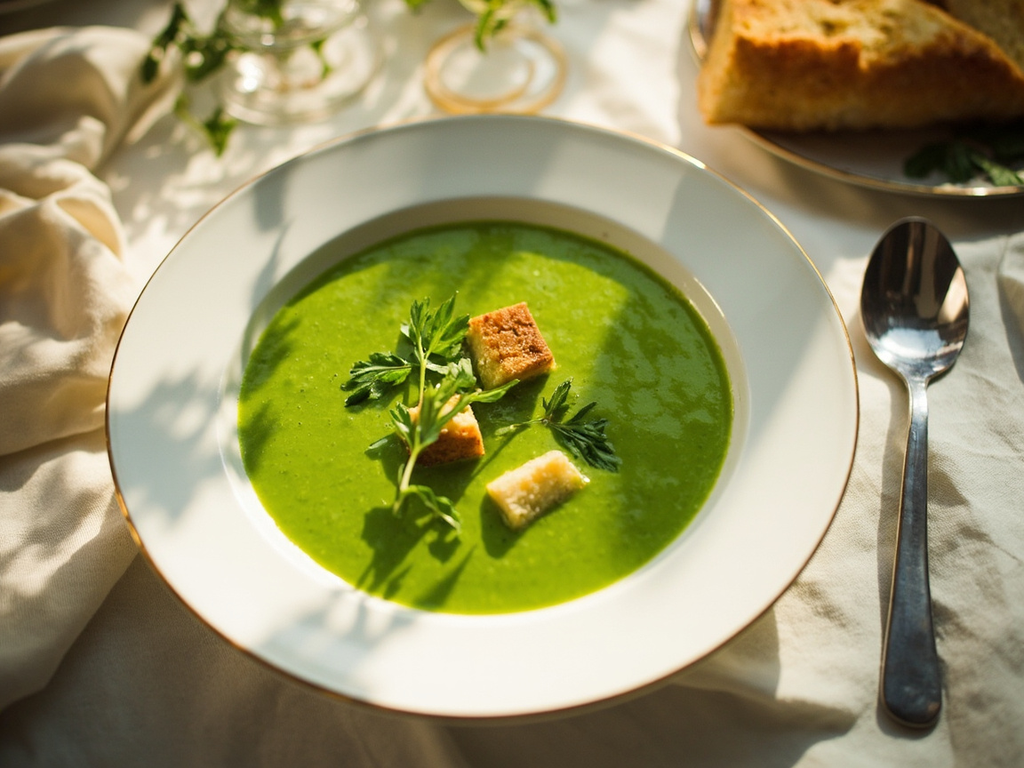
A tender green velouté of split peas, bound with butter and enlivened with a chiffonade of chervil, served blazing hot as the first course. The sweetness of the peas and the chicken stock give a round mouthfeel that prepares the appetite.
You see, my friend, I distrust dinners that begin with a flourish: true civilization is measured by the modesty of its soup. This one was simmered for hours with an old ham, and the peas were passed through a sieve until they offered no more resistance, like a mind well-formed to received ideas. I had them add, at the last minute, a cloud of chervil — for one must have a little poetry, even in a pea soup.
- •Green split peas — a good pound (base of the velouté)
- •Chicken stock — to cover (umami liquid)
- •Onion and leek — one of each (aromatic base)
- •Ham or rind — one piece (flavored saltiness)
- •Butter — a large knob (final binding)
- •Fresh chervil — a few sprigs (freshness)
Potage Saint-Germain
A tender green velouté of split peas, bound with butter and enlivened with a chiffonade of chervil, served blazing hot as the first course. The sweetness of the peas and the chicken stock give a round mouthfeel that prepares the appetite.
Why this dish? This split pea velouté, named after the Faubourg Saint-Germain where the upper bourgeoisie lived, almost ritually opened the Parisian dinners that France enjoyed on the Quai Malaquais as well as at the Villa Saïd. A soup both simple and noble, like the man who loved good food without ostentation.
You see, my friend, I distrust dinners that begin with a flourish: true civilization is measured by the modesty of its soup. This one was simmered for hours with an old ham, and the peas were passed through a sieve until they offered no more resistance, like a mind well-formed to received ideas. I had them add, at the last minute, a cloud of chervil — for one must have a little poetry, even in a pea soup.
Ingredients (period version)
- Green split peas — a good pound (base of the velouté)
- Chicken stock — to cover (umami liquid)
- Onion and leek — one of each (aromatic base)
- Ham or rind — one piece (flavored saltiness)
- Butter — a large knob (final binding)
- Fresh chervil — a few sprigs (freshness)
Ingredients
- Green split peas — 250 g (base of the velouté)
- Chicken stock — 1.2 L (liquid)
- Onion — 1 (aromatic)
- Leek white — 1 (aromatic)
- Ham dice or smoked bacon lardons — 60 g (salty umami)
- Butter — 40 g (binding)
- Chervil — 1/2 bunch (garnish)
Method
- Rinse the split peas (no soaking needed for split peas).
- Sauté the chopped onion and leek in butter without browning.
- Add the peas, ham, pour in the stock, and simmer covered for 45 minutes until the peas are soft.
- Remove the ham, blend finely, and pass through a sieve for a very smooth velouté.
- Adjust seasoning, mount with cold butter off the heat.
- Serve piping hot, sprinkled with chervil and small golden croutons.
How it was made : In the 19th century, this soup was worked through a sieve by hand — a pantry labor — to obtain a perfectly velvety texture without any lumps. The ham or rind stock advantageously replaced salt.
The contemporary twist : A spoonful of unsweetened whipped cream and a few raw fresh peas placed on top for color and crunch contrast.
Sources : Auguste Escoffier, Le Guide culinaire (1903) · Jules Gouffé, Le Livre de cuisine (1867)
Anatole France · Charactorium