 flip
flipLibation of honey, milk and wine for the dead
Libation of honey, milk and wine for the dead
Why this dish? Andromache is the very figure of mourning: she weeps for Hector dragged beneath the walls, then for the child Astyanax. Pouring libations on the tomb is the gesture that defines her grief — the funerary urn is one of her objects. This is inspired by Greek rites for the dead, without reproducing them.
Not a dish but a poured offering: a mixture of honey, milk, sweet wine and water, sometimes sprinkled with barley grains, poured on the tomb to soothe the soul of the deceased. The gesture of mourning par excellence.
Do not eat this, stranger — rather tilt the vessel and pour. On the earth that covers my own, I first pour milk, then sweet honey, then dark wine, and finally clear water, and I whisper the name I loved. I throw a handful of barley on top, as one feeds those who no longer eat. As long as a living hand pours, the dead are not entirely alone.
- •Honey — a pour (offering sweetness)
- •Milk — a splash (purity)
- •Sweet wine — a splash (libation)
- •Spring water — a splash (libation)
- •Barley grains — a handful (cereal offering)
Libation of honey, milk and wine for the dead
Not a dish but a poured offering: a mixture of honey, milk, sweet wine and water, sometimes sprinkled with barley grains, poured on the tomb to soothe the soul of the deceased. The gesture of mourning par excellence.
Why this dish? Andromache is the very figure of mourning: she weeps for Hector dragged beneath the walls, then for the child Astyanax. Pouring libations on the tomb is the gesture that defines her grief — the funerary urn is one of her objects. This is inspired by Greek rites for the dead, without reproducing them.
Do not eat this, stranger — rather tilt the vessel and pour. On the earth that covers my own, I first pour milk, then sweet honey, then dark wine, and finally clear water, and I whisper the name I loved. I throw a handful of barley on top, as one feeds those who no longer eat. As long as a living hand pours, the dead are not entirely alone.
Ingredients (period version)
- Honey — a pour (offering sweetness)
- Milk — a splash (purity)
- Sweet wine — a splash (libation)
- Spring water — a splash (libation)
- Barley grains — a handful (cereal offering)
Ingredients
- Liquid honey — 2 tbsp (sweetness)
- Milk — 100 ml (base)
- Sweet wine (e.g., muscat) — 100 ml (flavor)
- Water — 100 ml (dilution)
- Barley grains or pearl barley — 1 handful (symbolic garnish)
Method
- This "recipe" is above all commemorative: it can be turned into a sweet drink to consume, or kept as a symbolic libation.
- Gently warm the milk to dissolve the honey.
- Off the heat, mix with the sweet wine and water.
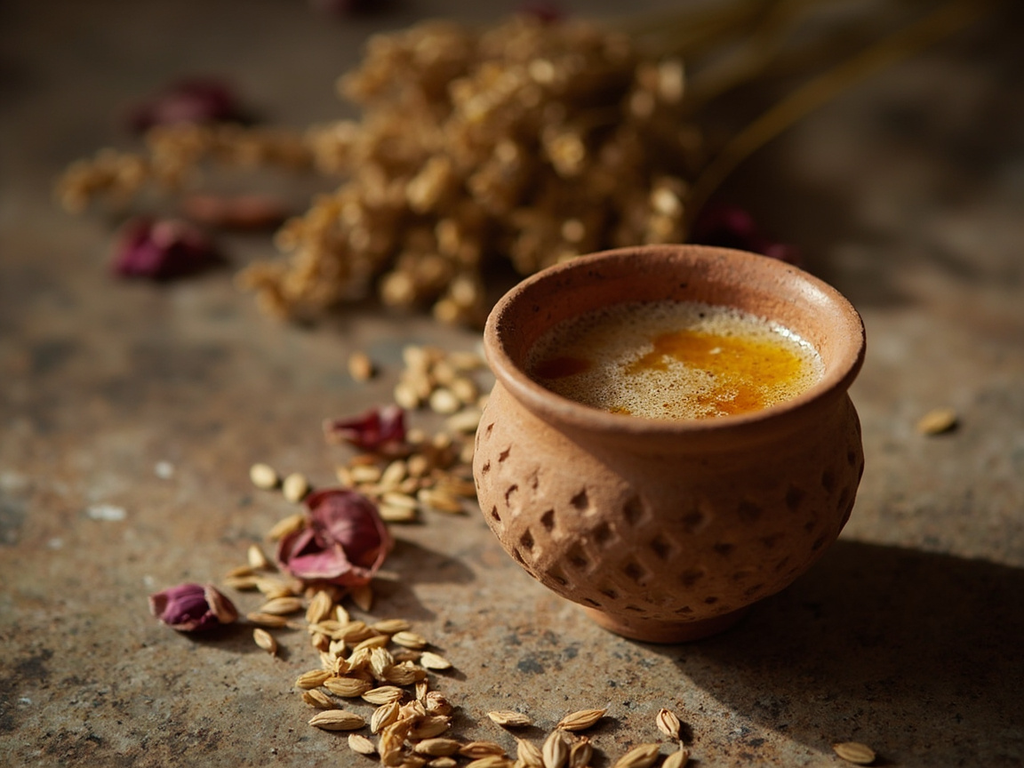
- For tasting: serve warm in a small cup, flavored with a pinch of cinnamon or dried petals.
- For the symbolic gesture: pour slowly at the foot of a tree, scattering a few barley grains.
How it was made : The Greeks poured choaí to the dead: libations without burnt alcohol, consisting of honey mixed with milk (melíkraton), wine and water, accompanied by barley. In the Odyssey, Odysseus pours exactly this mixture to summon the shades. Female mourning — that of Andromache — was central to these rites.
The contemporary twist : Reinterpreted as a comforting hot drink, akin to "honey milk with muscat", to evoke the gesture without misappropriating it — an evening sweetness.
Sources : Homer, Odyssey (Book XI, libations to the dead) · Euripides, Andromache · Robert Garland, The Greek Way of Death (1985)
Andromache · Charactorium