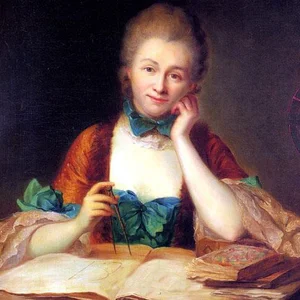

Anne Conway was an English philosopher of the 17th century. Self-taught, she developed a vitalist metaphysics set out in her posthumous work “The Principles of the Most Ancient and Modern Philosophy.” Her thought notably influenced Leibniz and his concept of the monad.
Anne Conway(1631 — 1679)
Anne Conway
royaume d'Angleterre
6 min read
Frequently asked questions
Key Facts
- Born in 1631 in London into an English aristocratic family
- Educated by correspondence with the philosopher Henry More, a leading figure of Cambridge Platonism
- Wrote her only work, “The Principles of the Most Ancient and Modern Philosophy,” published posthumously in 1690
- Her vitalist philosophy, in which all substance is animate, influenced Leibniz and the concept of the monad
- Converted to Quakerism late in her life; died in 1679
Works & Achievements
Her only work, a vitalist metaphysics in which the entire universe is made of spirit and where matter and spirit are but one and the same substance. A work that influenced Leibniz.
Years of philosophical letter-exchanges that served both as her education and as a major testament to her thought in the making.
She conceives of the universe as a set of living, interconnected entities, rejecting Descartes's sharp separation between body and mind. This idea foreshadows Leibniz's monads.
Anne Conway brings together Jewish Kabbalah, the thought of the Cambridge Platonists, and modern science into a single original and harmonious system.
Anecdotes
Anne Conway suffered all her life from atrocious, incurable migraines. The greatest physicians of her time, including the famous William Harvey who discovered blood circulation, tried to cure her, in vain. Yet it was in pain and confined to her bed that she developed an entire philosophy.
As a woman in the 17th century, she was not allowed to study at the universities of Oxford or Cambridge. She therefore taught herself, corresponding for years with the philosopher Henry More of Cambridge, who became her teacher and then regarded her as his intellectual equal.
Her only book was published posthumously, nine years after her death, and first in Latin. It had been found in the form of notes in her notebooks, then translated and printed without her name clearly appearing on it at first.
Toward the end of her life, Anne Conway joined the Quaker movement, a bold and frowned-upon decision since they were being persecuted in England at the time. She welcomed imprisoned and freed Quakers into her home.
When she died, her husband had her body preserved in a coffin filled with spirits (alcohol) and fitted with a glass pane, so that he could see her one last time upon his return from his journey.
Primary Sources
Every creature, every spirit and every body, can be changed from one into the other, for they were originally but one and the same substance.
I beg you to forgive me if my thoughts seem confused to you, for I set them down on paper in the midst of pains that leave me almost no rest.
These principles were written by a certain English lady, learned beyond her sex, versed in the most profound questions of philosophy.
Key Places
Birthplace of Anne Finch (later Conway), where she was born into a wealthy family in 1631. England's great intellectual and political capital.
The Conway family estate where Anne spent much of her adult life and developed her philosophy. She died there in 1679.
The university town from which Henry More, Anne Conway's mentor and correspondent, taught. It was through this correspondence that she trained in philosophy, since she was unable to study there herself.
A London residence associated with the Conway family, a place where the viscountess stayed and engaged in intellectual exchanges.
Liens externes & ressources
Références
Œuvres
Principes de la philosophie la plus ancienne et la plus moderne (Principia philosophiae)
1690 (posthume)
Correspondance avec Henry More
années 1650-1670
Théorie des « monades » et critique du dualisme
vers 1670-1679
Synthèse entre kabbale, platonisme et philosophie moderne
vers 1670