 flip
flipBruine bonen — brown beans stewed with potatoes
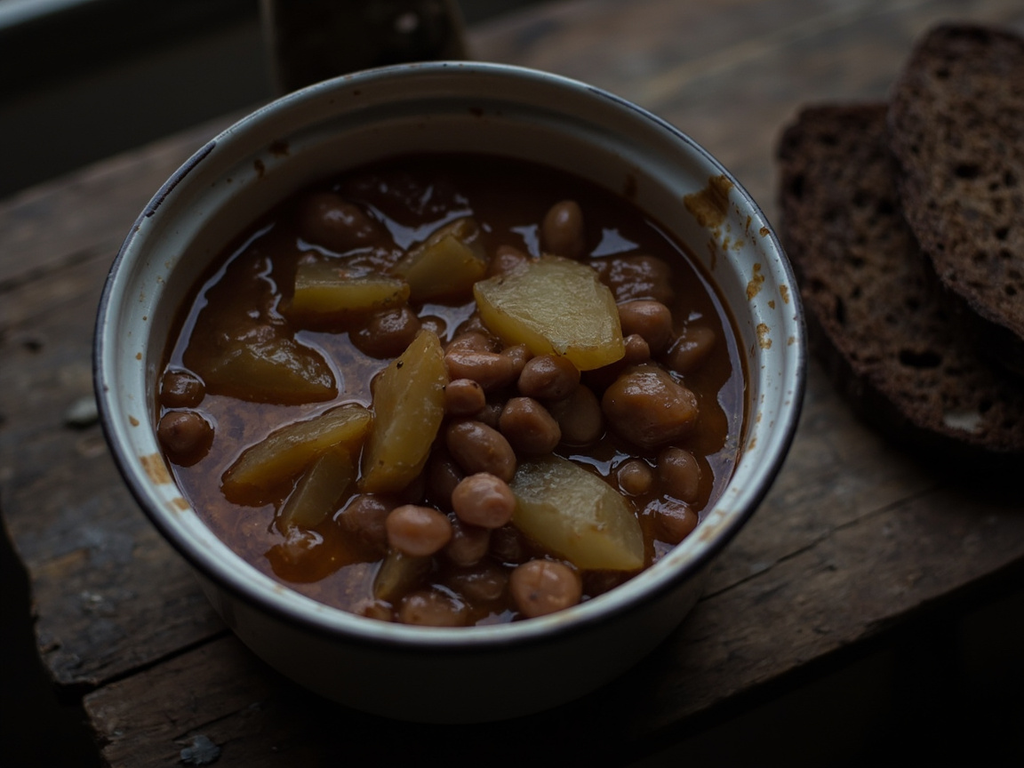
Bruine bonen — brown beans stewed with potatoes
Why this dish? Dried legumes were the basis of survival in the Annex. Anne describes in her diary a large sack of brown beans whose seam gave way: the beans cascade down the stairs and almost bury Peter van Pels. This dish is literally the pantry of the hiding place.
A thick, comforting stew: brown beans soaked long, melted with potatoes and an onion, barely seasoned. Poor but nourishing, it was the kind of meal that came back again and again to the Annex table, to the point of monotony.
If you had seen it! One of the bean sacks suddenly burst and the whole supply tumbled down the stairs onto Peter's head — he had beans in his socks, and I was laughing so hard I was afraid they'd hear us downstairs. Mother soaks them the night before in a basin, then everything simmers for hours on the little stove with potatoes and an onion. It's no feast, believe me, and some evenings I'm sick to death of those beans — but when there's nothing else, a warm bowl is already a lot.
- •Dried brown beans — a large bowl (protein base)
- •Potatoes — a few (starch that binds the dish)
- •Onion — one (aromatic)
- •Rationed fat or margarine — a little (scarce fat)
- •Salt — as much as the little available (seasoning)
Bruine bonen — brown beans stewed with potatoes
A thick, comforting stew: brown beans soaked long, melted with potatoes and an onion, barely seasoned. Poor but nourishing, it was the kind of meal that came back again and again to the Annex table, to the point of monotony.
Why this dish? Dried legumes were the basis of survival in the Annex. Anne describes in her diary a large sack of brown beans whose seam gave way: the beans cascade down the stairs and almost bury Peter van Pels. This dish is literally the pantry of the hiding place.
If you had seen it! One of the bean sacks suddenly burst and the whole supply tumbled down the stairs onto Peter's head — he had beans in his socks, and I was laughing so hard I was afraid they'd hear us downstairs. Mother soaks them the night before in a basin, then everything simmers for hours on the little stove with potatoes and an onion. It's no feast, believe me, and some evenings I'm sick to death of those beans — but when there's nothing else, a warm bowl is already a lot.
Ingredients (period version)
- Dried brown beans — a large bowl (protein base)
- Potatoes — a few (starch that binds the dish)
- Onion — one (aromatic)
- Rationed fat or margarine — a little (scarce fat)
- Salt — as much as the little available (seasoning)
Ingredients
- Dried brown (or red) beans — 300 g (protein base)
- Firm potatoes — 500 g (starch)
- Onion — 1 large (aromatic)
- Oil or butter — 2 tbsp (fat)
- Bay leaf — 1 (flavor)
- Salt and pepper — to taste (seasoning)
Method
- The night before, soak the beans in a large volume of cold water.
- Drain, cover with fresh water with the bay leaf, and cook 60 to 90 minutes until tender (do not salt at the beginning).
- Sauté the sliced onion in the fat, add the potatoes cut into large dice.
- Pour in the beans with a little of their cooking water, simmer 25 to 30 minutes until the potatoes crumble and bind the dish.
- Season with salt and pepper, roughly mash part to thicken, and serve hot.
How it was made : Under the occupation, meat and butter were rationed and often unavailable. Dried legumes, which keep for months, formed the backbone of meals throughout Holland, and even more so in a secret hideout supplied in secret.
The contemporary twist : A spoonful of mustard and a dash of vinegar at the end of cooking wake up this humble dish; served with grilled country bread, it becomes a perfectly current winter dinner.
Sources : Anne Frank, The Diary of a Young Girl (Het Achterhuis)
Anne Frank · Charactorium