 flip
flipThree-Glass Mint Tea
Three-Glass Mint Tea
Why this dish? Appointed airfield manager at Cape Juby (Tarfaya) in 1927-1928, on the edge of the Spanish Sahara, Saint-Exupéry negotiated pilots' safety with the Moorish tribes. The tea shared under the tent sealed truces: he kept the memory in Wind, Sand and Stars.
A strong green tea, perfumed with fresh mint and heavily sweetened, served in three successive glasses, each with its own character. Much more than a drink: a gesture of welcome and patience, which suspends time.
When I was airfield manager at Cape Juby, on that rim of the Sahara where the mail made a stop, I learned from the men of the desert that nothing seals a truce better than a glass of tea. You let the water sing on the brazier, you throw in a handful of mint, you break a lump of sugar with a knife. And you pour from very high, to crown the glass with foam — the first bitter like life, the second strong like friendship, the last sweet like farewell. Drink it slowly, traveler: under the tent, time has no watch.
- •Chinese green tea (gunpowder) — a good pinch (base, bitterness)
- •Fresh nanah mint — a large handful (fragrance)
- •Sugar loaf — a few chips (sweetness)
- •Spring water — the contents of the teapot (infusion)
- •Charcoal brazier — — (slow heat)
Three-Glass Mint Tea
A strong green tea, perfumed with fresh mint and heavily sweetened, served in three successive glasses, each with its own character. Much more than a drink: a gesture of welcome and patience, which suspends time.
Why this dish? Appointed airfield manager at Cape Juby (Tarfaya) in 1927-1928, on the edge of the Spanish Sahara, Saint-Exupéry negotiated pilots' safety with the Moorish tribes. The tea shared under the tent sealed truces: he kept the memory in Wind, Sand and Stars.
When I was airfield manager at Cape Juby, on that rim of the Sahara where the mail made a stop, I learned from the men of the desert that nothing seals a truce better than a glass of tea. You let the water sing on the brazier, you throw in a handful of mint, you break a lump of sugar with a knife. And you pour from very high, to crown the glass with foam — the first bitter like life, the second strong like friendship, the last sweet like farewell. Drink it slowly, traveler: under the tent, time has no watch.
Ingredients (period version)
- Chinese green tea (gunpowder) — a good pinch (base, bitterness)
- Fresh nanah mint — a large handful (fragrance)
- Sugar loaf — a few chips (sweetness)
- Spring water — the contents of the teapot (infusion)
- Charcoal brazier — — (slow heat)
Ingredients
- Gunpowder green tea — 1 tbsp (base, bitterness)
- Fresh mint (verbena in winter) — 1 large bunch (fragrance)
- Sugar cubes — 4 to 6 cubes (sweetness)
- Water — 50 cl (infusion)
Method
- Scald the teapot, add the tea and a splash of boiling water. Swirl for 10 seconds and discard this first water (it removes bitterness and dust from the tea).
- Pour the 50 cl of boiling water over the tea, let steep for 2 to 3 minutes.
- Add the sugar and the large handful of mint, pressed well into the teapot.
- Pour a glass, pour it back into the teapot, repeat two or three times to mix without stirring.
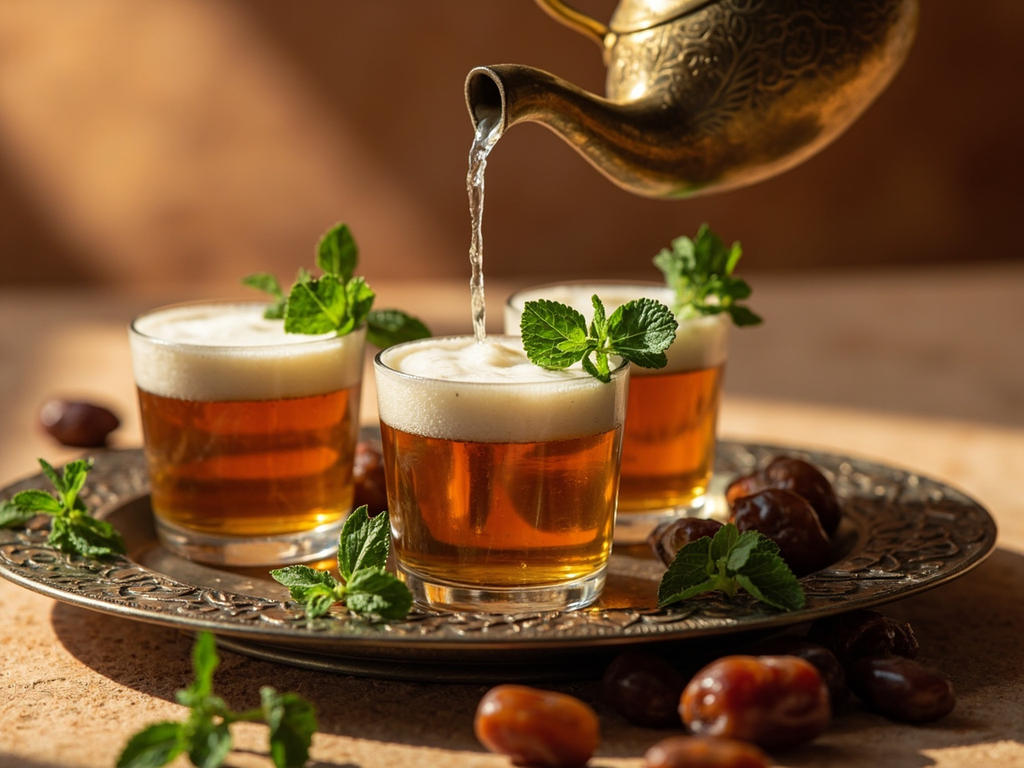
- Serve by raising the arm high, the stream as long as possible, to crown each glass with a fine foam. Taste and adjust sugar.
- Serve three rounds: tradition says you should not refuse any of the three glasses.
How it was made : In the Sahara, tea was prepared on a small charcoal brazier, right on the sand, and the ceremony could last an hour. The three glasses are said to be "bitter as life, sweet as love, suave as death." The high pour is not for show: it aerates and slightly cools the tea while forming the foam, a sign of tea served with care.
The contemporary twist : Serve in small decorated tea glasses on a engraved tray, with a plate of dates. In summer, add a sprig of frozen mint for a refreshing warm tea.
Sources : Antoine de Saint-Exupéry, Wind, Sand and Stars (1939) · Antoine de Saint-Exupéry, Southern Mail (1929)
Antoine de Saint-Exupéry · Charactorium