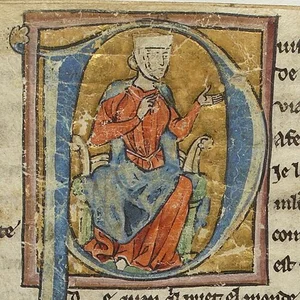

Daughter of King Louis VII and Eleanor of Aquitaine, Marie of Champagne was Countess of Champagne and one of the greatest patrons of letters in the 12th century. A patron of Chrétien de Troyes, she made her court at Troyes a radiant center of courtly literature.
Marie of Champagne(1145 — 1198)
Marie of France
France
6 min read
Frequently asked questions
Key Facts
- Born around 1145, the eldest daughter of King Louis VII of France and Eleanor of Aquitaine
- Married Henry I the Liberal, Count of Champagne, around 1159
- Commissioned Chrétien de Troyes's Lancelot, the Knight of the Cart (around 1177–1181)
- Regent of the County of Champagne during the absence and later the minority of her kin (1180s–1190s)
- Died in 1198
Works & Achievements
Marie commissioned and inspired this Lancelot romance, helping to crystallize the Arthurian legend and the ideal of courtly love.
She had a book of the Bible put into French verse, making learned culture accessible to laypeople in the vernacular Romance language.
Her court brought together poets, trouvères, and clerics; the treatise “On Love” by Andreas Capellanus made it the setting for her “judgments of love.”
During the pilgrimage and then after the death of Henry the Liberal, Marie governed the county and administered its affairs.
When her son Henry II left for the Crusade, she once again ruled one of the richest territories in the kingdom until her death.
Anecdotes
It was at the request of Marie of Champagne that Chrétien de Troyes wrote “Lancelot, the Knight of the Cart,” the romance in which Lancelot's love for Queen Guinevere appears. In his prologue, the poet himself acknowledges that the countess provided him with “the matter and the meaning” of the story: a rare case in which we know exactly which patron lies behind a medieval masterpiece.
Marie was the daughter of King Louis VII of France and Eleanor of Aquitaine. When her parents had their marriage annulled in 1152 and Eleanor married the future King Henry II of England, Marie found herself half-sister both to Richard the Lionheart (on her mother's side) and to King Philip Augustus (on her father's side): she was kin to the two rival royal families of Europe.
The treatise “On Love” by Andreas Capellanus stages, at the court of Troyes, genuine “judgments of love” handed down by great ladies. A verdict attributed to Marie, dated 1174, declares that true love cannot exist between a married couple: a refined literary game that shows how central a role the countess played in the courtly art of love.
On two occasions, Marie governed the county of Champagne on her own: first during the pilgrimage and then after the death of her husband Henry the Liberal, as regent for her young son; then again when that son, now grown, left for the Third Crusade and became King of Jerusalem. For years, a woman thus administered one of the richest territories in the kingdom.
Marie did not only patronize romances written for entertainment: she also commissioned the cleric Évrat to produce a French verse translation of the biblical book of Genesis. Carrying a sacred text over from Latin into the “Romance” vernacular was a new and daring undertaking, one that made learned culture accessible to a lay audience.
Primary Sources
Since my lady of Champagne wishes me to undertake the writing of a romance, I shall undertake it most willingly... Chrétien begins his book about the knight of the cart; the matter and the meaning are furnished and given to him by the countess.
We declare and affirm by the tenor of these presents that love cannot extend its rights over two married persons. Given in the year 1174, on the first day of May.
The clerk Évrat declares that he has undertaken to put the book of Genesis into the vernacular at the request of Countess Marie de Champagne, so that lay people might hear the divine word in their own language.
Key Places
Capital of the kingdom where the court of Louis VII resided; Marie was born there, the daughter of the king and Eleanor of Aquitaine.
Capital of the County of Champagne and Marie's principal residence; her court there became a great center of courtly literature.
Another major comital town of Champagne, famous for its fairs; the counts stayed there and exercised their power.
Church founded by her husband Henry the Liberal, which became the necropolis of the counts of Champagne where the comital family was buried.
Typical Objects

The courtly romances commissioned by Marie were copied by hand onto parchment and sometimes adorned with paintings. It is through such manuscripts that we know the work of Chrétien de Troyes.

During her regencies, Marie sealed her charters and orders with wax to authenticate them, like a lord wielding power in his own name.

The instrument of the jongleurs and trouvères who performed in the great hall of Troyes to accompany courtly songs and tales.

On these small boards coated with wax, clerks and poets jotted down drafts and first verses before copying them out fair onto parchment.

A long, fitted, and precious gown worn by a great lady of the 12th century; this refined garment was a sign of rank and of the court's taste.

A small pouch hung from the belt, often richly embroidered, an emblematic accessory of the courtly elegance of noble ladies.
School Curriculum
Vocabulary & Tags
Key Vocabulary
Daily Life
Morning
A countess's day began with mass in the palace chapel, followed by a reception of stewards and messengers. During her regencies, Marie heard petitions, dictated charters to her clerks, and settled disputes in the name of the county.
Afternoon
The afternoon might be devoted to falconry, horseback rides, or overseeing the household. It was also the time for reading aloud, when a clerk would recite a romance or freshly composed verses.
Evening
In the evening, dinner was served in the great hall among knights and guests. Jugglers and trouvères sang love songs and tales of adventure, accompanied by vielle and harp, sometimes followed by dancing.
Food
A great lady's table offered white bread, meats and game, fish on lean days, fruit, cheeses, and wine, all seasoned with costly spices from the East. Neither potato nor tomato, both unknown in Europe before the 16th century.
Clothing
Marie wore the *bliaut*, a long gown fitted at the waist and made of fine fabrics, covered by a lined mantle. A married woman covered her hair with a veil or a wimple, and completed her outfit with brooches, belts, and embroidered alms purses.
Housing
She lived in the comital palace of Troyes or the residences of Provins: vast stone dwellings arranged around a great ceremonial hall, hung with tapestries for warmth, where private life and the exercise of power intertwined.
Historical Timeline
Period Vocabulary
Liens externes & ressources
Références
Œuvres
Mécénat de Chrétien de Troyes — « Le Chevalier de la charrette »
vers 1177-1181
Commande de la traduction de la Genèse par Évrat
vers 1192
Cour de Troyes, foyer de l'amour courtois
vers 1170-1198
Première régence de Champagne
1179-1181
Seconde régence de Champagne
1190-1198