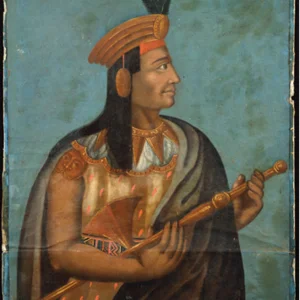

The last Inca emperor, Atahualpa seized power at the end of a civil war against his brother Huáscar. Captured by Francisco Pizarro's Spanish conquistadors in 1532, he was executed in 1533, marking the collapse of the Inca Empire.
Atahualpa(1500 — 1533)
Atahualpa
Empire inca
6 min read
Frequently asked questions
Key Facts
- Son of emperor Huayna Cápac, who died around 1527 of smallpox brought by the Europeans
- Won the civil war against his half-brother Huáscar around 1532
- Captured by Francisco Pizarro during the ambush at Cajamarca on 16 November 1532
- Gathered an enormous ransom of gold and silver for his release, in vain
- Executed by the Spanish on 26 July 1533, marking the end of the independent Inca Empire
Works & Achievements
Backed by the northern armies and his generals Quizquiz, Chalcuchimac and Rumiñahui, Atahualpa prevailed over his brother Huáscar and reunified the empire under his authority.
His troops seized his rival Sapa Inca near Cuzco, making Atahualpa the sole master of the Tawantinsuyu.
To secure his release, Atahualpa orchestrated the gathering of the largest ransom in history: a room filled once with gold and twice with silver, draining the treasures of the entire empire.
Even as a prisoner, Atahualpa continued to give orders to his generals and to administer the empire, proof of the nearly sacred authority of the Sapa Inca.
Atahualpa strengthened the hub of Quito and Tomebamba as a new center of power rivaling Cuzco, shifting the empire's balance toward the north.
Anecdotes
When Atahualpa was captured at Cajamarca in November 1532, he offered an extraordinary ransom: to fill a room once with gold and twice with silver, up to the height his hand could reach. The Incas gathered tons of precious metals from across the empire, but Pizarro had him executed all the same.
Atahualpa learned to play chess (or a European board game) during his captivity and impressed his Spanish jailers with how quickly he grasped the rules. According to the chroniclers, he also watched writing with amazement, guessing that the letters traced on paper could carry spoken words across a distance.
On the day of his capture, a Spanish priest handed him a Bible (or a breviary) and asked him to submit to God and the king of Spain. Atahualpa held the book to his ear, heard nothing, and threw it to the ground — a gesture the Spaniards used as a pretext to launch the massacre.
Sentenced to be burned at the stake, Atahualpa agreed at the last moment to be baptized a Christian in order to escape the flames, for according to Inca belief cremation would have prevented the survival of his body and his soul. He was then strangled with the garrote in July 1533 instead of being burned.
Atahualpa was carried on a golden litter by his servants, and no one was allowed to look him in the face: his status as Sapa Inca, son of the sun god Inti, made him a nearly divine being in the eyes of his people.
Primary Sources
Atahualpa said that he would fill the room in which he stood with gold, up to the height his raised hand could reach against the wall, and that he would fill it twice over with silver.
Atahualpa was a man of good understanding, quick of mind, and although unlettered he grasped readily the things that were shown to him.
The war between the two brothers Huáscar and Atahualpa bloodied the Tawantinsuyu and weakened it at the very moment the Spaniards were arriving.
No one could enter his presence without carrying a load on his back as a sign of humility, and no one ever looked him in the face.
Key Places
City in northern Peru where Atahualpa was captured during the Spanish ambush of 1532, then held, tried, and executed.
Capital of the empire's northern region, Atahualpa's stronghold and the base of his armies during the civil war against Huáscar.
Historic capital and religious heart of the Tawantinsuyu, controlled by Huáscar and then captured by Atahualpa's generals.
Hot springs near Cajamarca where Atahualpa and his army were camped at the time of the Spanish arrival.
Great Inca city in the south of present-day Ecuador, a favored residence of the dynasty; it was devastated during the civil war.
Typical Objects

Supreme insignia of the Sapa Inca: a fringe of red wool adorned with tassels and feathers, worn across the forehead. Only the reigning emperor had the right to wear it.

A bundle of knotted cords in different colors used to record the empire's accounts, censuses, and tributes. It was handled by specialists known as quipucamayocs.

A portable throne covered in gold and feathers on which the emperor was carried by servants. It was aboard his litter that Atahualpa entered the square of Cajamarca.

A ritual knife with a semicircular blade made of copper, bronze, or gold, used during Inca sacrifices and religious ceremonies.

An Inca weapon of war: a wooden shaft topped with a star-shaped head of stone or bronze. It was one of the main weapons of Atahualpa's armies.

A tunic of fine wool (cumbi) with woven geometric patterns, whose quality and designs indicated rank. The emperor's tunic was of exceptional fineness, sometimes blended with bat fur or other precious hairs.

A large ceramic jar with a pointed base and narrow neck, carried on the back with a rope, used to transport and store chicha (corn beer).
School Curriculum
Vocabulary & Tags
Key Vocabulary
Tags
Lieu
Daily Life
Morning
The Sapa Inca would wake in his guarded apartments and was washed and dressed by chosen servants. The morning might be devoted to receiving messengers (chasquis) bringing news from across the empire and to listening to reports from his governors.
Afternoon
In the afternoon, Atahualpa dispensed justice, gave military orders, and received nobles and ambassadors, who had to approach with lowered eyes and bearing a symbolic burden. He might also inspect his troops or visit the thermal baths.
Evening
The evening was marked by banquets where chicha was drunk in great quantity, accompanied by musicians and recitations of the dynasty's great deeds. The emperor would sometimes share the drink with the nobles as a mark of favor.
Food
The diet was based on maize, the potato, quinoa, beans, and chili pepper, supplemented with the meat of the llama, the guinea pig (cuy), and dried fish along the coast. Chicha, a fermented maize beer, accompanied meals and festivities.
Clothing
Atahualpa wore tunics (unku) of vicuña wool of rare fineness, with geometric patterns and adorned with gold and feathers. On his forehead he displayed the mascapaicha, the red fringe that was the emblem of supreme power; it is said that he never wore the same garment twice.
Housing
He resided in palaces with walls of perfectly fitted stone, sometimes faced with plates of gold, surrounded by courtyards, storehouses, and gardens. When he traveled, he lodged in the tambos, way stations laid out along the vast Inca road network.
Historical Timeline
Period Vocabulary
Liens externes & ressources
Références
Œuvres
Victoire dans la guerre civile inca
1529-1532
Capture de Huáscar
1532
La rançon de Cajamarca
1533
Gouvernement de l'empire depuis sa captivité
1532-1533
Consolidation de la base nordique de l'empire
vers 1530