Mesopotamia
Kings, goddesses and builders of Sumer, Babylon and Assyria — the cradle of writing and the first cities.
19 characters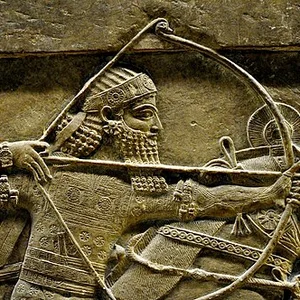
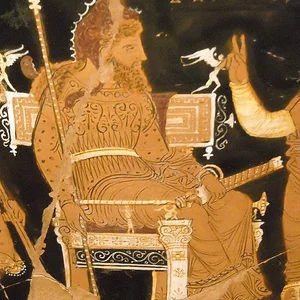

19 characters
Ashurbanipal
684 av. J.-C. — 630 av. J.-C.
Ashurbanipal was one of the last great kings of the Neo-Assyrian Empire, reigning from 669 to roughly 627 BC. A warrior and scholar king, he brought Assyria to its greatest territorial extent and founded at Nineveh a vast library gathering tens of thousands of cuneiform tablets.
Baal
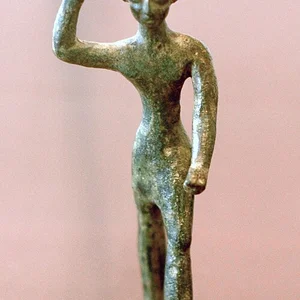
Supreme god of the Canaanite pantheon, master of rain, storms, and fertility. His cult was practiced across the ancient Near East from the 2nd millennium BCE and came into conflict with Hebrew monotheism. Demonized by the Abrahamic traditions, he became a demonic figure in medieval texts.
Cyrus II
599 av. J.-C. — 529 av. J.-C.
Founder of the Persian Achaemenid Empire in the 6th century BCE, Cyrus II unified the Median and Persian peoples. Renowned for his tolerance toward conquered peoples, he notably freed the Jewish captives held in Babylon.
Dagon
Dagon is a Semitic deity worshipped by the Philistines and Canaanites, associated with fertility and the harvest. His cult is attested throughout the ancient Near East, notably at Ugarit and Gaza. He was later reinterpreted as a demonic figure in Christian literature and in John Milton's Paradise Lost.
Darius I
549 av. J.-C. — 485 av. J.-C.
Darius I (c. 549–485 BC) was the third great king of the Achaemenid Persian Empire. He expanded the empire to its greatest territorial extent, from the Indus River to Thrace, and profoundly reorganized its administration. He was defeated by the Greeks at the Battle of Marathon in 490 BC.
Énheduana
High priestess of the moon at Ur and daughter of Sargon of Akkad, Enheduana is the first known author in history. Around 2300 BCE, she composed hymns to the goddess Inanna and songs for the Sumerian temples, laying the foundations of religious literature.
Enheduanna
2300 av. J.-C. — 2300 av. J.-C.
Enheduanna, high priestess of the moon god at Ur and daughter of Sargon of Akkad, is the first known author in history. Around 2300 BCE, she composed hymns to the goddess Inanna of rare poetic power, laying the foundations of world religious literature.
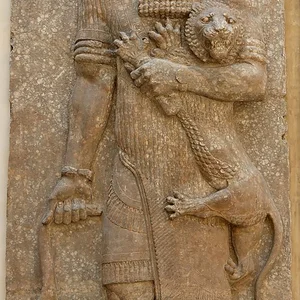
Gilgamesh
Gilgamesh is a legendary king of Sumer, whose story is told in the Epic of Gilgamesh, the oldest known literary text in human history. This Mesopotamian work explores themes of friendship, the quest for immortality, and the human condition in the face of death.
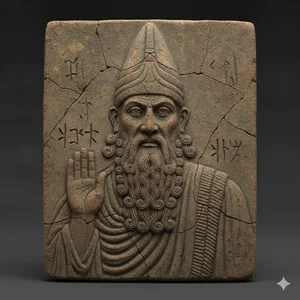
God (Yahweh)
Principal deity of the ancient Hebrew religion, Yahweh is the one God worshiped by the Israelites. His cult, attested from the 2nd millennium BCE, structures the foundational narratives of the Hebrew Bible and gives rise to Abrahamic monotheism.
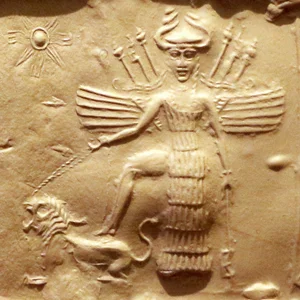
Inanna
Sumerian goddess of love, war, and fertility, venerated in Mesopotamia since the 4th millennium BCE. She is the best-documented female deity of the ancient world, celebrated in cuneiform hymns among the oldest known literary texts. Her cult, centered on the city of Uruk, influenced the religious traditions of the ancient Near East.

Inanna / Ishtar
Inanna (Sumerian) or Ishtar (Akkadian) is the great goddess of love, war, and fertility in ancient Mesopotamia. She stands at the heart of many foundational myths, including the famous Descent into the Underworld. Her cult, one of the most important in the ancient Near East, spans more than three millennia.
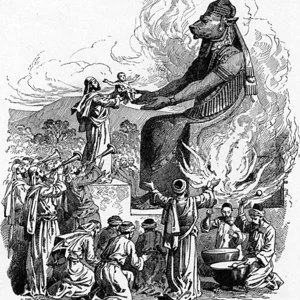
Moloch
A Canaanite Semitic deity associated with child sacrifice, Moloch is mentioned in the Bible as an abhorrent idol. Depicted as a bull or a bronze statue, he became in Judeo-Christian and literary tradition the symbol of idolatrous cruelty.
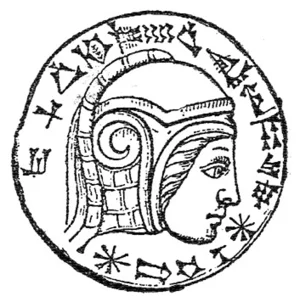
Nebuchadnezzar II
641 av. J.-C. — 561 av. J.-C.
King of Babylon from 604 to 562 BC, Nebuchadnezzar II brought the Neo-Babylonian Empire to its height. He conquered Jerusalem, destroyed the Temple of Solomon, and deported the Hebrews to Babylonia. A great builder, he is associated with the legendary Hanging Gardens of Babylon.
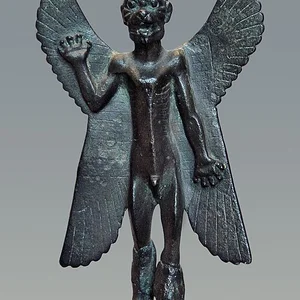
Pazuzu
Pazuzu is a Mesopotamian demon of the evil wind, depicted with a canine face, raptor wings, and a hybrid body. Paradoxically, he was invoked as a protector against Lamashtu, the demon of childbirth. His image adorned amulets to protect pregnant women and newborns.

Sammu-ramat (Semiramis)
Regent of the Assyrian Empire around 811–808 BC, Sammu-ramat held power in the name of her son Adad-nirari III. A historical figure, she quickly became a legendary character in the Greek world, symbolizing the warrior queen and great builder of the ancient Near East.
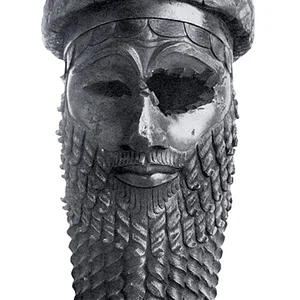
Sargon of Akkad
2350 av. J.-C. — 2300 av. J.-C.
Sargon of Akkad (c. 2334–2279 BCE) was the founder of the first empire in history, the Akkadian Empire. Rising from humble origins according to legend, he unified Mesopotamia under his rule and governed a territory stretching from the Persian Gulf to the Mediterranean.
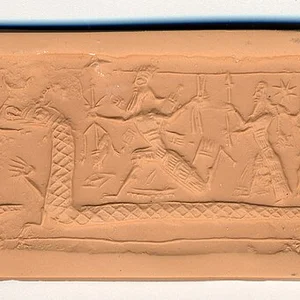
Tiamat
Primordial Babylonian goddess personifying the salt ocean and original chaos. In the Enuma Elish, the Mesopotamian creation epic, she is defeated by the god Marduk, whose body is used to create the sky and the earth.
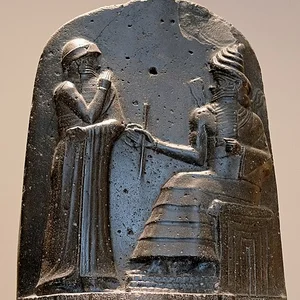
Hammurabi
1809 av. J.-C. — 1749 av. J.-C.
Sixth king of Babylon (1792–1750 BC), Hammurabi transformed a small kingdom into a regional empire. He is best known for promulgating the Code of Hammurabi, one of the oldest written compilations of laws in history.
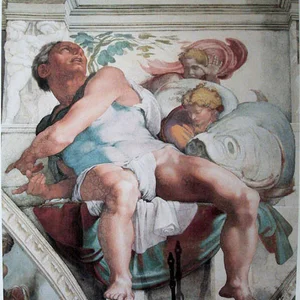
Jonas
822 av. J.-C. — 719 av. J.-C.
A biblical prophet from the kingdom of Israel (8th century BCE), Jonah is known for being sent by God to Nineveh to preach repentance. According to the Book of Jonah, he was swallowed by a great fish after attempting to flee his divine mission.