
Behemoth is a monstrous creature from the Hebrew Bible, described as a colossal, primordial land beast. In the Book of Job, God invokes it to illustrate his omnipotence before humankind. Jewish tradition makes it the terrestrial counterpart of the sea monster Leviathan.
Behemoth
Behemoth
7 min read
Frequently asked questions
Famous Quotes
« Behold now behemoth, which I made with thee; he eateth grass as an ox.»
Key Facts
- Appears in the Book of Job (chapter 40), a text likely composed between the 6th and 4th centuries BCE
- Described as a land beast of colossal strength, grazing on grass, with bones like tubes of bronze
- Together with Leviathan (a sea monster), forms a pair of primordial creatures of chaos in Jewish tradition
- Rabbinic tradition makes it an animal reserved for the feast of the righteous at the end of time
- Its Hebrew name (behemot) is a plural of intensity literally meaning “the beasts,” evoking the beast par excellence
Works & Achievements
Founding text in which God describes Behemoth and then Leviathan to answer Job. It is the biblical source of the entire tradition about the beast.
The first text to clearly distinguish Behemoth (land) from Leviathan (sea) and to place them in specific mythical locations.
Jewish apocrypha that introduce the idea of the feast of the end times, when the two monsters will be eaten by the righteous.
Develops the legends of Behemoth grazing on a thousand mountains and of his final clash with Leviathan.
The English poet names Behemoth “biggest born of earth” there, among the creatures of Creation.
An essay on the English Civil War, conceived as the counterpart to Leviathan: the monster symbolizes chaos and civil disorder.
A plate from the Illustrations of the Book of Job, a famous image showing the two monsters framed by divine power.
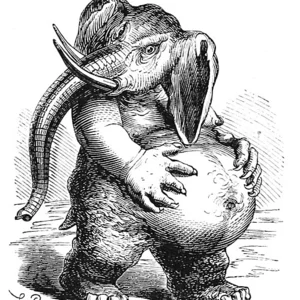
Ranks Behemoth among the demons and fixes his popular image as a potbellied monster with an elephant's head, the demon of gluttony.
Anecdotes
The name “Behemoth” is actually a Hebrew plural of the word behemah, which means “beast” or “animal.” In Hebrew, putting a word in the plural is sometimes a way of magnifying it: Behemoth therefore means something like “the beast of beasts,” the super-beast. The name alone heralds a monster of colossal size.
In the Book of Job, God does not tell a story about Behemoth: he uses the creature to silence Job. From the heart of a storm, he describes this being that no one can capture or tame, to show man just how small he is before the power of Creation.
Jewish tradition forms a trio of primordial monsters: Behemoth rules over the dry land, Leviathan over the sea, and the Ziz over the sky. According to several texts, at the end of time their flesh will be served as a feast to the righteous at the great messianic banquet.
For centuries, scholars have wondered whether Behemoth describes a real animal: the way it grazes on grass and wallows in the marshes calls to mind the hippopotamus or the elephant. But the detail of the “tail stiff as a cedar” continues to divide the experts.
In the 19th century, the demonologist Collin de Plancy turned Behemoth into a demon of gluttony in his Dictionnaire infernal, depicting him as a big monster with an elephant's head and a plump belly — a far cry from the wild and powerful beast of the Bible.
Primary Sources
Behold Behemoth, which I made along with you: he feeds on grass like the ox. His strength is in his loins, and his vigor in the muscles of his belly. He stiffens his tail like a cedar; his bones are tubes of bronze.
On that day, two monsters will be separated from one another: a female monster, named Leviathan, to dwell in the depths of the sea; and a male monster, named Behemoth, which occupies with its breast an immense desert named Dendain.
Then you preserved two creatures: you named one Behemoth and the other Leviathan. You separated them from one another... To Behemoth you gave one of the parts that were dried up on the third day, where the thousand mountains are.
And Behemoth will come forth from its place, and Leviathan will rise from the sea, these two great monsters which I created on the fifth day of creation, and which I have kept until that time; then they will serve as food for all who remain.
The sages teach that Behemoth grazes each day on the grass of a thousand mountains, and that these mountains grow back their pasture during the night, so that the beast always finds something to feed on.
Key Places
According to the Book of Enoch, Behemoth occupies with his breast a vast desert named Dendain, located to the east of the Garden of Eden. It is his mythical home on dry land.
The Book of Job imagines Behemoth confident in the waters: he stays calm even when the Jordan rushes into his mouth, as he lies among the reeds. The real river serves here as a backdrop for the beast.
Rabbinic tradition places Behemoth upon a thousand mountains whose grass serves as his daily pasture. These mythical heights convey the vast extent of his territory.
The site of the end-times banquet where, according to Jewish texts, the flesh of Behemoth will feed the righteous. It is an eschatological space, outside ordinary time.
In the Dictionnaire Infernal, Behemoth becomes a demon of Hell, guardian of feasts and gluttony. This place marks his transformation into a diabolical figure.
Typical Objects

In the Book of Job, only the one who made Behemoth can approach it with his sword. It symbolizes God's exclusive power over the beast that no man can master.

Behemoth grazes on grass like an ox and, according to the Talmud, devours each day the pasture of a thousand mountains, which grow back during the night. This limitless food highlights its colossal size.

The Book of Job describes Behemoth lying in the shade of the lotuses, hidden among the marsh reeds. This leafy lair places it at the water's edge, in a primordial setting.

Several texts announce that at the end of time the flesh of Behemoth, along with that of Leviathan, will be served as a banquet to the righteous. The object becomes a symbol of reward and of a renewed world.

In late demonological imagery, Behemoth is sometimes depicted blowing into a horn. The instrument echoes his reputation as a noisy demon and a leader of feasts.

Demonology makes Behemoth the great cupbearer in charge of the infernal banquets. The cup then symbolizes his role as the demon of gluttony and the table.
School Curriculum
Vocabulary & Tags
Key Vocabulary
Tags
Daily Life
Morning
At daybreak, Behemoth leaves the shadow of the reeds to reach the mountains. According to the Talmud, there it grazes on the grass of a thousand hills, like a gigantic ox, without ever exhausting its pasture.
Afternoon
During the hottest hours, the beast comes back down to the marshes and wallows in the mud, sheltered beneath the lotuses. The Book of Job shows it confident and calm, even when the river swells around it.
Evening
In the evening, Behemoth lies down among the reeds and the willows of the stream. During the night, says Jewish legend, the mountains it has grazed grow their grass back again for the next day.
Food
Behemoth is herbivorous: it “eats grass like an ox,” the Book of Job tells us. Far from being a predator, it is a peaceful mass that devours entire meadows.
Clothing
As a primordial beast, Behemoth wears nothing: its “finery” is its own body. The text praises its bones “like tubes of bronze” and its limbs “like bars of iron.”
Housing
Its home is the wilderness: a mythical desert named Dendain, the banks of a river, and a bed of reeds in the marshes. No human enclosure could ever contain it.
Historical Timeline
Period Vocabulary
Liens externes & ressources
Références
Œuvres
Livre de Job (chapitres 40-41)
VIe-IVe siècle av. J.-C.
Livre d'Hénoch (1 Hénoch, ch. 60)
IIe-Ier siècle av. J.-C.
Quatrième livre d'Esdras et Apocalypse de Baruch
fin du Ier siècle ap. J.-C.
Talmud de Babylone, traité Baba Batra (74b-75a)
IIIe-Ve siècle ap. J.-C.
Le Paradis perdu, de John Milton
1667
Behemoth, de Thomas Hobbes
1681
Béhémoth et Léviathan, gravure de William Blake
1826