
Belle Starr (1848-1889) was an American outlaw of the Wild West, nicknamed the “Bandit Queen.” A fence, horse thief, and associate of several gangs in the Indian Territory, she became a legendary figure popularized by the sensationalist press and dime novels.
Belle Starr(1848 — 1889)
Belle Starr
États-Unis
6 min read
Frequently asked questions
Key Facts
- Born on February 5, 1848, in Missouri under the name Myra Maybelle Shirley
- Connected to the James brothers and the Younger brothers, former Confederate soldiers turned outlaws, after the Civil War
- Married Sam Starr, a Cherokee, in 1880 and settled in the Indian Territory (present-day Oklahoma)
- Convicted in 1883 for horse theft by Judge Isaac Parker, the “Hanging Judge” of Fort Smith
- Shot and killed on February 3, 1889, near Eufaula, in a murder that was never solved
Works & Achievements
More than a thief herself, Belle Starr offered shelter, horses, and connections to the bandits of Indian Territory, acting as a hub for local outlawry.
The only solidly documented criminal act of her life; it permanently shaped her reputation and provided the raw material for her later legend.
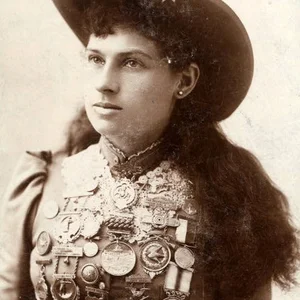
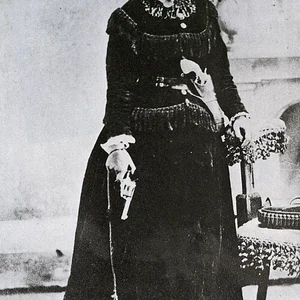
Belle Starr posed armed and richly dressed; these widely circulated images helped forge her public persona.
A sensational novel published just after her death that invented most of her legend and propelled her to the status of a Wild West icon, despite numerous inaccuracies.
Belle Starr became a recurring character in films and tales of the West, notably the film Belle Starr (1941), durably anchoring the myth of the woman outlaw.
Anecdotes
Belle Starr was not really named Belle: she was born Myra Maybelle Shirley, into a well-to-do Missouri family that owned an inn in Carthage. The Civil War ruined the Shirleys and tipped the young woman over to the side of the outlaws.
Her reputation as the “Bandit Queen” owes a great deal to the New York press of Richard K. Fox, who in 1889, a few months after her death, published a sensational novel portraying her as a terrifying criminal. The historical reality is far more modest: she is known mainly for receiving stolen goods and a single horse theft.
In 1883, Belle Starr and her husband Sam Starr were tried for horse theft by the famous judge Isaac Parker, nicknamed the “Hanging Judge,” at the Fort Smith court. She was given two six-month prison sentences: this is the only truly documented conviction of her career.
From a young age, Belle Starr kept company with figures of banditry: her brother Bud served in the Southern guerrilla bands, and the family rubbed shoulders with the Youngers and the Jameses. Legend claims she had an affair with Cole Younger, but no solid evidence confirms it.
On February 3, 1889, two days before her 41st birthday, Belle Starr was shot in the back and killed as she rode home near her house at Younger's Bend. Her murder was never solved: neighbors, her stepson, and enemies were all suspected, but no one was ever convicted.
Primary Sources
Belle Starr, the Bandit Queen, was perhaps the most desperate woman that ever figured on the borders. Of her almost nothing was known until she was made famous by the boldness of her crimes.
Sam Starr and Belle Starr, convicted of larceny of horses in the Indian Territory, sentenced each to two terms of six months' imprisonment.
Belle Starr, the noted woman of the Indian Territory, was shot and killed near her home at Younger's Bend on the 3d of February, the assassin firing from ambush.
Key Places
Birthplace of Myra Maybelle Shirley, where her family ran an inn before being ruined by the Civil War.
Where the Shirley family settled after fleeing Missouri, and where Belle became involved with outlaw circles.
Isolated farm on the Canadian River where Belle Starr lived with Sam Starr and which became the center of her legend. She was killed nearby.
Seat of Judge Isaac Parker's federal court, the “Hanging Judge,” where Belle Starr was tried and convicted of horse theft in 1883.
Facility where Belle and Sam Starr served part of their sentence after their conviction, far from the Indian Territory.
Typical Objects

An iconic handgun of the West, which Belle Starr carried openly. She loved to be photographed and described armed, carefully crafting her image as a dangerous woman.

A lady's saddle allowing one to ride in a long skirt. Belle Starr was reputed to be an excellent rider and moved about constantly on horseback in Indian Territory.

Belle Starr cultivated a striking appearance, combining velvet outfits, an adorned hat, and weapons. This concern for showmanship fed her legend.

At the heart of the economy and crime of the West, the horse was the prize of the thefts that earned Belle Starr her only documented conviction.

A cheap little book sold in great numbers, which turned ordinary outlaws into legendary heroes or monsters. It was this genre that made Belle Starr the “Bandit Queen.”
School Curriculum
Vocabulary & Tags
Key Vocabulary
Tags
Daily Life
Morning
On her isolated farm at Younger's Bend, the day began early with the chores of a ranch in Indian Territory: tending and feeding the horses, caring for the livestock, and keeping up the log house. An excellent rider, Belle traveled a great deal on horseback.
Afternoon
The afternoon might be spent riding to trading posts or neighboring settlements, receiving visitors who were sometimes wanted by the law, or managing family affairs. The line between lawful activity and harboring stolen goods remained blurry.
Evening
In the evening, gathered around the hearth, the family and passing guests shared meals and news. In a territory with no town nearby, the house served as both a refuge and a place to socialize.
Food
Meals relied on what the frontier could provide: salt pork and game, corn and cornbread, beans, and strong coffee. Fresh produce depended on the seasons and the rare trips to the trading post.
Clothing
Belle Starr took care with her appearance: she liked to wear velvet dresses, a plumed hat, and openly displayed firearms, a striking contrast with the rough clothing of ranch life. This showy elegance fed her legend.
Housing
She lived at Younger's Bend, an isolated log house on the bank of the Canadian River in Indian Territory (present-day Oklahoma). Its distance from the authorities made it an ideal hideout for outlaws passing through.
Historical Timeline
Period Vocabulary
Liens externes & ressources
Références
Œuvres
Carrière de recéleuse et d'organisatrice de hors-la-loi
années 1870-1880
Condamnation pour vol de chevaux (procès devant le juge Parker)
1883
Photographies de studio mettant en scène la « Bandit Queen »
années 1880
Bella Starr, the Bandit Queen (roman de Richard K. Fox)
1889