 flip
flipPoached Pike with Verjuice and Parsley
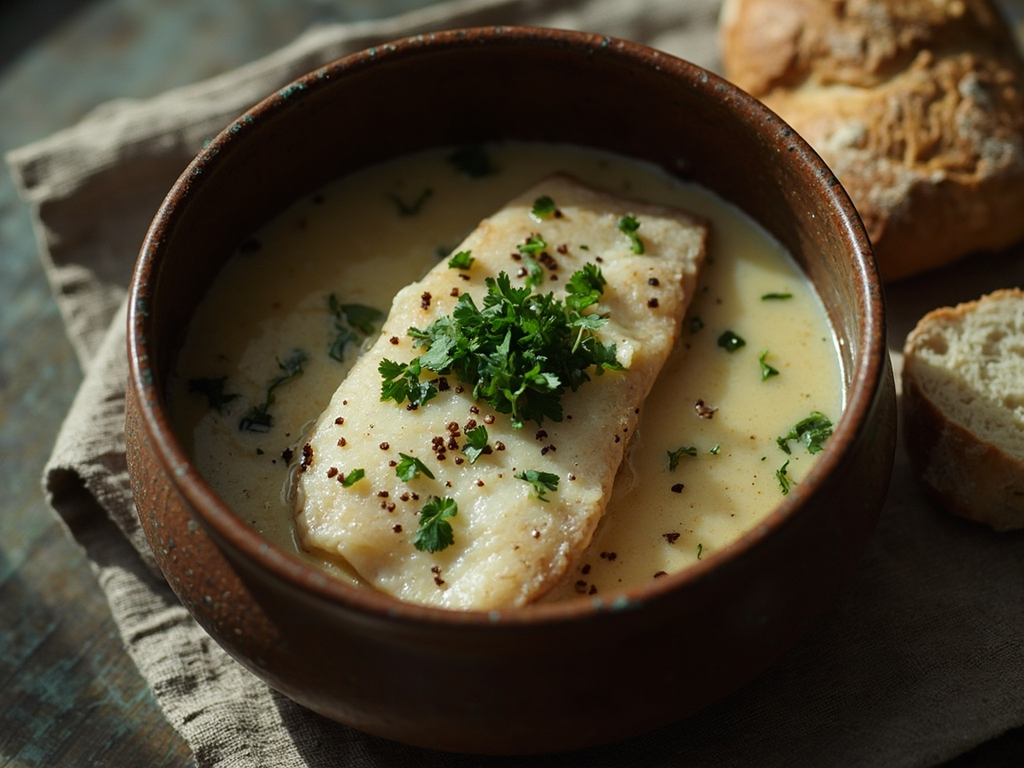
Poached Pike with Verjuice and Parsley
Why this dish? Robert II the Pious multiplied fasts and imposed them on his entourage; on lean days, meat gave way to freshwater fish. For Berthe, whose union was closely scrutinized by the Church, this penitential fish speaks of the devout daily life of the court, punctuated by fasts and pious charters.
A freshwater fish gently poached in a verjuice court-bouillon, sprinkled with parsley and touched with a hint of ginger: simple, clear, in keeping with the monastic rules that the king imposed on himself.
On fast days, and God knows they are many under my lord Robert, no meat in my house: the pike from our fishponds is brought. I want it cooked in barely simmering water, without excess, seasoned only with verjuice and parsley, for penitence does not forbid cleanliness of taste. Eat it with a white wheat bread, and let this sobriety serve as your prayer.
- •Pike or freshwater carp — a fine fish (lean day meat)
- •Verjuice — a splash (acidity for court-bouillon)
- •Fresh parsley — a handful (aromatic herb)
- •Ginger — a pinch (discreet spice)
- •Onion — one (flavoring for broth)
- •Salt — to taste (seasoning)
Poached Pike with Verjuice and Parsley
A freshwater fish gently poached in a verjuice court-bouillon, sprinkled with parsley and touched with a hint of ginger: simple, clear, in keeping with the monastic rules that the king imposed on himself.
Why this dish? Robert II the Pious multiplied fasts and imposed them on his entourage; on lean days, meat gave way to freshwater fish. For Berthe, whose union was closely scrutinized by the Church, this penitential fish speaks of the devout daily life of the court, punctuated by fasts and pious charters.
On fast days, and God knows they are many under my lord Robert, no meat in my house: the pike from our fishponds is brought. I want it cooked in barely simmering water, without excess, seasoned only with verjuice and parsley, for penitence does not forbid cleanliness of taste. Eat it with a white wheat bread, and let this sobriety serve as your prayer.
Ingredients (period version)
- Pike or freshwater carp — a fine fish (lean day meat)
- Verjuice — a splash (acidity for court-bouillon)
- Fresh parsley — a handful (aromatic herb)
- Ginger — a pinch (discreet spice)
- Onion — one (flavoring for broth)
- Salt — to taste (seasoning)
Ingredients
- Pike, zander, or carp fillets or steaks — 600 g (main fish)
- Verjuice (or grape juice + 1 dash vinegar) — 100 ml (acidity)
- Flat-leaf parsley — 1 small bunch (fresh herb)
- Ground ginger — 1 pinch (spice)
- Onion — 1 (broth aromatic)
- Water — 1 liter (court-bouillon)
- Salt — to taste (seasoning)
Method
- Bring water to a simmer with the sliced onion, verjuice, salt, and a pinch of ginger; let infuse for 10 min.
- Gently lower the fish pieces into the barely simmering court-bouillon.
- Poach gently for 8 to 10 min without boiling, to keep the flesh tender.
- Drain carefully, sprinkle with chopped parsley, and drizzle with a spoonful of strained broth.
- Serve warm with good white wheat bread.
How it was made : The medieval Christian calendar forbade meat for more than a hundred days a year. Seigneurial and monastic fishponds supplied pike, carp, and tench; they were cooked simply, in water or verjuice, since butter and cream were also forbidden on strict fast days.
The contemporary twist : Plate the fish on a bed of watercress and coat with a verjuice emulsion for a dish as pale and luminous as an illuminated manuscript.
Berthe de Bourgogne · Charactorium