 flip
flipSvendborg Herring Smørrebrød
Svendborg Herring Smørrebrød
Why this dish? Driven out by Nazism, Brecht lived his Danish exile in Svendborg (1933-1939), where he wrote part of his major work. Smørrebrød — open-faced sandwich with pickled herring, a pillar of the Danish lunch — was the bread of this modest Nordic exile, shared with the émigré community.
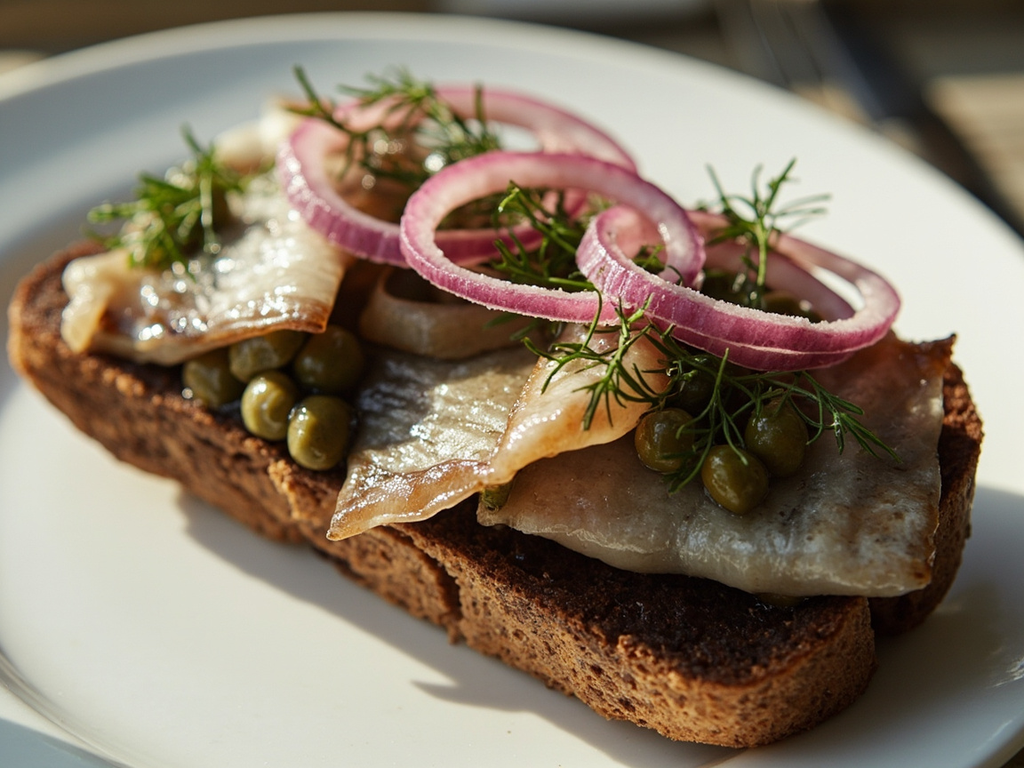
A slice of dense rye bread buttered, topped with pickled herring, onion, and dill. The open Danish lunch, frugal and salty-sour, that nourished the exile years in Denmark.
Exile teaches you to eat what the land gives you. In Denmark, by the sea, it was herring — that poor man's fish, pickled in vinegar to last. You take your black bread, butter it thick, lay the glistening fish on top, raw onion, a sprig of dill, and you eat without a set table, among the other outcasts. It's not the homeland, but it feeds the thinking man — and a sour fish is better than a swastika on your back.
- •Pickled herring (vinegar) — a few fillets (salty-sour topping)
- •Dense rye bread — slices (base)
- •Butter — generously (barrier and binder)
- •Raw onion — a little (bite)
- •Dill — a few sprigs (freshness)
Svendborg Herring Smørrebrød
A slice of dense rye bread buttered, topped with pickled herring, onion, and dill. The open Danish lunch, frugal and salty-sour, that nourished the exile years in Denmark.
Why this dish? Driven out by Nazism, Brecht lived his Danish exile in Svendborg (1933-1939), where he wrote part of his major work. Smørrebrød — open-faced sandwich with pickled herring, a pillar of the Danish lunch — was the bread of this modest Nordic exile, shared with the émigré community.
Exile teaches you to eat what the land gives you. In Denmark, by the sea, it was herring — that poor man's fish, pickled in vinegar to last. You take your black bread, butter it thick, lay the glistening fish on top, raw onion, a sprig of dill, and you eat without a set table, among the other outcasts. It's not the homeland, but it feeds the thinking man — and a sour fish is better than a swastika on your back.
Ingredients (period version)
- Pickled herring (vinegar) — a few fillets (salty-sour topping)
- Dense rye bread — slices (base)
- Butter — generously (barrier and binder)
- Raw onion — a little (bite)
- Dill — a few sprigs (freshness)
Ingredients
- Pickled herring fillets (rollmops or vinegar herring) — 4 fillets (salty-sour topping)
- Danish rye bread (rugbrød) — 4 slices (base)
- Salted butter — 40 g (barrier and binder)
- Red onion — 1/2, thinly sliced into rings (bite)
- Fresh dill — 1 small bunch (freshness)
- Capers — 1 tbsp (tangy accent (optional))
Method
- Butter the rye bread slices generously, right to the edges (butter prevents the bread from getting soggy).
- Drain the herring fillets and arrange them on the bread.
- Distribute the onion rings and a few capers.
- Sprinkle with chopped dill and pepper.
- Serve immediately, to be eaten with fork and knife in Danish fashion.
How it was made : Smørrebrød has structured the Danish lunch since the 19th century: traditionally starting with fish (herring), then meat, then cheese, each open sandwich eaten in order. Pickled herring, abundant and cheap in the Baltic Sea, was a staple of coastal regions — and therefore of penniless exiles.
The contemporary twist : A dollop of sour cream (smetana) under the herring and a mandoline of quick-pickled onion transform the exile's tartine into a refined Nordic bite.
Bertolt Brecht · Charactorium