
Bhūmi Devi is the goddess of the Earth in Hindu mythology, the personification of the nurturing planet. Wife of the god Vishnu, she is also known by the names Bhūdevi or Prithvi. She embodies the patience, fertility, and generosity of the earth.
Bhumi Devi
Bhūmi Devi (भूमि देवी)
6 min read
Frequently asked questions
Key Facts
- Divine personification of the Earth in Hinduism, present as early as the Vedic hymns (Rigveda, around 1500 BCE)
- Wife of Vishnu, she forms with Lakshmi one of his two principal consorts
- Mother of Naraka (Narakasura) and, in some traditions, associated with Sītā, regarded as an incarnation of the Earth in the Rāmāyana
- Worshipped as Prithvi, the nurturing goddess who guarantees the fertility of the soil and the harvests
- Central figure in the myth of the avatar Varaha, in which Vishnu as a boar rescues her from the primordial waters
Works & Achievements
Founding tale in which Bhumi Devi, saved from the waters by Vishnu's boar avatar, becomes the symbol of the Earth protected by the divine.
A long hymn from the *Atharva Veda* celebrating the nurturing Earth; regarded as a forerunner of ecological thought.
Bhumi Devi, mother of the demon Naraka, accepts the death of her son slain by Krishna, illustrating the balance between justice and compassion.
The final episode of the *Ramayana*, in which the Earth receives Sita, her daughter, into her bosom, sealing the bond between the goddess and the heroine.
A rich body of statuary showing the Earth goddess supported by Varaha or placed beside Vishnu, a lasting iconographic model.
Anecdotes
In the Vishnu Purana, Bhūmi Devi is rescued from the primordial waters by Vishnu incarnated as a giant boar, Varāha. The god dives to the bottom of the cosmic ocean, lifts the Earth up on his tusks, and brings it back to the surface to set it back in its place in the cosmos.
According to several traditions, Bhūmi Devi is the mother of the demon Naraka (Narakāsura). When Krishna, an avatar of Vishnu, kills this tyrannical son, the goddess accepts the death of her child because she recognizes divine justice — illustrating the idea that the Earth bears good as well as evil.
In the Rāmāyana, the heroine Sītā, regarded as a daughter of the Earth, chooses at the end of the epic to return to the womb of her mother Bhūmi: the ground opens and swallows her up, marking her refusal to prove her purity yet again.
Many Hindu texts recommend reciting a prayer of apology to Bhūmi Devi every morning before setting foot on the ground, to ask her forgiveness for having to walk upon her all day long.
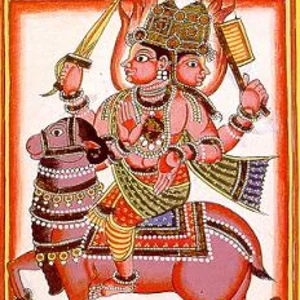
Bhūmi Devi is often depicted seated on an elephant or holding lotus flowers, and she is sometimes shown supporting the whole Earth, sometimes being the personified Earth herself.
Primary Sources
May Heaven and Earth, benevolent parents, grant us their protection; vast, broad and deep, they sustain all creatures.
The Earth that bears the oceans, the rivers and the waters, upon which food and tilled fields arise, which sustains all that breathes and moves, may she grant us preeminence.
The lord Vishnu, having taken the form of the boar Varaha, raised up the Earth submerged beneath the waters and restored her to her place, while the goddess Prithvi praised him.
Then the Earth opened, and Sita, welcomed by her mother seated upon a throne, was carried away into the depths before the eyes of the assembled gathering.
Key Places
The infinite waters from which Vishnu, in the form of the boar Varaha, raises the submerged Earth at the beginning of the world cycle.
Celestial abode of Vishnu where, in the Vaishnava tradition of southern India, Bhudevi stands at the god's side together with Lakshmi.
Cave site in central India home to a famous Gupta-era relief showing Varaha lifting the Earth goddess.
Kingdom where, according to the Ramayana, King Janaka finds Sita in a furrow while ploughing, making her the daughter of the Earth.
Great Vaishnava shrine in southern India where Vishnu is worshipped flanked by his two wives, including Bhudevi, the Earth goddess.
Typical Objects
Sacred flower held by Bhūdevi, a symbol of purity, fertility and life springing forth from earth and water.

A fruit full of seeds sometimes held by the goddess, evoking abundance, fertility and the nourishing generosity of the earth.

The tusks of the divine boar on which Vishnu lifts Bhūmi Devi out of the primordial waters to save her.

A ritual container filled with water, grains and leaves, used during Bhumi Puja ceremonies in honor of the Earth.

Bhūmi Devi is often depicted seated on or carried by an elephant, an animal associated with strength, rain and the prosperity of the earth.

Harvests and cereals that embody the Earth's nourishing gift to living beings, offered back in return during agricultural rites.
School Curriculum
Vocabulary & Tags
Key Vocabulary
Daily Life
Morning
As a cosmic goddess, Bhūmi Devi has no human daily routine, but the faithful begin their day by greeting her: before setting foot on the ground, they recite a prayer asking forgiveness for walking upon her. At dawn, farmers honor the earth of the fields they are about to plow.
Afternoon
In the afternoon, in the villages, the Earth is called upon through agricultural labor; she is thanked for the harvests during sowing and reaping. The Bhumi Puja ceremonies, which ask the goddess for permission before digging or building, may be held at any hour deemed auspicious.
Evening
In the evening, offerings of flowers, grains, and water are placed on household altars or at the foot of sacred trees. The Puranic tales of Varaha and Sita are told to children to pass on the respect owed to Mother Earth.
Food
Bhūmi Devi has no diet of her own: she is herself the source of all nourishment. The offerings made to her — rice, milk, fruit, honey, and grains — symbolize the earth's gift returned to the goddess as a sign of gratitude.
Clothing
In iconography, she is dressed in rich, colorful fabrics and adorned with golden jewelry, a crown, and necklaces, signs of her divine nature and of abundance. Her skin is sometimes depicted as dark green or earth-colored.
Housing
Her “dwelling” is the Earth itself, but in the Vaishnava tradition she also resides in Vaikuntha, the celestial palace of Vishnu. She is depicted seated on a lotus or carried by an elephant.
Historical Timeline
Period Vocabulary
Liens externes & ressources
Références
Œuvres
Le sauvetage de la Terre par Varâha
mythe fixé vers Ier-Ve siècle apr. J.-C.
Hymne à la Terre (Bhûmi Sûkta)
vers 1000 av. J.-C.
Maternité de Naraka
récit puranique
Le retour de Sîtâ dans la Terre
Râmâyana, vers IVe s. av. - IIe s. apr. J.-C.
Représentations de Bhūdevi dans l'art Gupta et médiéval
IVe-XIIe siècle apr. J.-C.