 flip
flipPayasa — Rice Pudding with Jaggery and Cardamom
Payasa — Rice Pudding with Jaggery and Cardamom
Why this dish? Payasa (ancestor of kheer) is the dessert of offering and celebration in ancient India, served on great occasions and temple ceremonies. For a Brahmin of Ujjain like Brahmagupta, it was prepared on holy days and astronomical festivals marking the solstices he calculated.
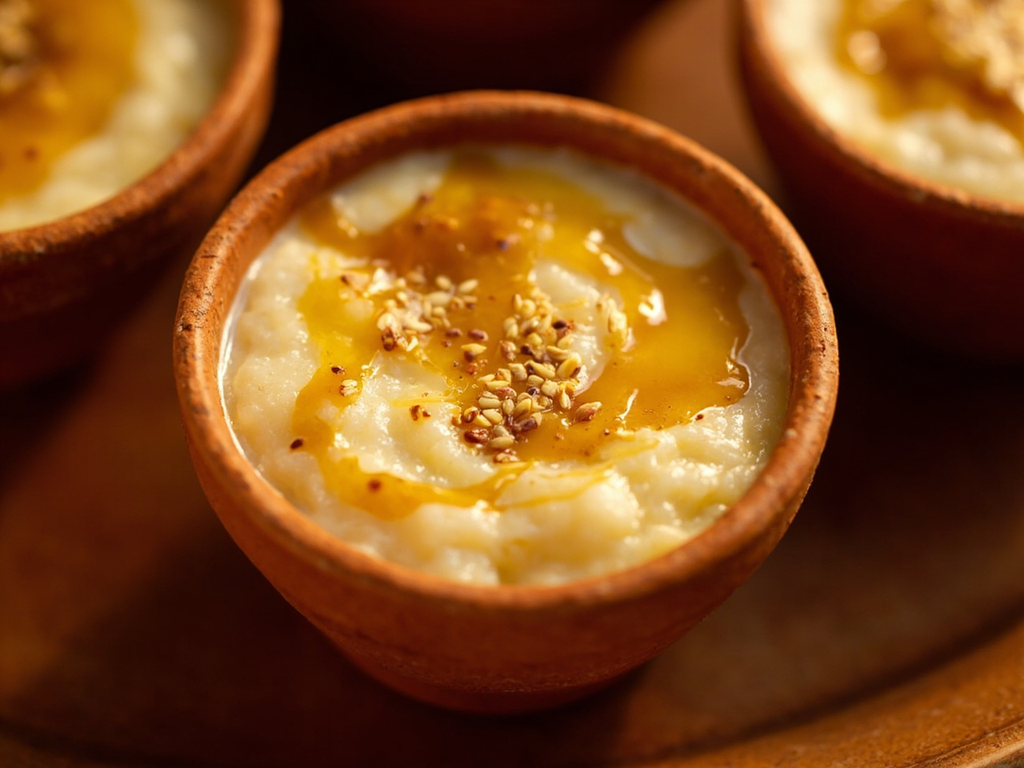
Rice slowly simmered in milk until thickened, sweetened with jaggery (unrefined cane sugar), perfumed with cardamom, and sprinkled with toasted sesame. A deep sweetness, both food for men and offering to the gods.
On the days when the sun reaches its highest point — that point I calculate with my gnomon planted in the courtyard — my house prepares payasa. Reduce the milk over a patient fire, long and slow, as one waits through a difficult calculation; when it has thickened, melt in the golden gur and the breath of elâ seeds. Sweeten only at the end, never over a high flame, else the milk turns and the offering is wasted. This sweet I first share with the sacred fire, then with my pupils who chant the rules of zero.
- •Rice (shali) — a handful (cereal)
- •Cow's milk (kshira) — in abundance (base)
- •Jaggery/cane sugar (guda) — as needed (sweetness)
- •Cardamom (elâ) — a few pods (fragrance)
- •Sesame seeds (tila) — a pinch (garnish)
- •Ghee — a little (aromatic binder)
Payasa — Rice Pudding with Jaggery and Cardamom
Rice slowly simmered in milk until thickened, sweetened with jaggery (unrefined cane sugar), perfumed with cardamom, and sprinkled with toasted sesame. A deep sweetness, both food for men and offering to the gods.
Why this dish? Payasa (ancestor of kheer) is the dessert of offering and celebration in ancient India, served on great occasions and temple ceremonies. For a Brahmin of Ujjain like Brahmagupta, it was prepared on holy days and astronomical festivals marking the solstices he calculated.
On the days when the sun reaches its highest point — that point I calculate with my gnomon planted in the courtyard — my house prepares payasa. Reduce the milk over a patient fire, long and slow, as one waits through a difficult calculation; when it has thickened, melt in the golden gur and the breath of elâ seeds. Sweeten only at the end, never over a high flame, else the milk turns and the offering is wasted. This sweet I first share with the sacred fire, then with my pupils who chant the rules of zero.
Ingredients (period version)
- Rice (shali) — a handful (cereal)
- Cow's milk (kshira) — in abundance (base)
- Jaggery/cane sugar (guda) — as needed (sweetness)
- Cardamom (elâ) — a few pods (fragrance)
- Sesame seeds (tila) — a pinch (garnish)
- Ghee — a little (aromatic binder)
Ingredients
- Short-grain or basmati rice — 60 g (cereal)
- Whole milk — 1 liter (base)
- Grated jaggery (gur) — 100 g (sweetness)
- Ground green cardamom — 1/2 tsp (fragrance)
- Sesame seeds — 1 tbsp (garnish)
- Ghee — 1 tsp (binder)
Method
- Rinse rice and sauté 1 min in ghee in a heavy-bottomed pan.
- Pour in milk, bring to a simmer then cook over low heat 35-45 min, stirring often to prevent sticking.
- When rice is tender and milk thickened, remove from heat and let cool 5 min.
- Stir in grated jaggery off the heat until dissolved (never over high heat, or milk may curdle).
- Add cardamom, mix.
- Dry-toast sesame seeds, sprinkle over payasa, and serve warm or chilled.
How it was made : Refined sugar existed in India (the word 'sugar' comes from Sanskrit sharkara), but brown jaggery was the daily sweetener. Flavored with cardamom, saffron, and long pepper; vanilla and chocolate, from the Americas, were unknown. Payasa was offered as naivedya before being eaten.
The contemporary twist : Add a few saffron threads and serve in small terracotta cups (kulhar): payasa retains the taste of a 7th-century solstice.
Sources : K.T. Achaya, A Historical Dictionary of Indian Food, Oxford University Press, 1998
Brahmagupta · Charactorium