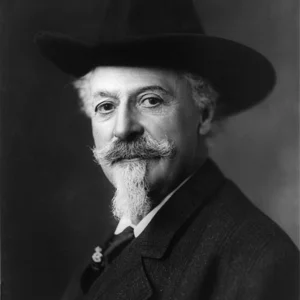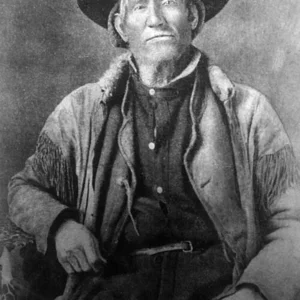

American trapper, guide, and explorer, an iconic figure among the “mountain men” of the Rockies. In 1824, he was one of the first Anglo-Americans to reach the Great Salt Lake. He founded Fort Bridger, a key way station on the western trails.
Jim Bridger(1804 — 1881)
Jim Bridger
États-Unis
6 min read
Frequently asked questions
Key Facts
- Born in 1804 in Virginia, he joined Ashley's fur-trading expedition on the Missouri as early as 1822
- In 1824-1825, he became one of the first Anglo-Americans to see the Great Salt Lake (Utah)
- He explored and described the area of the future Yellowstone Park, long dismissed as far-fetched
- In 1843, he founded Fort Bridger (Wyoming), a supply post on the Oregon and California trails
- Died in 1881 in Missouri, after guiding numerous military and settler expeditions
Works & Achievements
One of the first Anglo-Americans to reach and describe the Great Salt Lake, contributing to geographic knowledge of the West.
Establishment of a trading post that became an essential stop on the Oregon, California, and Mormon Trails.
Identification of a pass that shortened the crossing of the Rockies, later followed by the telegraph and the transcontinental railroad.
Led the survey expedition of the Great Salt Lake, for which he pointed out new passable routes.
Guided the official exploration of the Yellowstone basin and the Yellowstone River for the U.S. Army.
Laid out an alternative and safer route to the gold mines of Montana, avoiding the territories in conflict with the Lakota.
Anecdotes
In 1823, when he was only 19, the young Bridger was assigned along with another trapper to watch over Hugh Glass, a companion horribly mauled by a grizzly bear and believed to be dying. The two men eventually abandoned him, taking his rifle with them. But Glass survived, crawled for hundreds of miles, and came back to haunt the legend of the West — Bridger, for his part, was forgiven on account of his youth.
Around 1824-1825, while following the Bear River to win a bet among trappers, Bridger came upon an immense expanse of salt water: the Great Salt Lake. Tasting the water and finding it briny, he believed for a moment that he had reached an arm of the Pacific Ocean. He was one of the first Anglo-Americans to lay eyes on it.
Bridger was famous for his extraordinary tales about the region of the future Yellowstone Park: bubbling geysers, steaming springs, a “petrified forest” with petrified birds singing songs of stone. People laughed at his exaggerations, but many of his descriptions of the geothermal area proved accurate years later.
In 1843, Bridger founded a trading post with his partner Louis Vasquez, Fort Bridger, on the Oregon Trail. This way station became a vital stop for the thousands of pioneers, Mormons, and gold-seekers crossing the Rockies: wagons were repaired there, and horses and provisions could be bought.
Bridger could neither read nor write, but he possessed a prodigious geographic memory: he could draw astonishingly accurate maps of vast territories on a hide or in the ashes. He also spoke several Native American languages, as well as the French and Spanish he had picked up from the other trappers.
Primary Sources
Bridger, who served as guide to the expedition, was described as the man with the best knowledge of the Rocky Mountains, able to describe from memory regions he had not seen in years.
Bridger could neither read nor write, yet his knowledge of the mountains and the plains was so precise that he could draw maps of remarkable accuracy on the ground or on a hide.
The guide Bridger pointed out a new pass through the mountains, shorter and more practicable for wagons than the route then followed by the emigrants.
Key Places
City where Jim Bridger was born in 1804, before his family emigrated west, settling near St. Louis in Missouri.
Vast saltwater lake in present-day Utah that Bridger reached around 1824-1825, briefly believing he had touched an arm of the Pacific.
Trading post founded by Bridger in 1843 on the Oregon Trail, a vital waystation for emigrants crossing the Rockies.
Geothermal area of the Rockies whose geysers and bubbling springs Bridger described, long dismissed as tall tales.
Pass through the Rocky Mountains discovered by Bridger in 1850, offering a shorter route for wagons and later for the railroad line.
Place where Bridger retired to a farm and died in 1881, nearly blind, far from the mountains he had roamed.
Typical Objects

Short, heavy-barreled black powder rifle, prized by the mountain men for its accuracy and power against bison or grizzly bears. It was the trapper's trusted weapon in the wilderness.

Steel jaw trap set underwater along the banks to capture beavers, whose fur was highly sought after. It was the trapper's primary tool of the trade.

Large knife with a sturdy blade used to butcher game, skin beavers, and prepare hides. Indispensable, it could also become a close-combat weapon.

Fringed leather outfit (buckskin) sewn in the Native American fashion, resistant to brambles and cold. The fringes helped rainwater run off.

Soft leather shoes learned from Native American peoples, allowing one to walk silently and feel the ground. The trapper made and repaired them himself.

Container made from a hollowed-out cattle horn, used to keep black powder dry and to measure it out for loading the rifle. The trapper carried it slung over the shoulder.
School Curriculum
Vocabulary & Tags
Key Vocabulary
Tags
Daily Life
Morning
At camp, the trapper rises before dawn to check the beaver traps he set the day before in the icy river waters. He must skin the animals he has caught and stretch the hides on wooden frames.
Afternoon
The afternoon is spent traveling on horseback or on foot toward new beaver streams, hunting bison or deer for meat, and scouting the terrain. Bridger was constantly memorizing waterways, mountain passes, and landmarks.
Evening
In the evening, around the fire, they would dry meat, repair traps and moccasins, and swap stories. Bridger was famous for his extraordinary tales that helped pass the long nights.
Food
The diet relied above all on wild game: bison, deer, beaver, and sometimes horse or dog in times of famine. They also ate pemmican (dried meat pounded together with fat) and berries, while bread and vegetables were scarce.
Clothing
Bridger wore fringed leather clothing (buckskin) in the Native American style, moccasins, a hat or a fur cap, and a blanket for the cold. The outfit was practical, mended and made on the spot.
Housing
In the mountains, his dwelling was a tent, a shelter of branches, or a simple bivouac under the stars. Later, at Fort Bridger, he lived in the log cabins of the trading post he had founded.
Historical Timeline
Period Vocabulary
Liens externes & ressources
Références
Œuvres
Atteinte du Grand Lac Salé
1824-1825
Fondation de Fort Bridger
1843
Découverte de Bridger Pass
1850
Guide de l'expédition Stansbury
1850
Guide de l'expédition Raynolds
1859-1860
Ouverture du Bridger Trail
1864