 flip
flipAsh-Roasted Murnong and Creek Fish
Ash-Roasted Murnong and Creek Fish
Why this dish? Murnong (yam daisy, Microseris) was a staple food for the peoples of Victoria, dug by the thousands along creek banks and billabongs. The fish comes from the same waters that the Bunyip is said to guard: a meal drawn from the edge of the waterhole.
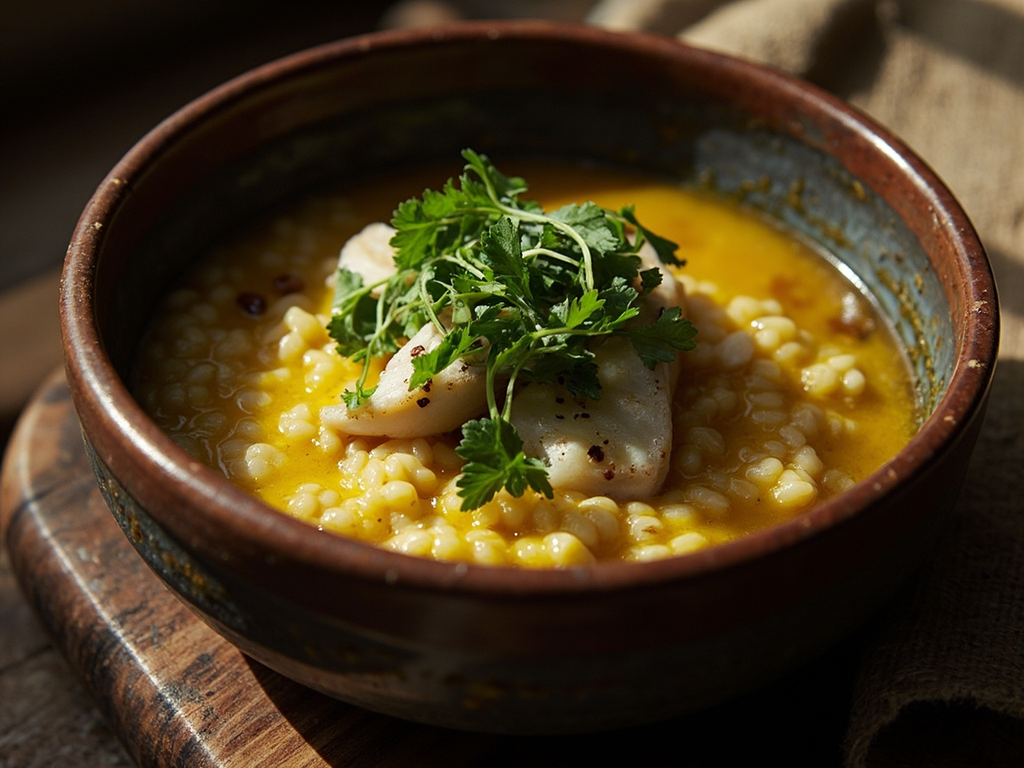
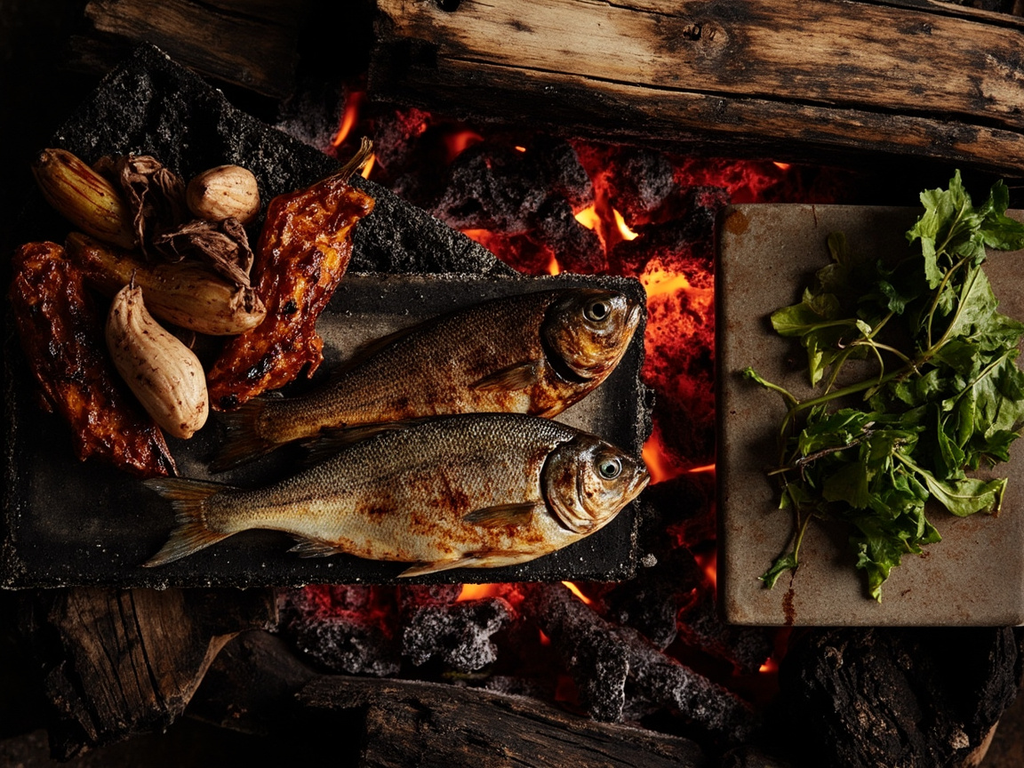
A small sweet root that caramelizes under the ashes, served with a freshwater fish laid directly on the coals. The confit sweetness of the root answers the smoky flesh of the fish: the simplest, most nourishing daily fare of billabong country.
I lie hidden in the brown water, where people come to scrape the soft earth for sweet roots. Come close, but not too close: I see your footprints in the mud. The murnong is roasted under the ash until it turns to syrup, and the fish is laid on the coals, scales against the fire. Eat quickly, and keep an eye on the dark water—for what feeds the shore also belongs to me.
- •Murnong tubers (yam daisy) — a good handful per person (sweet root, base of the meal)
- •Freshwater fish (blackfish, small Murray cod) — one per person (protein, freshly caught)
- •River mint (Mentha australis) — a few sprigs (flavoring)
- •Warrigal greens (sea spinach) — a handful (greens)
Ash-Roasted Murnong and Creek Fish
A small sweet root that caramelizes under the ashes, served with a freshwater fish laid directly on the coals. The confit sweetness of the root answers the smoky flesh of the fish: the simplest, most nourishing daily fare of billabong country.
Why this dish? Murnong (yam daisy, Microseris) was a staple food for the peoples of Victoria, dug by the thousands along creek banks and billabongs. The fish comes from the same waters that the Bunyip is said to guard: a meal drawn from the edge of the waterhole.
I lie hidden in the brown water, where people come to scrape the soft earth for sweet roots. Come close, but not too close: I see your footprints in the mud. The murnong is roasted under the ash until it turns to syrup, and the fish is laid on the coals, scales against the fire. Eat quickly, and keep an eye on the dark water—for what feeds the shore also belongs to me.
Ingredients (period version)
- Murnong tubers (yam daisy) — a good handful per person (sweet root, base of the meal)
- Freshwater fish (blackfish, small Murray cod) — one per person (protein, freshly caught)
- River mint (Mentha australis) — a few sprigs (flavoring)
- Warrigal greens (sea spinach) — a handful (greens)
Ingredients
- Small sweet roots (salsify or new parsnips, if murnong unavailable) — 400 g (root, base)
- Whole gutted trout or perch — 2 (approx. 300 g each) (protein)
- Fresh mint — a few sprigs (flavoring)
- Young spinach leaves — 2 handfuls (greens)
- Neutral vegetable oil — 1 tbsp (cooking)
Method
- Prepare good embers (barbecue or wood fire with red-hot coals, no flames).
- Wrap the roots in aluminum foil (or damp bark) and slide them under the hot ashes for 25–30 minutes, until tender and caramelized.
- Lightly oil the fish, stuff the mint inside the cavity, and place on a grill over the embers for 4–6 minutes per side, depending on thickness.
- Wilt the greens for one minute on the hot edge of the grill.
- Serve the fish with scales removed, the roots split and crushed, and the greens on top.
How it was made : Settlers described entire plains dotted with digging holes where women harvested murnong with digging sticks. The root, raw, is slightly bitter; slowly cooked under ash or in an earth oven, it becomes sweet and syrupy. Fish was simply cooked on the coals, with no added salt.
The contemporary twist : Serve the confit roots with a dash of finger lime juice, whose tart pearls burst like billabong water bubbles.
Sources : Beth Gott, « Ecology of Root Use by the Aborigines of Southern Australia », Archaeology in Oceania, 1982 · Bill Gammage, The Biggest Estate on Earth, Allen & Unwin, 2011 · Bruce Pascoe, Dark Emu, Magabala Books, 2014
Bunyip · Charactorium