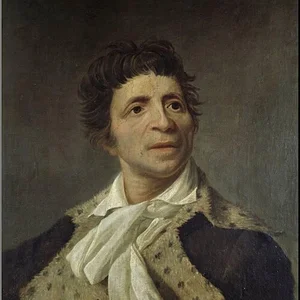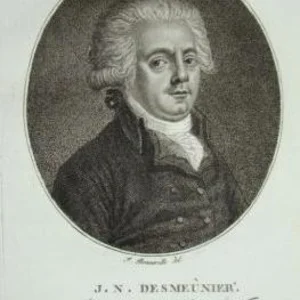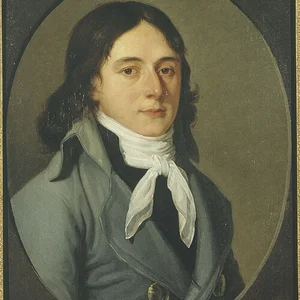

French lawyer, journalist and politician, a figure of the Revolution. An orator at the Palais-Royal in July 1789, he was one of the most influential pamphleteers of his time before being guillotined alongside the Indulgents in 1794.
Camille Desmoulins(1760 — 1794)
Camille Desmoulins
France
6 min read
Frequently asked questions
Key Facts
- Born on 2 March 1760 in Guise (Picardy)
- On 12 July 1789, harangued the crowd at the Palais-Royal, calling people to arms two days before the storming of the Bastille
- Founded and wrote the newspaper Les Révolutions de France et de Brabant (1789-1791)
- Launched the newspaper Le Vieux Cordelier in 1793-1794, calling for clemency in the face of the Terror
- Guillotined on 5 April 1794 alongside Danton and the Indulgents
Works & Achievements
A bold pamphlet calling for the establishment of a republic, published shortly after the storming of the Bastille.
A satirical pamphlet that earned him the nickname “Attorney General of the Lamppost,” evoking the popular hangings of the time.
A hugely successful weekly newspaper blending current events, satire, and revolutionary ideas, which built his reputation as a journalist.
A scathing pamphlet against the Girondins that contributed to their downfall and condemnation.
His most famous work: seven issues pleading for clemency and against the Terror, which sealed his fate.
An improvised speech that galvanized the Parisian crowd two days before the storming of the Bastille — the founding act of his legend.
Anecdotes
On 12 July 1789, upon learning that Necker had been dismissed, Camille Desmoulins leapt onto a table at a café in the Palais-Royal, a pistol in hand, and harangued the crowd, shouting “To arms!” A stammerer from birth, he suddenly stopped stuttering under the surge of emotion. Two days later, the Bastille fell.
To rally the crowd at the Palais-Royal, Desmoulins plucked a green leaf from a tree and pinned it to his hat as a cockade, the color of hope. The crowd immediately followed suit, and green briefly became the symbol of the insurrection — before being abandoned, as it was also the color of the livery of the Count of Artois, the king's brother.
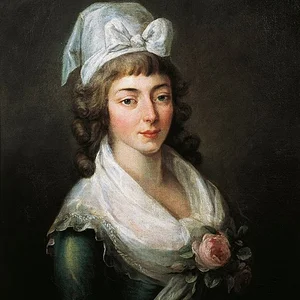
Camille Desmoulins married Lucile Duplessis in 1790 at a wedding where Robespierre was one of the witnesses. Their love was famous; when Camille was guillotined on 5 April 1794, Lucile herself was arrested and executed eight days later, accused of having plotted to free him.
In his journal Le Vieux Cordelier, in late 1793, Desmoulins dared to call for clemency and an end to the Terror, quoting the Roman historian Tacitus to denounce tyranny. This courage cost him his life: his former friend Robespierre turned against him and had him sent before the revolutionary tribunal.
At his trial, Camille Desmoulins bitterly declared that he was “thirty-three years old, the age of the sans-culotte Jesus,” underscoring the irony of being condemned by the Republic he had helped to found. He climbed the scaffold with his shirt torn, after having resisted the executioner.
Primary Sources
“You want to exterminate all your enemies by the guillotine! But was there ever greater folly? Can you put a single one to death on the scaffold without making ten enemies of his family or his friends?”
“The word republic has toppled thrones everywhere... a government in which all citizens are electors and eligible for office, that is what seems best to me.”
“O lamppost, you who lit the way so well on the 14th of July, by you alone are the traitors and the enemies of the people punished.”
“The happiness I had dreamed of for my country has fled from me. Farewell, my Lucile, my dear Lucile... I feel the shore of life slipping away, I still see Lucile, I see her, my beloved.”
Key Places
Birthplace of Camille Desmoulins, in the Aisne, where he was born in 1760 into a family of lawyers.
Prestigious school where he studied alongside the young Robespierre, his future companion and later adversary.
Site of his famous speech on 12 July 1789, a seething hotbed of pre-revolutionary political agitation.
Political society where Desmoulins campaigned alongside Danton and Marat, the cradle of Parisian popular democracy.
Today's Place de la Concorde, where he was guillotined on 5 April 1794 along with the Indulgents.
Prison on the Île de la Cité where he was held before his trial and execution.
Typical Objects

A tree leaf and then a green ribbon worn by Desmoulins at the Palais-Royal on 12 July 1789, a symbol of hope and a rallying sign for insurrection.

The tools of the pamphleteer's daily writing, with which he wrote his fiery articles and revolutionary newspapers.

A periodical founded in late 1793 in which Desmoulins pleaded for clemency and an end to the Terror, which led to his downfall.

A typographic machine that enabled the mass distribution of revolutionary pamphlets and newspapers in Paris.

A red cap worn by the revolutionaries, which became the emblem of liberty and of the sans-culottes.

A weapon brandished by Desmoulins during his Palais-Royal speech to dramatize his call to arms.
School Curriculum
Vocabulary & Tags
Key Vocabulary
Daily Life
Morning
A lawyer and then a journalist, Camille often began his morning by reading the news and writing his articles. In his Parisian apartment, he filled page after page destined for the printer, his pen lively and his wit biting.
Afternoon
The afternoon took him to the Palace of Justice, to the sessions of the Convention, or to the Cordeliers Club. There he debated with Danton and crossed paths with Robespierre, taking part in the decisions that made and unmade the Revolution.
Evening
In the evening, he reunited with his wife Lucile and their friends for lively dinners where they set the world to rights. These gatherings blended impassioned political discussions, readings, and family tenderness.
Food
Like the Parisian bourgeoisie of his time, he ate bread, soups, and meat when his finances allowed, and drank wine. The cafés of the Palais-Royal, where coffee and lemonade were served, were his meeting places.
Clothing
He wore the attire of the revolutionary citizen: a dark frock coat, a waistcoat, breeches or trousers, a ruffled shirt, and sometimes the Phrygian cap or the tricolor cockade. His outfit displayed his commitment to the ideals of the Republic.
Housing
He lived in a bourgeois Parisian apartment, near the revolutionary heart of the capital. The dwelling, shared with Lucile, also served as a study where his pamphlets were written.
Historical Timeline
Period Vocabulary
Liens externes & ressources
Références
Œuvres
La France libre
1789
Discours de la lanterne aux Parisiens
1789
Révolutions de France et de Brabant
1789-1791
Histoire des Brissotins
1793
Le Vieux Cordelier
1793-1794
Discours du Palais-Royal
12 juillet 1789