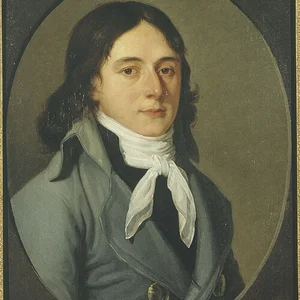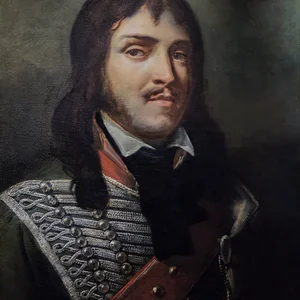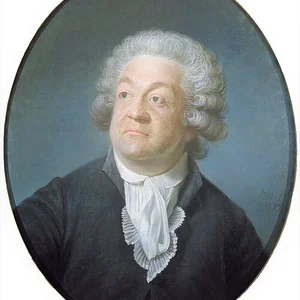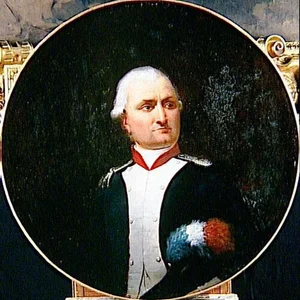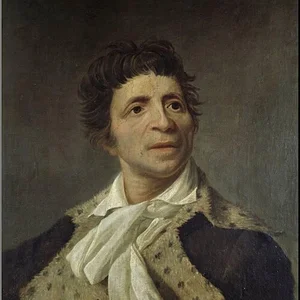

A physician, physicist, and journalist who became one of the most radical figures of the French Revolution. Founder of the newspaper L'Ami du peuple, he served as a Montagnard deputy in the National Convention before being assassinated in his bath by Charlotte Corday in 1793.
Jean-Paul Marat(1743 — 1793)
Jean-Paul Marat
France
6 min read
Frequently asked questions
Key Facts
- Born in 1743 in Boudry (Principality of Neuchâtel), he worked as a physician before the Revolution
- Founded the newspaper L'Ami du peuple in 1789, the radical voice of the sans-culottes
- Elected deputy for Paris to the National Convention in 1792, sitting with the Montagnards
- Acquitted by the Revolutionary Tribunal in April 1793 during his trial
- Assassinated on 13 July 1793 in his bathtub by Charlotte Corday
Works & Achievements
Political essay denouncing despotism and urging peoples to beware of tyrants: a text foreshadowing his revolutionary struggles.
Research in physics through which Marat hoped to gain recognition from the Academy of Sciences, which rejected his work.
Pamphlet published at the start of the Revolution setting out his ideas for reforms in favor of the people.
Newspaper founded and written by Marat, the main platform of the sans-culottes and a major instrument of his political influence.
Legal work in which Marat proposes a reform of criminal law, more humane and favorable to poor defendants.
Anecdotes
Before becoming a revolutionary, Marat was a respected physician and physicist: he treated the stables of the Count of Artois (the king's brother) and conducted experiments on fire, electricity, and light. Offended that the Academy of Sciences refused to recognize his work, he held a lasting grudge against the official scholars.
Marat suffered from a very painful skin disease (probably a chronic dermatitis caught during his years in hiding in the sewers and cellars of Paris). To ease his itching, he spent long hours in his bathtub, where he continued to write his articles: it was there that Charlotte Corday stabbed him on 13 July 1793.
His newspaper *L'Ami du peuple* earned him many enemies. Threatened with arrest several times, Marat had to hide for months and constantly change his lodgings, which worsened his illness. He often signed his texts simply “the Friend of the People,” a nickname that became his public identity.
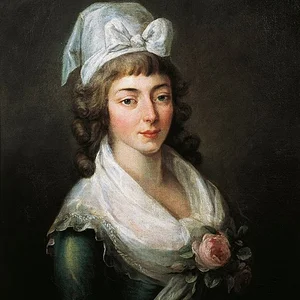
Charlotte Corday, a young Norman woman close to the Girondins, secured a meeting by claiming she would hand over the names of deputies to denounce. Received in the bathroom, she struck him with a single knife blow to the heart. Arrested on the spot, she was guillotined four days later.
After his death, Marat became a true martyr of the Revolution: the painter Jacques-Louis David created a famous painting, *The Death of Marat*, and his body was for a time transferred to the Panthéon in 1794, before being removed in 1795 when the Terror was disavowed.
Primary Sources
“Five or six hundred severed heads would have assured you repose, freedom and happiness.” In it, Marat defends swift, drastic measures against the enemies of the Revolution.
A political work in which Marat denounces despotism and urges peoples to be wary of tyrants and their plots against liberty.
A pamphlet published at the start of the Revolution, in which Marat sets out his ideas on the reforms that were needed and the defense of the people's rights.
“I killed one man to save a hundred thousand.” A statement attributed to Charlotte Corday during her trial before the Revolutionary Tribunal.
Key Places
Marat's birthplace, in present-day Switzerland, where he was born in 1743 into a modest family.
The district where Marat lived and worked, at the heart of the Cordeliers Club. It was in his apartment that he was assassinated.
The assembly where Marat sat as a Montagnard deputy for Paris from 1792, championing radical positions.
The city where Marat practiced medicine and published several political works, including The Chains of Slavery, before the Revolution.
The monument where Marat's ashes were transferred in 1794 as a martyr of the Revolution, before being removed from it in 1795.
Typical Objects

An elongated copper bathtub in which Marat worked to relieve his skin disease. It was there that he was assassinated, which made it an emblematic object of his death.

A printed sheet produced and distributed by Marat to denounce the enemies of the Revolution and defend the sans-culottes. His main weapon of political influence.

A weapon bought by Charlotte Corday at the Palais-Royal, with which she stabbed Marat through the heart with a single blow on 13 July 1793.

The instruments with which Marat wrote his articles, sometimes resting on a board laid across his bathtub. A symbol of the tireless journalist.

Devices used by Marat before the Revolution for his experiments on fire, electricity and light, which he hoped to have recognized by the Academy of Sciences.

A blue-white-red badge worn by revolutionaries to display their attachment to the nation and to the Revolution.
School Curriculum
Vocabulary & Tags
Key Vocabulary
Daily Life
Morning
During his years in hiding, Marat often woke up in cellars or makeshift lodgings, keeping watch for arrests. He began early in the day reading the news from Paris and preparing the articles for his newspaper.
Afternoon
His days were devoted to the relentless writing of *L'Ami du peuple*: drafting denunciations, reading letters from his readers, and meeting with activists from the revolutionary clubs.
Evening
In the evening, he continued his work of printing and distribution, sometimes late into the night, despite his exhaustion and the pain of his skin disease.
Food
Sick and often reclusive, Marat ate frugally; his fragile health and his clandestine way of life left little room for regular meals. It is reported that he mostly ate simple foods.
Clothing
Toward the end of his life, Marat wore modest clothing, sometimes just a simple cloth or a dressing gown, because of his disease; he had given up the refined attire of his time as a court physician.
Housing
After a youth spent traveling (Switzerland, England, France) and a comfortable period as a physician, he spent his final years in modest lodgings in the **Cordeliers** district of Paris, where he was assassinated.
Historical Timeline
Period Vocabulary
Liens externes & ressources
Références
Œuvres
Les Chaînes de l'esclavage
1774
Découvertes sur le feu, l'électricité et la lumière
1779-1782
Offrande à la patrie
1789
L'Ami du peuple
1789-1793
Plan de législation criminelle
1780