 flip
flipGarden Vegetable Soup
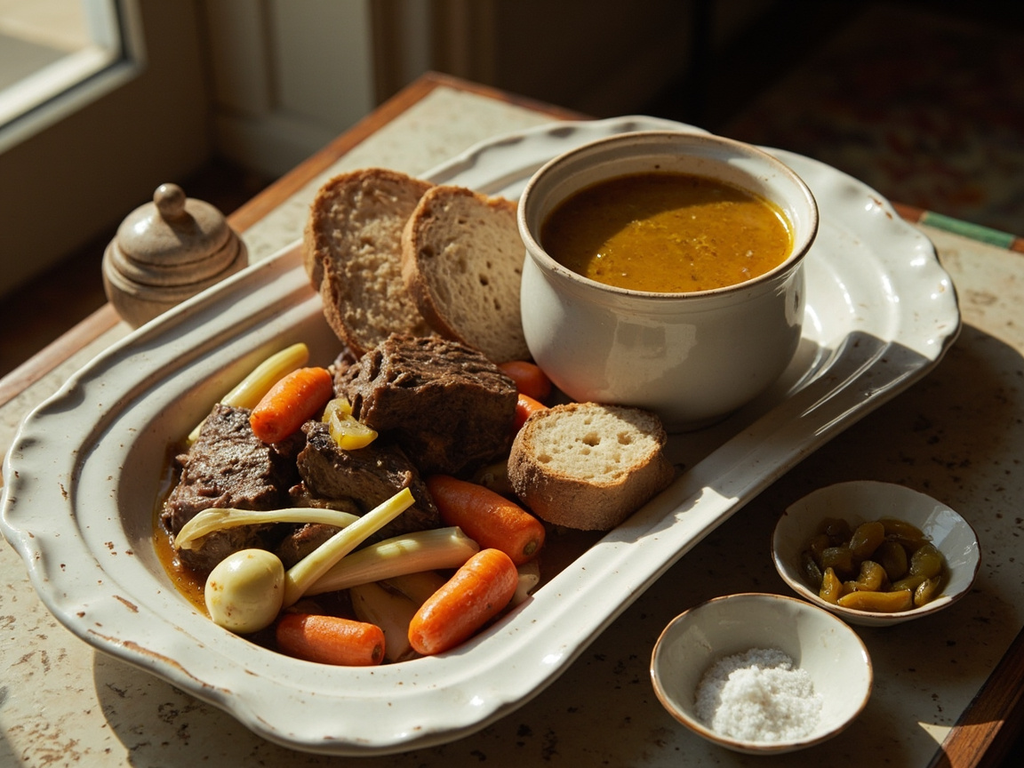
Garden Vegetable Soup
Why this dish? Pissarro lived frugally in the countryside with a large family to feed. Vegetable soup, drawn from the garden he painted tirelessly, was the economical daily staple of his table in Pontoise and Éragny.
A rustic soup thickened with leeks, cabbage, carrots, and turnips, simmered for a long time and bound with stale bread. Comforting and nourishing, it makes do with whatever the garden yields in season.
You see, my child, there's no great mystery to this soup: you take what the garden is willing to give that day—a leek, two carrots, a cabbage leaf—and put it all in the pot. The secret, if there is one, is time: you let it simmer gently while you work in the garden or on the canvas. When serving, I toss in a stale bread crust, for nothing is wasted here, and it keeps our bellies warm all evening. What can I say? We are not rich, but a good soup and the morning light—that is already a lot.
- •Garden leeks — one bunch (aromatic base)
- •Green cabbage — one quarter (body vegetable)
- •Carrots and turnips — a handful of each (sweetness)
- •Onion — one (base)
- •Stale brown bread — a few slices (thickener)
- •Lard or butter — a knob (fat)
- •Salt — to taste (seasoning)
Garden Vegetable Soup
A rustic soup thickened with leeks, cabbage, carrots, and turnips, simmered for a long time and bound with stale bread. Comforting and nourishing, it makes do with whatever the garden yields in season.
Why this dish? Pissarro lived frugally in the countryside with a large family to feed. Vegetable soup, drawn from the garden he painted tirelessly, was the economical daily staple of his table in Pontoise and Éragny.
You see, my child, there's no great mystery to this soup: you take what the garden is willing to give that day—a leek, two carrots, a cabbage leaf—and put it all in the pot. The secret, if there is one, is time: you let it simmer gently while you work in the garden or on the canvas. When serving, I toss in a stale bread crust, for nothing is wasted here, and it keeps our bellies warm all evening. What can I say? We are not rich, but a good soup and the morning light—that is already a lot.
Ingredients (period version)
- Garden leeks — one bunch (aromatic base)
- Green cabbage — one quarter (body vegetable)
- Carrots and turnips — a handful of each (sweetness)
- Onion — one (base)
- Stale brown bread — a few slices (thickener)
- Lard or butter — a knob (fat)
- Salt — to taste (seasoning)
Ingredients
- Leeks — 3 (aromatic base)
- Green cabbage — 1/4 head (body vegetable)
- Carrots — 3 (sweetness)
- Turnips — 2 (sweetness)
- Onion — 1 (base)
- Stale country bread — 4 slices (thickener)
- Butter — 30 g (fat)
- Water — 1.5 L (broth)
- Salt and pepper — to taste (seasoning)
Method
- Finely chop the onion and leeks; sweat them gently in butter without browning.
- Add the carrots, turnips, and cabbage cut into pieces; cover with water and lightly salt.
- Simmer over low heat for 45 minutes to 1 hour, until everything is tender.
- Place the bread slices in the bottom of bowls and ladle the boiling soup over them.
- Let the bread soak for a minute, adjust seasoning, and serve.
How it was made : In 19th-century rural France, soup was the central meal, often eaten morning and evening. It was made with available vegetables and thickened with stale bread to make it filling and avoid waste—a frugal kitchen practice that became emblematic.
The contemporary twist : A drizzle of olive oil and a few shavings of aged Comté on the soaked bread: the peasant soup takes on the air of a gratinée.
Camille Pissarro · Charactorium