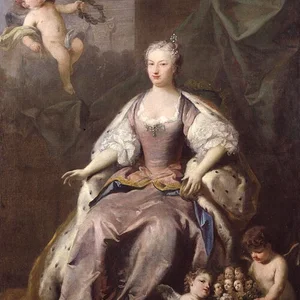

Queen consort of Great Britain and Ireland (1727–1737), wife of George II. An Enlightenment intellectual, she corresponded with Leibniz and actively supported Newton in the philosophical and scientific dispute between the two men. Regent on several occasions, she wielded major political influence over the British monarchy.
Caroline of Ansbach(1683 — 1737)
Caroline of Ansbach
Saint-Empire romain germanique, royaume de Grande-Bretagne
9 min read
Frequently asked questions
Key Facts
- 1683: Born in Ansbach, Brandenburg
- 1705: Married the future King George II in Hanover
- 1727: Became queen consort upon George II's accession to the throne
- 1729–1736: Served as regent four times during George II's absences
- 1737: Died in London, mourned by George II, who refused to remarry
Works & Achievements
Caroline organised and relayed the letters between Leibniz and Samuel Clarke on the nature of space, time, and divine Providence. The debate she made possible is regarded as one of the intellectual highpoints of eighteenth-century philosophical and scientific thought.
By having variolation tested on and adopted by the royal family, Caroline lent legitimacy to this innovative medical practice in British society, directly contributing to the rise of preventive medicine across Europe.
On several occasions, Caroline effectively governed the kingdom in the absence of George II, who had travelled to Hanover. Her regencies were universally praised for their political stability and her skill in managing affairs of state alongside Walpole.
Caroline personally oversaw the transformation of the gardens at Kensington Palace and Richmond Park, introducing the English landscape garden style. These ambitious projects had a lasting influence on the aesthetics of British royal gardens.
Caroline greatly enriched the royal library and supported artists, architects, and scientists. Her patronage helped establish the British court as a centre of Enlightenment intellectual life.
Anecdotes
In 1705, the future Emperor Charles VI asked for Caroline's hand in marriage — a union that could have made her Empress of the Holy Roman Empire. She flatly refused, as the condition imposed was that she convert to Catholicism. A committed Protestant, she chose to give up that imperial destiny rather than betray her religious convictions.
Caroline was the quiet instigator of the famous philosophical correspondence between Leibniz and Samuel Clarke (1715–1716). Leibniz wrote to Caroline to critique Newton's natural philosophy; she forwarded the letters to Clarke, a close associate of Newton, who would reply. This exchange of letters by proxy, orchestrated by Caroline from the court, remains one of the great intellectual debates of the 18th century, addressing the nature of space, time, and God.
In 1721, Caroline played a decisive role in introducing variolation against smallpox in England. Persuaded by the work of Lady Mary Wortley Montagu, she arranged for the procedure to be tested on willing condemned prisoners, then on orphans, before having her own children inoculated. This courageous risk, taken at a time when the procedure was still highly controversial, helped save thousands of lives.
Whenever George II set off for Hanover — sometimes for several months at a time — Caroline served as regent of the kingdom with remarkable authority. She worked closely with Prime Minister Robert Walpole, who greatly admired her political intelligence. Walpole is said to have openly acknowledged that she was the true ruler, adding that he communicated with the king through the queen.
On her deathbed in 1737, Caroline urged George II to remarry after she was gone. Deeply shaken, the king replied through tears that he would not remarry, but that he would have mistresses. Despite its apparent bluntness, Caroline herself took this response as a declaration of love in his own way — and he kept his word: he never remarried.
Primary Sources
The Princess of Wales has seen fit to place this letter in your hands... The natural philosophy of Mr. Newton, and his mathematics, have succeeded very well; but his metaphysics, his natural theology are worth considerably less.
Madam, Your Royal Highness does me too much honour in wishing to converse with me on philosophy... I hope that reason and truth will prevail, thanks to your enlightened protection.
Her Majesty the Queen, as Guardian of the Realm and Lieutenant of His Majesty during His Majesty's absence, did this day come to the House of Lords...
The Queen was the sole mover of every wheel in the political machine of this country... Sir Robert Walpole governed the country through the Queen, and the Queen governed the King.
The Princess of Wales has encouraged the practice of inoculation in a manner that does infinite honour to her good sense and humanity, by submitting her own children to the operation.
Key Places
Caroline's birthplace and capital of the small Protestant principality of Brandenburg-Ansbach. It was here that she received her earliest education before being orphaned at the age of 13.
Residence of Queen Sophie Charlotte of Prussia, where the young Caroline was taken in and shaped her mind through contact with the philosophers and scholars of the Berlin court, including Leibniz himself.
The court of the future George I, where Caroline lived after her marriage in 1705. It was from Hanover that she followed the great political and philosophical debates of Europe before moving to England in 1714.
Caroline's principal residence as Princess of Wales and later as Queen. She held her intellectual salons here, received philosophers and scientists, oversaw the redesign of the gardens, and ultimately died here in 1737.
A favourite royal retreat for Caroline, particularly in summer. She continued her political activities here during her regencies and received Robert Walpole for affairs of state.
The site of the coronation of George II and Caroline in 1727. Caroline was buried here, and George II, upon his death in 1760, requested to be laid beside her, with the sides of both coffins removed so that their remains could mingle.
Typical Objects

Caroline maintained a rich intellectual correspondence with the greatest thinkers of her time, including Leibniz. The quill and sealed paper were her daily tools for taking part in the European exchange of ideas.

Passionate about natural philosophy, Caroline took a keen interest in Newton's theories of gravitation and the debates surrounding the structure of the universe. Celestial globes adorned the royal cabinets where she held her learned discussions.

Caroline cherished the memory of her philosophical mentor. After Leibniz's death in 1716, she worked to have his legacy recognized in England, where he was often overshadowed by Newton.

Caroline was a pioneer of public health, championing variolation against smallpox. The medical kit used to inoculate her own children stands as a symbol of her courage and her faith in science.

On several occasions, Caroline governed the kingdom in George II's absence. The royal sceptre embodied her full authority as guardian of the realm — an authority she exercised with a political mastery that every minister acknowledged.

Deeply devout yet open to dialogue, Caroline had turned down an imperial crown rather than abandon her Protestant faith. She read theologians with the same diligence she brought to philosophers, seeking to reconcile faith and reason.

Caroline oversaw the transformation and expansion of the gardens at Kensington Palace along the principles of the emerging English landscape garden. This landscaping project reflects her love of the arts and her desire to anchor the monarchy in the modernity of the Enlightenment.
School Curriculum
Vocabulary & Tags
Key Vocabulary
Tags
Daily Life
Morning
Caroline rose early and devoted her mornings to correspondence — letters to philosophers, theologians, and ministers. She would then receive her ladies-in-waiting and political advisors, notably Robert Walpole, with whom she discussed the current affairs of the kingdom. The queen regularly read newspapers and political reports before official audiences.
Afternoon
Afternoons were devoted to representational duties: formal court audiences, receiving ambassadors, and ceremonial functions. When the weather allowed, Caroline would walk in the Kensington Gardens she had redesigned, sometimes accompanied by philosophers or scholars invited to court to engage her on the great questions of the day.
Evening
Court evenings were marked by state dinners, concerts, theatrical performances, and balls. Caroline shone there through her intelligence and cultured conversation. She regularly organized informal discussions on philosophy, theology, and natural sciences, transforming the court into an Enlightenment salon. Before retiring, she enjoyed reading works of philosophy or theology.
Food
The royal table was lavish, in keeping with the standards of the eighteenth-century British court: roasted meats, game, fish, refined entrées, and elaborate desserts. Caroline appreciated the German cuisine of her childhood but had adapted to British tastes. She drank claret and hot chocolate, a beverage very fashionable in the aristocratic circles of the time.
Clothing
As queen consort, Caroline wore pannier gowns in embroidered silks, Flemish lace, and richly ornamented velvets, following the French fashion that dominated European courts. Her wardrobes were assembled by dressmakers and milliners, often of French or Flemish origin. For major ceremonies, she wore the Crown Jewels and a purple velvet mantle trimmed with ermine, a symbol of her royal rank.
Housing
Caroline resided chiefly at Kensington Palace, the vast royal residence to the west of London, which she helped to enlarge and decorate. The court moved regularly to Hampton Court Palace for the summer and to St. James's Palace for official functions. Her apartments were filled with books, maps, globes, and scientific instruments, reflecting her intellectual passions as much as her status.
Historical Timeline
Period Vocabulary
Liens externes & ressources
Références
Œuvres
Correspondance philosophique Leibniz–Clarke (médiation)
1715-1716
Promotion de la variolisation contre la variole en Grande-Bretagne
1721
Régences du Royaume de Grande-Bretagne
1727-1736
Réaménagement des jardins royaux de Kensington et Richmond
1728-1737
Patronage de la bibliothèque royale et des arts
1714-1737
Rechercher
See also
Related Characters
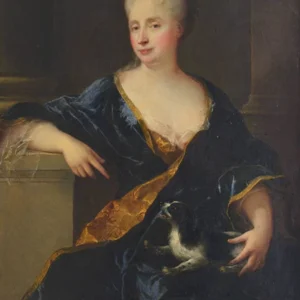
Anne Thérèse de Marguenat de Courcelles, marquise de Lambert
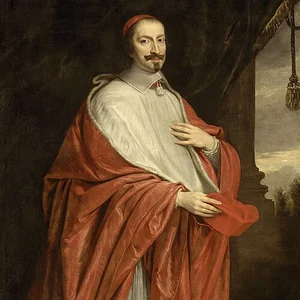
Cardinal Mazarin
1602 — 1661
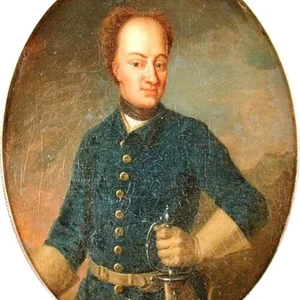
Charles XII of Sweden

Frederick II of Denmark
Jean le Rond d'Alembert
1717 — 1783
Marie Jean Antoine Nicolas de Condorcet