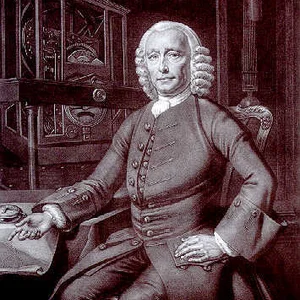

A self-taught British clockmaker (1693–1776), John Harrison solved one of the greatest scientific challenges of his era: the precise determination of longitude at sea. His marine chronometer H4 (1759) revolutionized navigation and saved countless lives.
John Harrison(1693 — 1776)
John Harrison
royaume de Grande-Bretagne
9 min read
Frequently asked questions
Key Facts
- 1693: born in Foulby, Yorkshire, England
- 1714: the British Parliament passes the Longitude Act, offering £20,000 to solve the problem of longitude
- 1735: Harrison presents his first marine chronometer, H1
- 1759: completion of H4, a marine watch of exceptional precision
- 1773: George III personally intervenes to ensure Harrison finally receives his reward at the age of 80
Works & Achievements
The first marine chronometer with compensating springs, tested on a voyage to Lisbon. Impressively large (around 30 kg), it demonstrated for the first time that a stable clock at sea was feasible, opening the way to a solution for the longitude problem.
An improved version of H1, incorporating modified balance bars. Harrison himself acknowledged its limitations and spent twenty years developing a more reliable successor.
The result of nineteen years of mechanical refinement. Though Harrison deemed it insufficient to claim the grand prize, its development yielded two major innovations: the bimetallic temperature-compensation strip and the caged ball bearing, both later adopted by industry.
The crowning achievement of Harrison's career: a 13 cm marine watch of revolutionary accuracy. Its success on voyages to Jamaica (1761) and Barbados (1764) conclusively proved that a chronometer could solve the longitude problem.
Built at the request of King George III, this chronometer was tested at the Richmond Observatory with an error of less than one second over ten weeks. It persuaded the King to intervene on Harrison's behalf to secure his reward.
Harrison's final major theoretical treatise, written a year before his death. In it he sets out the fundamental principles that guided his inventions, bearing witness to rigorous scientific thinking despite his lack of formal academic training.
Anecdotes
John Harrison was a carpenter's son who had received no formal training as a clockmaker. Around 1713, he built one of his earliest clocks almost entirely out of wood, using his father's tools and instincts. This self-taught genius would nonetheless go on to solve a problem that Europe's greatest scholars had failed to crack.
In 1714, the British Parliament had promised a reward of up to £20,000 to anyone who could solve the problem of longitude at sea. After the H4's resounding success on the crossing to Jamaica in 1761, the Board of Longitude stubbornly refused to pay him the full prize, citing technical pretexts. Harrison spent decades waiting for full recognition.
At the age of 79
worn down by years of bureaucratic struggle
Harrison wrote a petition to King George III. The king
outraged by the injustice
reportedly declared:
By God, Harrison, I will see you righted!" He personally intervened to compel Parliament to grant Harrison an additional sum in 1773.
His greatest adversary was not the sea, but Nevil Maskelyne, the Astronomer Royal and a member of the Board of Longitude. Maskelyne championed the lunar distance method and was appointed to evaluate the H4 during a voyage to Barbados in 1764 — a situation that was, to say the least, a conflict of interest, and one that helped delay Harrison's recognition.
The H4, Harrison's fourth marine chronometer completed in 1759, was remarkably compact: it resembled a large pocket watch just 13 cm in diameter, while its predecessors had been heavy machines. During the test voyage to Jamaica, the H4 accumulated an error of only 5 seconds over 81 days at sea — less than 2 kilometres of positional error.
Primary Sources
Harrison describes in detail the mechanism of his H4, including its escapement and thermal compensation system, with the aim of enabling other craftsmen to reproduce the instrument.
“I dare hope that my work will prove that the genius of a craftsman can, through perseverance and rigorous observation alone, surpass the theories of the most distinguished scholars.”
The records of the Board of Longitude document the successive evaluations of the H1 through H4 chronometers, the technical objections raised, and the deliberations that delayed the payment of the prize to Harrison.
“I have devoted forty years of my life to solving this problem in the service of British navigation, and I am still denied what is rightfully mine. I appeal to the justice of this House against those who have sought to appropriate my work.”
The commander recorded that the H4 indicated longitude with remarkable accuracy upon arrival at the coast of Madeira, confirming the instrument's effectiveness after several weeks of rough seas.
Key Places
Birthplace of John Harrison, born on 24 March 1693. His father, a carpenter, passed on to him a love of manual craftsmanship and mechanical precision.
Harrison grew up and spent his formative years in this village, where he built his first wooden clocks and developed his mechanical innovations. It was here that he invented the grasshopper escapement and the compensation pendulum.
Harrison travelled here in 1728 to present his designs to scientific authorities, and eventually established his workshop in the city. London was the seat of the Board of Longitude and the site of every decisive negotiation of his life.
The reference institution for British navigation, whose meridian served as the standard for longitude measurements. The Board of Longitude, which evaluated Harrison's work, was closely tied to this observatory. All four of his timekeepers — H1 through H4 — are on display there today.
Destination of the first official sea trial of the H4, in 1761–1762. On arrival, the longitude error calculated using the timekeeper was less than two kilometres — a performance that sailors of the day considered nothing short of miraculous.
Destination of the second official trial in 1764, supervised by Nevil Maskelyne. Despite further convincing results, the Board of Longitude used this voyage as grounds to continue disputing Harrison's claim to the prize.
Typical Objects

Harrison's masterpiece completed in 1759, this "marine timekeeper" resembles a large pocket watch and proved capable of keeping Greenwich time to within a few seconds over several weeks at sea. It represents the definitive answer to the longitude problem.

Harrison's invention, this pendulum uses alternating brass and steel rods to compensate for expansion caused by temperature variations. It allowed his first land clocks to achieve unprecedented accuracy for the era.

An escapement mechanism designed by Harrison to eliminate almost all friction and require no lubrication. This ingenious device is one of his major contributions to precision clockmaking.

Trained in carpentry by his father, Harrison built his first clocks using wooden tools before mastering metalwork. These instruments recall the artisanal origins of an entirely self-taught genius.

A navigation instrument used alongside marine chronometers to measure the altitude of celestial bodies. Navigators of the era compared local time (given by the sun via the sextant) and Greenwich time (given by the chronometer) to calculate their longitude.

Eighteenth-century sea charts contained considerable longitude errors, making shipwrecks frequent. Harrison's work gradually enabled the production of charts of revolutionary accuracy, making all major commercial routes far more reliable.
School Curriculum
Vocabulary & Tags
Key Vocabulary
Tags
Daily Life
Morning
Harrison rose early, as most craftsmen of his era did. He began his day with prayer, in keeping with the Protestant customs of eighteenth-century England, then examined by morning light the progress of his mechanical work, noting how his instruments varied over the course of the hours.
Afternoon
Most of his afternoons were devoted to hands-on work at the bench: adjusting springs, polishing gear wheels, assembling and testing mechanisms. The precision demanded by marine timekeeping required hours of silent concentration and painstaking refinement with file and chisel.
Evening
In the evenings, Harrison read, observed the stars from his garden, or corresponded with the scholars and officials of the Board of Longitude. He also recorded his observations and calculations in working notebooks, building up a mass of technical notes that testifies to his intellectual rigour.
Food
The table of a skilled English craftsman in the eighteenth century was simple but adequate: brown bread, cheese, boiled or roasted meat on Sundays, garden vegetables, and mild ale as daily fare. The years of belated recognition brought him a degree of comfort, allowing him to eat meat more regularly.
Clothing
Harrison wore the sober, practical dress of a prosperous craftsman: dark cloth breeches, a linen shirt, a woollen jacket, and a leather apron in the workshop. For his audiences before the Board of Longitude in London, he wore a more formal coat with a powdered wig, in the fashion of the eighteenth century.
Housing
Harrison long lived in modest circumstances in Barrow-upon-Humber, in a typical English village brick house where his forge and workshop occupied a central place. His move to London, made necessary by his negotiations with the Board of Longitude, provided him with more comfortable lodgings in the Red Lion Square neighbourhood.
Historical Timeline
Period Vocabulary
Liens externes & ressources
Références
Œuvres
Chronomètre marin H1
1735
Chronomètre marin H2
1737
Chronomètre marin H3
1757
Chronomètre marin H4
1759
Chronomètre marin H5
1772
A Description Concerning Such Mechanism as Will Afford a Nice, or True, Mensuration of Time
1775