 flip
flipItalian Macaroni Cheese
Italian Macaroni Cheese
Why this dish? The anchor reports that 'during his travels on the continent, he discovered French and Italian cuisine, which he commented on with enthusiasm in his writings.' Macaroni — Italian pasta then very fashionable among cultivated English returning from the Grand Tour — embodies the cosmopolitan taste of the scholar for Europe's tables.
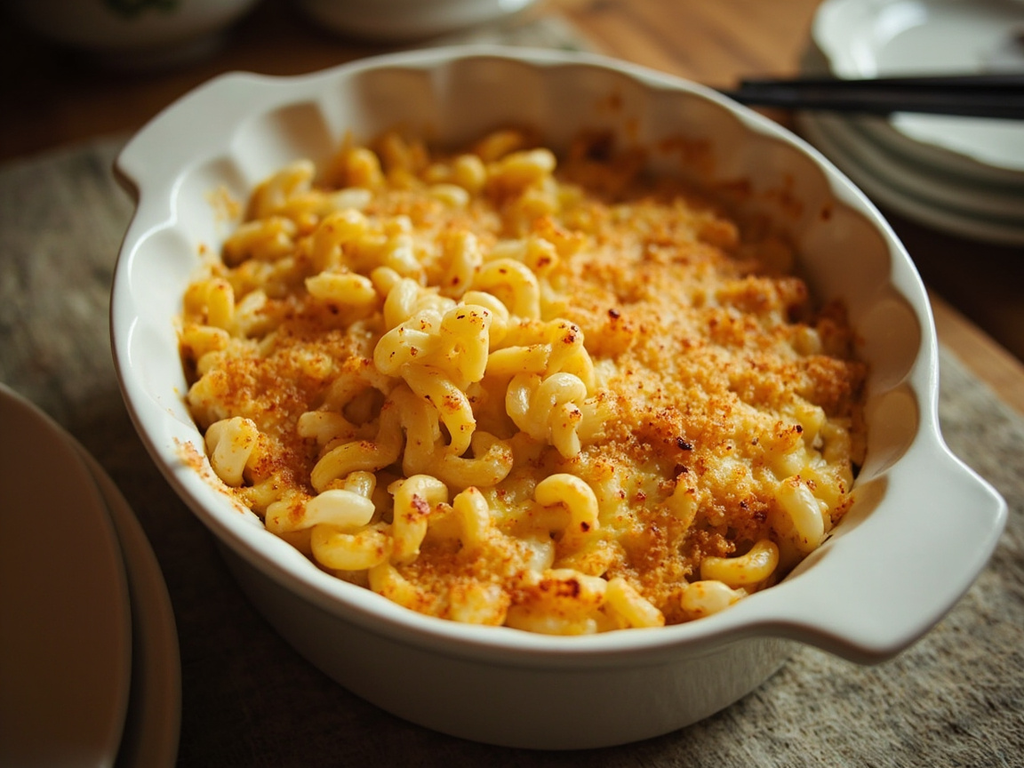
Macaroni coated in a creamy white sauce, generously sprinkled with grated cheese and nutmeg, baked until the surface is golden and crackling. The refined English version of a dish brought back from Italy.
On the continent, during my wanderings through Italy, I tasted these pastas called macaroni, and I admit I greatly enjoyed them. Back in London, I wanted to recapture the memory: these wheat tubes are cooked, coated in a well-bound white sauce, lavished with cheese and nutmeg, then browned in the oven. It is, I concede, less learned than a calculating machine — but of a comfort that no theorem can offer.
- •Macaroni (dried pasta) — a good quantity (base)
- •Milk — a pint (white sauce)
- •Butter and flour — for the roux (thickener)
- •Hard cheese (Parmesan, Cheshire) — grated abundantly (umami, gratin)
- •Nutmeg — one, grated (signature spice)
- •Breadcrumbs — a handful (crust)
Italian Macaroni Cheese
Macaroni coated in a creamy white sauce, generously sprinkled with grated cheese and nutmeg, baked until the surface is golden and crackling. The refined English version of a dish brought back from Italy.
Why this dish? The anchor reports that 'during his travels on the continent, he discovered French and Italian cuisine, which he commented on with enthusiasm in his writings.' Macaroni — Italian pasta then very fashionable among cultivated English returning from the Grand Tour — embodies the cosmopolitan taste of the scholar for Europe's tables.
On the continent, during my wanderings through Italy, I tasted these pastas called macaroni, and I admit I greatly enjoyed them. Back in London, I wanted to recapture the memory: these wheat tubes are cooked, coated in a well-bound white sauce, lavished with cheese and nutmeg, then browned in the oven. It is, I concede, less learned than a calculating machine — but of a comfort that no theorem can offer.
Ingredients (period version)
- Macaroni (dried pasta) — a good quantity (base)
- Milk — a pint (white sauce)
- Butter and flour — for the roux (thickener)
- Hard cheese (Parmesan, Cheshire) — grated abundantly (umami, gratin)
- Nutmeg — one, grated (signature spice)
- Breadcrumbs — a handful (crust)
Ingredients
- Macaroni — 300 g (base)
- Milk — 500 ml (sauce)
- Butter — 40 g (roux)
- Flour — 40 g (roux)
- Grated Parmesan (or aged Cheshire/cheddar) — 120 g (umami, gratin)
- Freshly grated nutmeg — 1 pinch (spice)
- Breadcrumbs — 3 tbsp (crispy crust)
- Salt, pepper — to taste (seasoning)
Method
- Cook macaroni in salted boiling water until tender, drain.
- Prepare white sauce: melt butter, add flour, cook 1 min, then gradually whisk in warm milk until thickened.
- Off heat, stir in two-thirds of the cheese, nutmeg, salt and pepper.
- Mix pasta with sauce, pour into a buttered gratin dish.
- Sprinkle with remaining cheese mixed with breadcrumbs.
- Bake at 200 °C for about 20 min, until surface is golden and crisp. Serve hot.
How it was made : Macaroni was so associated with the continental taste of young Englishmen returning from Italy that they were nicknamed 'macaronis' in the 18th century — hence the mocking line in the song *Yankee Doodle*. By Babbage's time, 'macaroni cheese' had become fully domesticated in English cooking and appeared in Mrs Beeton.
The contemporary twist : Serve in individual small cocottes aligned like the columns of a calculation table, each topped with a perfectly identical golden crust.
Sources : Isabella Beeton, Book of Household Management, 1861
Charles Babbage · Charactorium