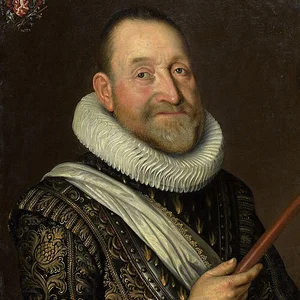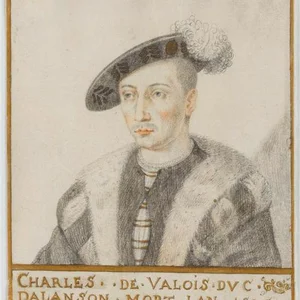

Charles IV of Alençon (1489-1525) was Duke of Alençon and Count of Perche, a prince of the blood and a great aristocrat during the reign of Francis I. Husband of Marguerite of Angoulême (the future Marguerite of Navarre), he took part in the Battle of Pavia in 1525.
Charles IV of Alençon(1489 — 1525)
Charles IV of Alençon
France
6 min read
Frequently asked questions
Key Facts
- Born in 1489, he became Duke of Alençon and one of the greatest lords of the kingdom.
- In 1509 he married Marguerite of Angoulême, sister of the future King Francis I.
- He commanded the left wing of the French army at the Battle of Pavia in 1525.
- Accused of having fled the battlefield at Pavia, he died shortly afterwards, in 1525, in Lyon.
- His death without an heir brought the Duchy of Alençon back to the Crown of France.
Works & Achievements
A union that closely tied the House of Alençon to the future royal dynasty and placed Charles at the very top of the noble hierarchy.
Governance of vast estates in Normandy and the Perche, exercised as an appanaged prince.
Participation, as a great lord of the realm, in Francis I's Italian campaigns against Charles V.
Leadership of one of the three main divisions of the French army during the decisive battle, marked by his controversial retreat.
Upon his death without an heir, the Duchy of Alençon reverted to the royal domain, his widow retaining its use as a dower.
Anecdotes
Charles IV of Alençon married Marguerite of Angoulême, sister of the future king Francis I, in 1509. This marriage placed him at the very forefront of the nobility, but the union remained childless, and Marguerite later became a great literary figure under the name Marguerite of Navarre.
At the Battle of Pavia, on 24 February 1525, Charles commanded the left wing of the French army. Seeing the rout taking hold and King Francis I about to be captured, he retreated with his troops rather than sacrificing himself in the fray.
His retreat at Pavia earned him a lasting reputation for cowardice. Having returned to France to his wife, ill and overwhelmed by public shame, he died a few weeks later, in April 1525, in Lyon.
As a prince of the blood from the Capetian branch of Valois-Alençon, Charles was one of the potential heirs to the throne before the birth of Francis I's sons. His dynastic position made him a key figure at court, despite a military career that remained lackluster.
Upon his death without descendants, the Duchy of Alençon reverted to the Crown. His widow Marguerite, who had received the duchy as her dower, kept it for a time before remarrying in 1527 to Henry of Albret, King of Navarre.
Primary Sources
Marguerite's correspondence speaks of the grief and ordeal of her husband the Duke of Alençon's illness in the weeks following the defeat at Pavia.
The du Bellay brothers recount the disposition of the French army at Pavia and the command entrusted to the Duke of Alençon on the left wing, as well as his retreat during the rout.
De Thou reports the role of Charles d'Alençon at Pavia and the blame he incurred for having abandoned the battlefield before the king's capture.
Key Places
Capital of the Duchy of Alençon, seat of the princely house that Charles headed. The center of his territorial power in Normandy.
City in Lombardy where the decisive battle of 24 February 1525 took place. Charles commanded the French left wing there before the retreat and defeat.
City where Charles IV of Alençon died in April 1525, shortly after his return from Italy, sick and disgraced.
The County of Perche was among Charles's domains, with Mortagne as one of its administrative centers. A region attached to his principality.
Center of royal power under Francis I, where Charles and his wife Marguerite held a leading rank among the princes of the blood.
Typical Objects

Weapon and symbol of noble rank, carried by every great lord in battle as well as at court. It embodied the military duty of the prince of the blood.

Articulated metal harness protecting the heavy horseman of the French gendarmerie. At Pavia, this armour did not prevent the rout against the Spanish arquebusiers.

The mounted gendarme's main weapon, used during the frontal charge. The heavy charge became less decisive against portable firearms.

Wax seal authenticating the acts of the Duke of Alençon and Count of Perche. It gave material form to the prince's administrative and legal authority over his lands.

Arms taking up the arms of France differenced with a border and bezants, the mark of the cadet branch of the Valois-Alençon. It displayed membership of the royal blood.

A fitted garment of velvet and silk worn by the great lords at the court of Francis I. Its richness signalled the wealth and rank of the wearer.
School Curriculum
Vocabulary & Tags
Key Vocabulary
Daily Life
Morning
The duke began his day with Mass in the chapel of his castle, surrounded by chaplains and gentlemen. Next came the reception of his household officers and the review of the duchy's affairs.
Afternoon
The afternoon blended audiences, seigneurial justice, and noble pursuits such as hunting with hounds or weapons training. In wartime, these hours were devoted to the council and the command of troops.
Evening
In the evening, the ducal court gathered for supper, music, and learned conversation, enlivened by the presence of **Marguerite** and her cultivated entourage. Poems and tales were sometimes read aloud.
Food
A prince's table offered roasted meats, game, fish on lean days, white bread, and fine wines. Spices, candied fruits, and sweet entremets marked feast-day meals.
Clothing
**Charles** wore velvet doublets, fur-lined cloaks, and fitted hose, adorned with embroidery and jewels signaling his rank. For war, he donned the full harness of the heavy cavalry.
Housing
He resided in the seigneurial castles of **Alençon** and the **Perche**, stone dwellings blending medieval defense with Renaissance comfort. The court also took him to the royal residences of the **Loire Valley**.
Historical Timeline
Period Vocabulary
Liens externes & ressources
Références
Œuvres
Mariage avec Marguerite d'Angoulême
1509
Administration du duché d'Alençon et du comté du Perche
1492-1525
Commandement militaire dans les guerres d'Italie
1515-1525
Commandement de l'aile gauche à Pavie
1525
Transmission du duché à la Couronne
1525