 flip
flipCaen Lobster in Cream and Calvados
Caen Lobster in Cream and Calvados
Why this dish? The *demoiselles de Caen* — small Norman lobsters — appear in Monet's kitchen notebooks, served at Sunday lunches attended by Clemenceau, Renoir, or Cézanne. Calvados and cream mark the Normandy of his childhood in Le Havre.
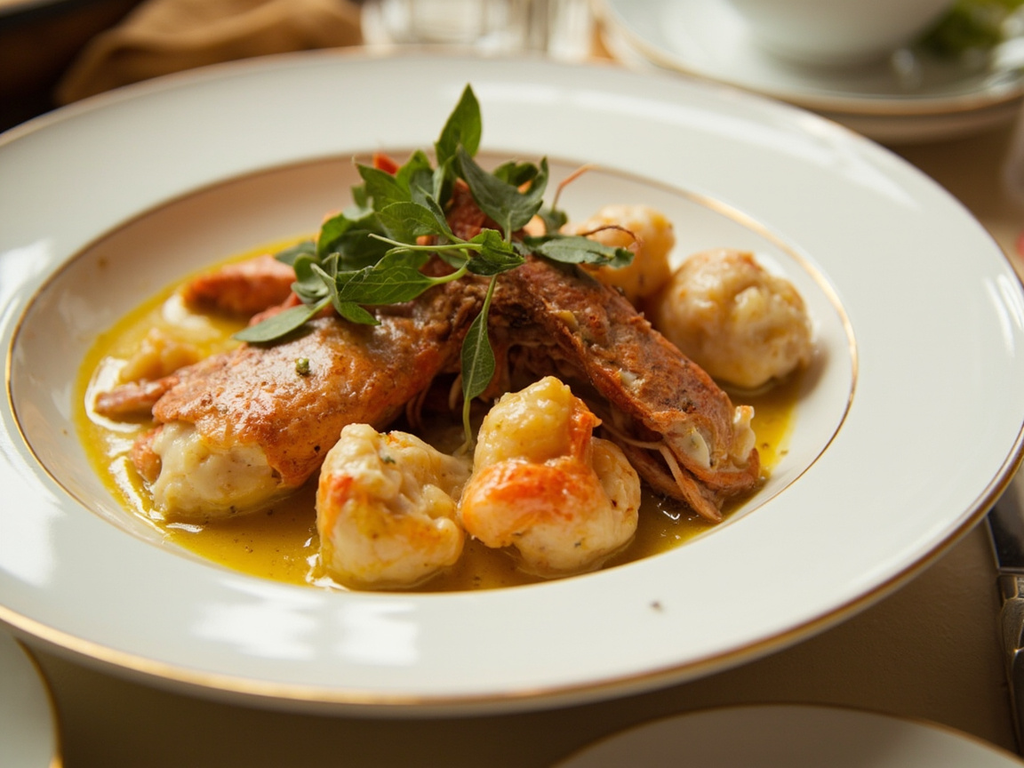
Small lobsters seared then simmered in a cream sauce flambéed with Calvados, spiced with shallot and pepper. A rich, iodized reception dish worthy of Giverny's artist-filled tables.
When my friends came up from Paris on Sunday, I didn't hold back: we brought out the demoiselles, those little lobsters from our coasts that I've loved since Le Havre. We sear them alive in butter, flambé with Calvados — watch your eyebrows! — then the cream wraps everything in a golden coat. I peppered firmly, as always, and Clemenceau asked for more, believe me.
- •Small live lobsters from the Norman coast — two (centrepiece)
- •Churned butter — a good lump (cooking)
- •Gray shallots — a few (aromatic base)
- •Local Calvados — a small glass (flambé)
- •Thick farm cream — a bowl (sauce)
- •Dry cider — a ladleful (deglazing)
- •Salt, pepper, pinch of cayenne pepper — to taste (seasoning)
Caen Lobster in Cream and Calvados
Small lobsters seared then simmered in a cream sauce flambéed with Calvados, spiced with shallot and pepper. A rich, iodized reception dish worthy of Giverny's artist-filled tables.
Why this dish? The *demoiselles de Caen* — small Norman lobsters — appear in Monet's kitchen notebooks, served at Sunday lunches attended by Clemenceau, Renoir, or Cézanne. Calvados and cream mark the Normandy of his childhood in Le Havre.
When my friends came up from Paris on Sunday, I didn't hold back: we brought out the demoiselles, those little lobsters from our coasts that I've loved since Le Havre. We sear them alive in butter, flambé with Calvados — watch your eyebrows! — then the cream wraps everything in a golden coat. I peppered firmly, as always, and Clemenceau asked for more, believe me.
Ingredients (period version)
- Small live lobsters from the Norman coast — two (centrepiece)
- Churned butter — a good lump (cooking)
- Gray shallots — a few (aromatic base)
- Local Calvados — a small glass (flambé)
- Thick farm cream — a bowl (sauce)
- Dry cider — a ladleful (deglazing)
- Salt, pepper, pinch of cayenne pepper — to taste (seasoning)
Ingredients
- Lobsters (or 4 raw langoustines per person) — 2 of 500 g each (centrepiece)
- Butter — 60 g (cooking)
- Chopped shallots — 3 (aromatic base)
- Calvados — 5 cl (flambé)
- Thick crème fraîche — 25 cl (sauce)
- Brut cider — 10 cl (deglazing)
- Tarragon — a few leaves (herb)
- Salt, pepper, pinch of cayenne pepper — to taste (seasoning)
Method
- Cut the raw lobsters into pieces (split lengthwise then segment the tail); reserve the coral.
- Brown the pieces shell-side down in hot butter until they redden.
- Add the shallots, pour in the Calvados and flambé away from children.
- Deglaze with cider, reduce by half, then add the cream and tarragon; simmer for 8 minutes.
- Remove the lobsters, mount the sauce with the coral, adjust salt, pepper and a pinch of cayenne, coat and serve immediately with country bread.
How it was made : In the 19th century, Norman lobster was more common and cheaper than today. It was cooked live, with cream and apple spirits, a specialty of Caen. At Monet's, the notebooks recorded dishes served to guests so they could be reproduced — a true household memory.
The contemporary twist : Monet-style plating: pearly meat on a mirror of sauce, sprinkled with tarragon flowers and garden nasturtiums (edible), like a colorful brushstroke.
Sources : Claire Joyes & Joël Robuchon, Les Carnets de cuisine de Monet, Éditions du Chêne, 1989
Claude Monet · Charactorium