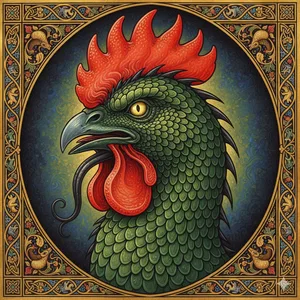

The cockatrice is a legendary creature from medieval bestiaries, half-rooster and half-serpent, reputedly born from a rooster's egg incubated by a toad or a snake. Similar to the basilisk, it was believed to kill with a single glance or its venomous breath. It haunted the European imagination from the Middle Ages through the Renaissance.
Cockatrice
Cockatrice
6 min read
Frequently asked questions
Key Facts
- Appears in European bestiaries from the 12th century onward, derived from the ancient basilisk
- Described as born from a rooster's egg incubated by a toad or a serpent
- Reputedly able to kill with a single glance or its poisonous breath
- The weasel and the rooster's crow were thought to be its only enemies or remedies
- Frequent motif in heraldry and medieval and Renaissance iconography
Works & Achievements
Ancient foundation of the myth: the basilisk with its deadly gaze and breath, source of the cockatrice.
Encyclopedia that transmits the "king of serpents" to all of medieval Western Europe.
Major illuminated manuscript where the creature illustrates vices and the power of evil.
Encyclopedia in French that spreads knowledge about the basilisk to laypeople.
Major literary work that uses the word "cockatrice" and anchors the creature in English culture.
Naturalist treatise that still describes and illustrates the cockatrice at the dawn of modern science.
Anecdotes
In the Middle Ages, it was believed that a cockatrice was born from an egg laid by an old rooster and then incubated by a toad or a snake on manure. This strange belief explains its hybrid appearance: head and legs of a rooster, body and tail of a snake or dragon.
It was said that the only way to kill a cockatrice was to show it a mirror: by meeting its own deadly gaze, the creature would strike itself dead. This trick, already told about the basilisk in antiquity, persisted for centuries in European tales.
The weasel was reputed to be the only animal capable of resisting the cockatrice. Medieval bestiaries claimed that its smell or bite was enough to defeat the monster, even though the weasel often died in the fight.
The crowing of a rooster was considered a weapon against the cockatrice: hearing it would kill the creature instantly. Medieval travelers sometimes said they brought a rooster to cross regions where the creature was feared.
The English word 'cockatrice' and the French word 'basilic' long referred to the same creature. Through translations and copies of bestiaries, the two figures became mixed, so that it is no longer always clear whether it is a rooster-snake or a crowned serpent.
Primary Sources
The basilisk… kills shrubs not only by its touch but also by its breath; it scorches the grass and shatters stones—such is the power of its venom.
Out of the serpent's root shall come forth a basilisk, and his fruit shall be a flying dragon.
The basilisk is called king of serpents, for other serpents fear it and flee before it; it kills a man just by looking at him.
There is a serpent that is called a cockatrice, which kills people by the venom of its gaze.
Key Places
Place where Pliny located the basilisk, ancestor of the cockatrice, whose venom withered the land.
City where a rooster was tried and burned in 1572 for allegedly laying a cockatrice egg.
Home of Isidore of Seville, whose *Etymologies* transmitted the basilisk myth throughout the Middle Ages.
Repository of the famous *Aberdeen Bestiary*, where the creature is richly illuminated.
Dark, damp places where popular imagination envisioned the cockatrice nesting with its deadly gaze.
Typical Objects

Legendary weapon against the cockatrice: by meeting its own gaze in the mirror, the creature killed itself.

An egg supposedly laid by an old rooster and incubated by a toad, from which the creature was to be born.

It was said that the crowing of a rooster would kill the cockatrice; travelers sometimes brought one as a precaution.

The only animal reputed to be able to defeat the cockatrice, a symbol of courage in bestiaries.

A medieval manuscript in which the cockatrice was depicted and laden with moral and religious lessons.

A common animal whose appearance inspired the upper half of the creature, half-rooster, half-serpent.

A shield on which the cockatrice appeared as an emblem of terror, vigilance, and fearsome power.
School Curriculum
Vocabulary & Tags
Key Vocabulary
Tags
Daily Life
Morning
A legendary creature, the cockatrice doesn't have a real daily routine, but medieval imagination placed it lurking in a dark cellar at dawn. Paradoxically, the crow of the rooster was said to kill it, so it would fear daybreak.
Afternoon
It was imagined prowling in wells, ruins, and damp places, striking dead with its gaze any creature that came too close. Bestiaries made it a permanent threat to the careless traveler.
Evening
Twilight was its domain, when shadows concealed its scaly body. Villagers closed doors and shutters, fearing its venomous breath that withered herbs and fruits.
Food
A symbol of evil rather than a real animal, the cockatrice was reputed to poison everything it touched. Its venom was said to dry up the earth and kill plants, rendering it unable to feed like an ordinary beast.
Clothing
A naked and monstrous creature, it wore no clothing: its "garment" was its very body—red rooster's comb, feathers and serpent's scales, and a barbed dragon's tail.
Housing
Legends housed it in dark and remote places—caves, dried-up wells, cellars, and ruins—far from the light and the crow of roosters, which were fatal to it.
Historical Timeline
Period Vocabulary
Visual Style
Un style d'enluminure de bestiaire médiéval sur parchemin vieilli, mêlant encre, feuille d'or et créature hybride coq-serpent richement ornée.
Sound Ambience
Une ambiance de cave médiévale humide où résonnent goutte d'eau, sifflement de serpent et chant soudain du coq, entre frayeur et superstition.
Liens externes & ressources
Références
Œuvres
Histoire naturelle (Pline l'Ancien)
vers 77
Étymologies (Isidore de Séville)
VIIe siècle
Bestiaire d'Aberdeen
vers 1200
Li Livres dou Tresor (Brunetto Latini)
vers 1260
Les Contes de Cantorbéry (Chaucer)
fin XIVe siècle
The History of Serpents (Edward Topsell)
1658