 flip
flipGilded Eggs with Herbs, Against the Cursed Egg
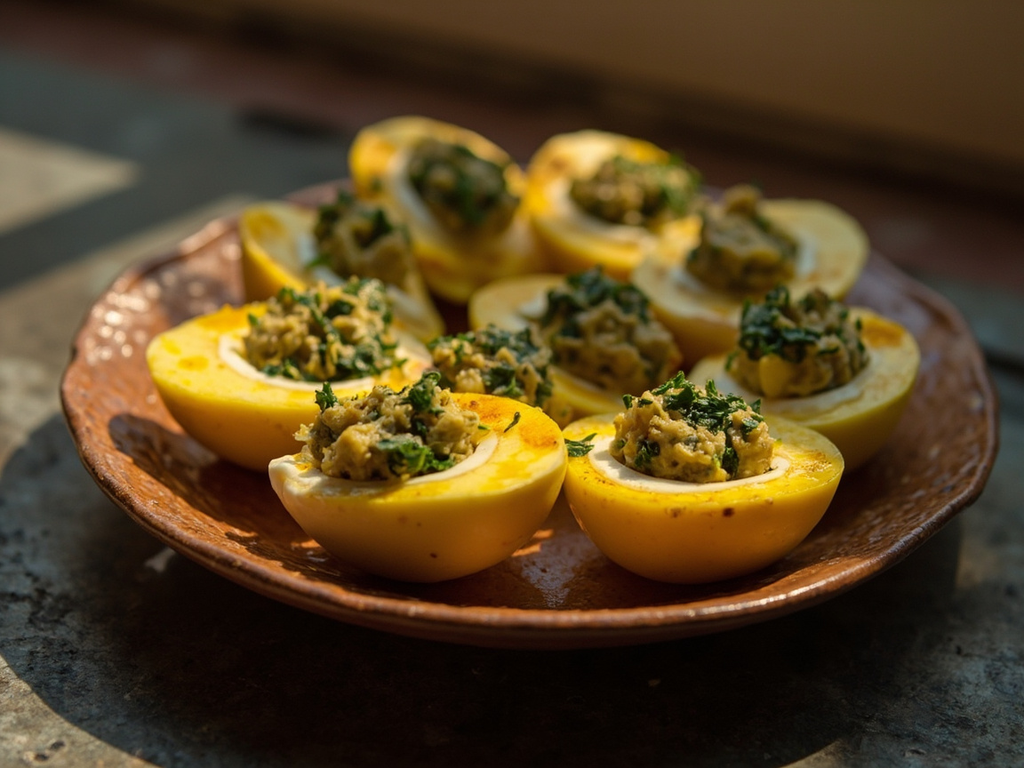
Gilded Eggs with Herbs, Against the Cursed Egg
Why this dish? The cockatrice is said to be born from a cock's egg hatched by a toad: medieval belief thus feared small eggs without a yolk. Cooking and gilding good, honest eggs filled with herbs was an everyday way to ward off this bad luck.
Hard-boiled eggs cut in half, their yolks mixed with fresh herbs, ginger and a little cheese, then returned to the whites and gilded with saffron in a pan or oven.
I was born, they say, from an egg laid by a cock and hatched in the mud by a toad. That is why the good folk mistrusted aborted eggs and broke them quickly, lest one of my kind emerge. But proper, full eggs they boiled hard, filled with herbs and spices, and gilded to ward off evil. Eat them without fear, mortal: as long as you bless them, no vermin will hatch from their shell.
- •Hen's eggs — a dozen (base)
- •Parsley, mint, hyssop — a handful (herbs for stuffing)
- •Ginger, pepper — to taste (spices)
- •Fresh cheese or curd — a little (binder)
- •Saffron + egg yolk — a pinch (gilding)
- •Salt — to taste (seasoning)
Gilded Eggs with Herbs, Against the Cursed Egg
Hard-boiled eggs cut in half, their yolks mixed with fresh herbs, ginger and a little cheese, then returned to the whites and gilded with saffron in a pan or oven.
Why this dish? The cockatrice is said to be born from a cock's egg hatched by a toad: medieval belief thus feared small eggs without a yolk. Cooking and gilding good, honest eggs filled with herbs was an everyday way to ward off this bad luck.
I was born, they say, from an egg laid by a cock and hatched in the mud by a toad. That is why the good folk mistrusted aborted eggs and broke them quickly, lest one of my kind emerge. But proper, full eggs they boiled hard, filled with herbs and spices, and gilded to ward off evil. Eat them without fear, mortal: as long as you bless them, no vermin will hatch from their shell.
Ingredients (period version)
- Hen's eggs — a dozen (base)
- Parsley, mint, hyssop — a handful (herbs for stuffing)
- Ginger, pepper — to taste (spices)
- Fresh cheese or curd — a little (binder)
- Saffron + egg yolk — a pinch (gilding)
- Salt — to taste (seasoning)
Ingredients
- Eggs — 6 (base)
- Chopped parsley and mint — 3 tbsp (herbs)
- Ground ginger — 1/2 tsp (spice)
- Pepper — to taste (spice)
- Fresh cheese (e.g., brousse) — 2 tbsp (binder for yolks)
- Saffron — 1 pinch (gilding)
- Butter — a knob (cooking)
- Salt — to taste (seasoning)
Method
- Hard-boil the eggs (9 min), cool, peel and cut in half.
- Mash the yolks with the fresh cheese, chopped herbs, ginger, pepper and salt.
- Generously fill the whites with this stuffing.
- Infuse the saffron in 1 tsp hot water and brush the tops of the eggs.
- Briefly sear the eggs stuffing-side down in a little hot butter, or bake 5 minutes in the oven, to brown them.
- Serve warm, as a snack or family starter.
How it was made : Eggs were a popular and cheap food, often stuffed with herbs, cheese and spices then "endored" (gilded with saffron and yolk). The fear of the "cock's egg" without a yolk, believed to give birth to the basilisk or cockatrice, is attested in European beliefs: such eggs were sometimes tried in court and destroyed.
The contemporary twist : Arrange the egg halves in a circle around a small table mirror: a nod to the creature's deadly gaze, which only its own reflection could kill.
Sources : Le Ménagier de Paris (c. 1393) · Isidore of Seville, Etymologiae (Book XII, on the basilisk)
Cockatrice · Charactorium