 flip
flipTharīd with Lamb and Chickpeas
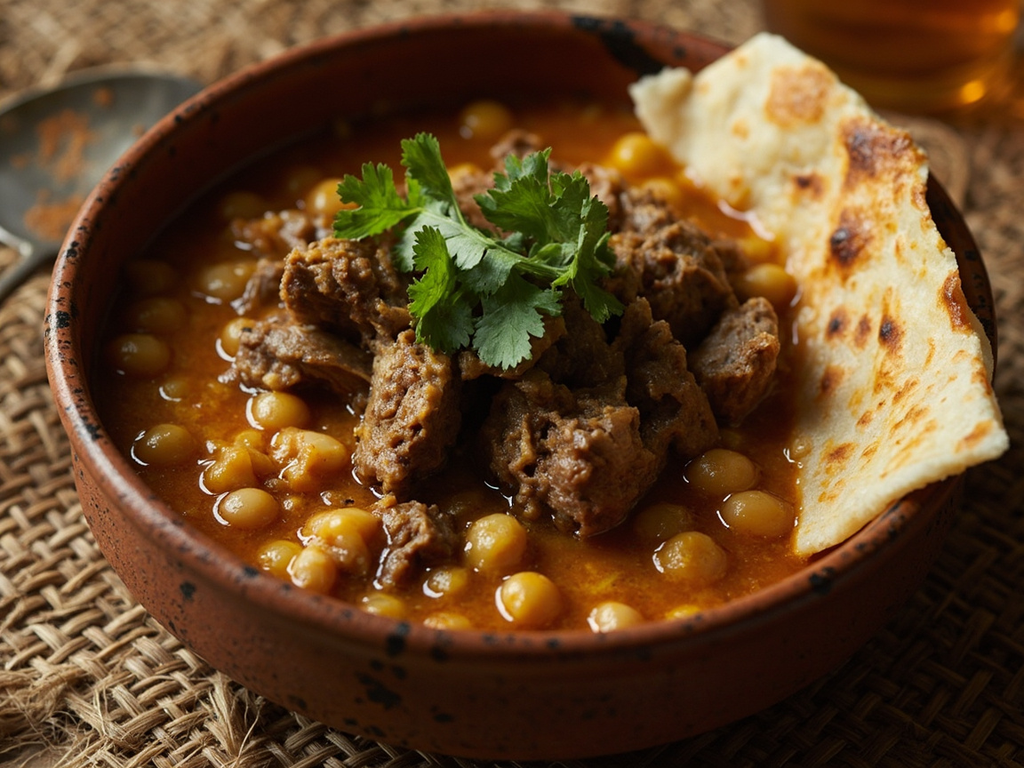
Tharīd with Lamb and Chickpeas
Why this dish? Tharīd was the quintessential daily dish of Baghdad's scholars — a stew poured over crumbled bread, nourishing and economical. Al-Farghānī, working long hours on his astronomical tables at the House of Wisdom, would have consumed this restorative dish that requires only a bowl and spoon, leaving the mind free for celestial calculations.
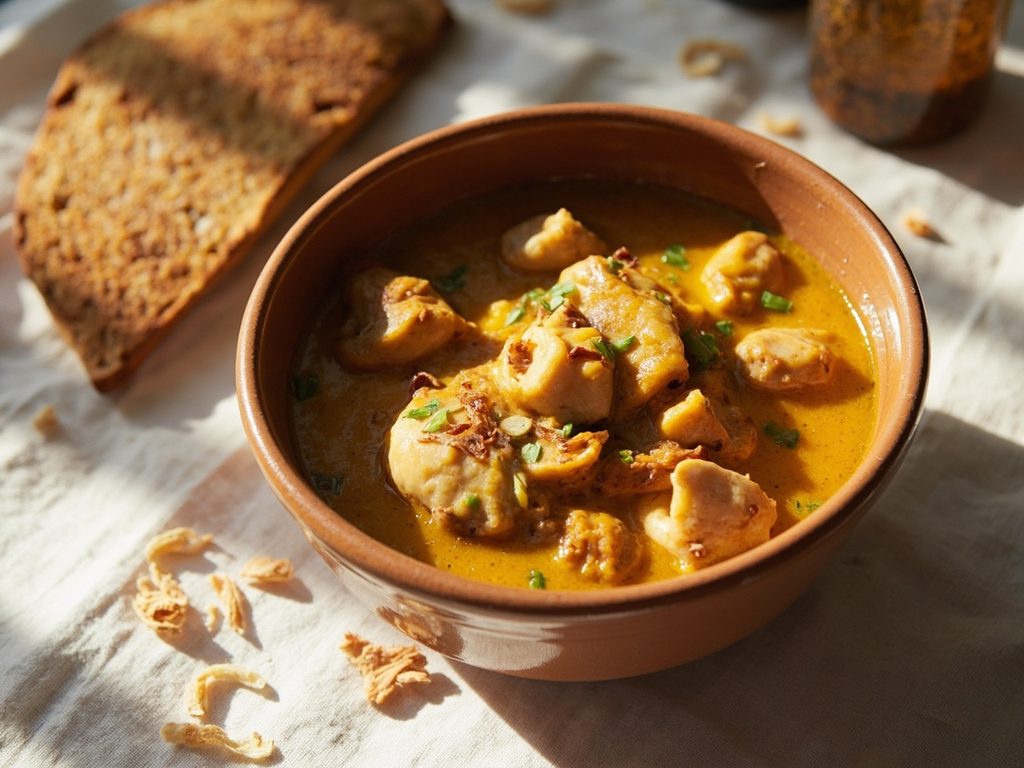
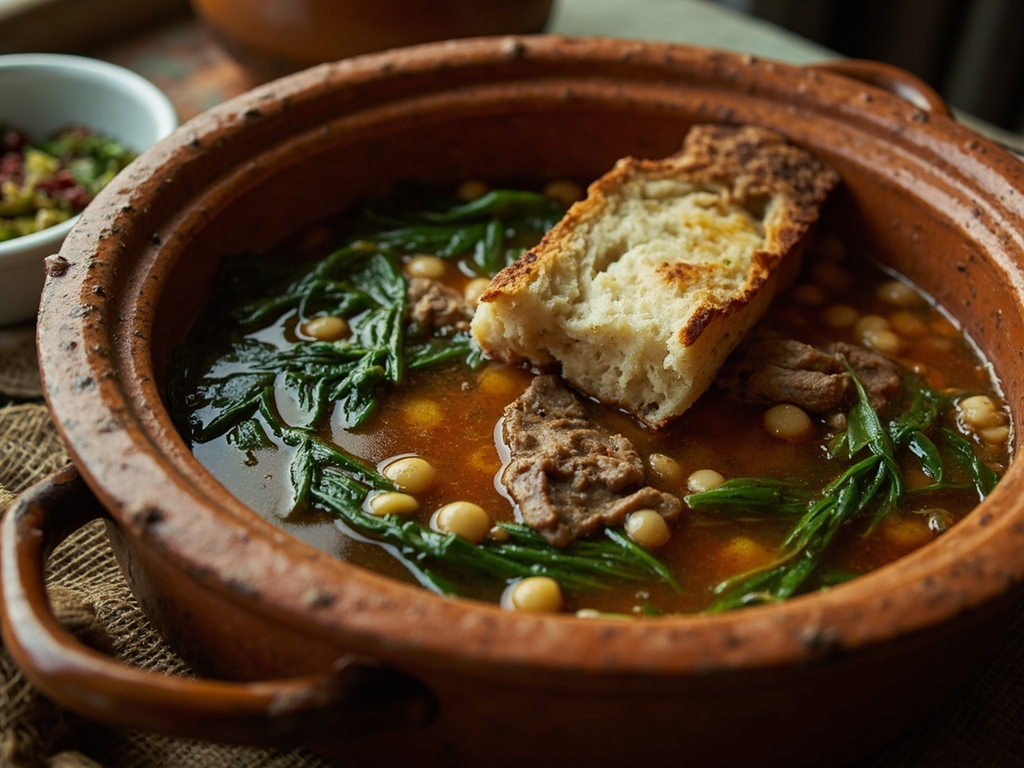
Lamb stew with chickpeas, perfumed with cumin and coriander, poured over stale flatbread. The bread absorbs the spiced broth and forms a tender, flavorful base. A dish mentioned in the oldest Arabic culinary collections, considered the king of foods.
Know, friend, that the man who scans the stars all night needs a dish that restores the body without weighing down the mind. My tharīd is brought to me in the evening in an earthen bowl, the bread well soaked in the juice of the lamb and cumin — I eat it with one hand while the other still holds the calamus. In Baghdad they say that tharīd is the lord of dishes, just as the Prophet — peace be upon him — said of ʿĀʾisha among women. The secret is in the broth: let it be fatty, full of tender chickpeas, and let the stale bread drink it all up before it reaches the mouth.
- •Lamb shoulder — a good piece, cut up (base of the stew)
- •Dried chickpeas — a handful, soaked the day before (nourishing legume)
- •Onion — two, sliced (aromatic base)
- •Cumin seeds — a spoonful (main spice)
- •Coriander seeds — a spoonful (complementary spice)
- •Murri or salt — to taste (umami seasoning)
- •Sheep's tail fat (alya) — a piece (cooking fat)
- •Stale flatbread (khubz) — several rounds (absorbent base)
- •Fresh coriander — a bunch (garnish)
Tharīd with Lamb and Chickpeas
Lamb stew with chickpeas, perfumed with cumin and coriander, poured over stale flatbread. The bread absorbs the spiced broth and forms a tender, flavorful base. A dish mentioned in the oldest Arabic culinary collections, considered the king of foods.
Why this dish? Tharīd was the quintessential daily dish of Baghdad's scholars — a stew poured over crumbled bread, nourishing and economical. Al-Farghānī, working long hours on his astronomical tables at the House of Wisdom, would have consumed this restorative dish that requires only a bowl and spoon, leaving the mind free for celestial calculations.
Know, friend, that the man who scans the stars all night needs a dish that restores the body without weighing down the mind. My tharīd is brought to me in the evening in an earthen bowl, the bread well soaked in the juice of the lamb and cumin — I eat it with one hand while the other still holds the calamus. In Baghdad they say that tharīd is the lord of dishes, just as the Prophet — peace be upon him — said of ʿĀʾisha among women. The secret is in the broth: let it be fatty, full of tender chickpeas, and let the stale bread drink it all up before it reaches the mouth.
Ingredients (period version)
- Lamb shoulder — a good piece, cut up (base of the stew)
- Dried chickpeas — a handful, soaked the day before (nourishing legume)
- Onion — two, sliced (aromatic base)
- Cumin seeds — a spoonful (main spice)
- Coriander seeds — a spoonful (complementary spice)
- Murri or salt — to taste (umami seasoning)
- Sheep's tail fat (alya) — a piece (cooking fat)
- Stale flatbread (khubz) — several rounds (absorbent base)
- Fresh coriander — a bunch (garnish)
Ingredients
- Boneless lamb shoulder — 600 g, cubed (base of the stew)
- Canned chickpeas — 400 g, drained (legume)
- Yellow onions — 2 medium, sliced (aromatic base)
- Ground cumin — 1 tsp (main spice)
- Ground coriander — 1 tsp (complementary spice)
- Soy sauce — 1 tbsp (substitute for murri)
- Olive oil — 3 tbsp (cooking fat)
- Pita or flatbread — 3 pieces, torn (absorbent base)
- Fresh coriander — 1 bunch (garnish)
- Salt — to taste (seasoning)
Method
- Sear the lamb cubes in olive oil over high heat in a pot until browned.
- Add the sliced onions and sweat for 5 minutes.
- Stir in the ground cumin and coriander, cook for 1 minute.
- Cover with water (about 1 liter), add soy sauce and salt. Bring to a boil then reduce heat.
- Simmer covered for 1 hour 15 minutes, until lamb is very tender.
- Add the drained chickpeas and cook for another 15 minutes.
- Place the torn pita pieces at the bottom of a large serving dish.
- Pour the hot stew over the bread and let soak for 5 minutes.
- Sprinkle with chopped fresh coriander and serve directly from the dish.
How it was made : Tharīd is one of the earliest documented dishes of Arab cuisine. The Kitāb al-Ṭabīkh by Ibn Sayyār al-Warrāq (10th century) gives several variants. Sheep's tail fat (alya) was the fat of choice, and murri replaced salt as a flavor enhancer in wealthy Baghdadi homes.
The contemporary twist : Serve in a deep earthenware bowl, bread at the bottom like a soup base, with a drizzle of extra virgin olive oil and a pinch of sumac to finish.
Sources : Ibn Sayyār al-Warrāq, Kitāb al-Ṭabīkh (10th century) — tharīd recipes · Nawal Nasrallah, Annals of the Caliphs' Kitchens (annotated translation of Kitāb al-Ṭabīkh), Brill, 2007 · Charles Perry, A Baghdad Cookery Book (translation of al-Baghdādī's Kitāb al-Ṭabīkh, 13th c.), Prospect Books, 2005
Al-Farghani · Charactorium