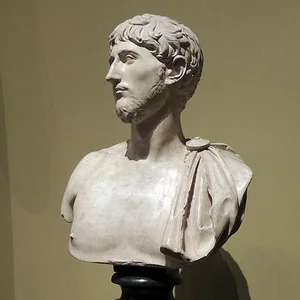

Roman politician and general of the 1st century BC, Lepidus formed the Second Triumvirate with Octavian and Mark Antony in 43 BC. Gradually marginalized, he was removed from power by Octavian in 36 BC.
Lepidus(89 av. J.-C. — 12 av. J.-C.)
Lepidus
Rome antique
9 min read
Frequently asked questions
Key Facts
- 46 BC: appointed Master of the Horse by Julius Caesar
- 43 BC: formation of the Second Triumvirate with Octavian and Mark Antony (lex Titia)
- 42 BC: takes part in the Battle of Philippi against the republicans
- 36 BC: removed from the triumvirate by Octavian after the Sicilian campaign
- Retained the title of Pontifex Maximus until his death around 13 BC
Works & Achievements
Appointed by Caesar to the highest military office of deputy commander, Lepidus governed Rome and Italy during the dictator's African and Spanish campaigns, demonstrating his loyalty and administrative competence.
In command of several legions in southern Gaul and Spain, Lepidus maintained order in these strategic provinces and was hailed as imperator by his troops, consolidating the military power base that made him an indispensable partner.
Lepidus was co-founder of this board of three men charged with restoring the order of the Republic (tresviri rei publicae constituendae), an unprecedented institution that legally sanctioned the sharing of supreme power among three generals.
Together with Octavian and Antony, Lepidus signed the condemnation lists of hundreds of political opponents; this radical act, however morally questionable, destroyed republican opposition and financed the triumviral armies.
Lepidus administered proconsular Africa, Rome's breadbasket, securing vital grain supplies and provincial legitimacy, even as his influence within the triumvirate waned in the face of Octavian and Antony.
Appointed head of the Roman priestly college after Caesar's death, Lepidus held Rome's highest religious office for thirty-two years, overseeing cults, the calendar, and priestly discipline — long after his political disgrace.
Anecdotes
In 43 BC, Lepidus, Octavian, and Mark Antony met near Bologna to establish the Second Triumvirate, formally recognized by Roman law. Together, they drew up proscription lists condemning hundreds of Roman senators and knights to death — including the great orator Cicero — in order to eliminate their political opponents and fund their armies.
During the war against Sextus Pompey in 36 BC, Lepidus contributed to the victory at the Battle of Naulochus. But in the days that followed, attempting to seize Sicily for himself alone, his own soldiers — won over by Octavian's promises — deserted en masse to join him. Abandoned, Lepidus was forced to beg Octavian on his knees and was stripped of all his triumviral powers.
Despite his complete political disgrace, Lepidus retained until his death the supreme office of Pontifex Maximus, Rome's highest religious dignity. Octavian, though all-powerful, could not legally remove this title from him until it fell vacant upon Lepidus's death in 12 BC — he then immediately claimed it for himself to further reinforce his aura as absolute ruler.
Exiled to the town of Circei on the Tyrrhenian coast, Lepidus spent his last thirty years in forced and closely monitored retirement, stripped of any public role. He was even forbidden from staying in Rome without special authorization from Octavian, by then Augustus. This long survival in humiliation illustrates the political cruelty of the era: the harmless defeated were allowed to live, but kept under tight surveillance.
Primary Sources
The triumvirs published a proscription list targeting approximately one hundred and seventy senators and two thousand knights. Lepidus was tasked with posting the first lists in Rome while Octavian and Antony raised troops.
Lepidus, whose clemency and moderation we have often praised, now finds himself allied with the enemies of the Republic. May he yet return to reason before it is too late — for his sake as well as ours.
Lepidus, having attempted to seize Sicily after the defeat of Sextus, saw his soldiers defect to Caesar Octavian. He came to Octavian's camp dressed in a plain cloak and begged for mercy. Octavian spared his life but stripped him of all authority.
Lepidus, having attempted to seize Sicily, was abandoned by his soldiers and forced to submit. Augustus spared his life but confined him to permanent retirement, allowing him to keep only the title of pontifex maximus.
Lepidus, a man whose feebleness of character matched the distinction of his name, was expelled from the triumvirate by Octavian after the Sicilian War and spent the remainder of his long life in obscurity at Circeii.
Key Places
The political and religious heart of Rome where Lepidus held his magistracies, attended Senate debates, and oversaw the posting of the proscription lists in 43 BC. This was the stage on which most of his public career played out.
Site of the secret meeting between Lepidus, Octavian, and Antony in October 43 BC, where the alliance of the Second Triumvirate was sealed before its official ratification in Rome.
The theater of war against Sextus Pompey in 36 BC, where Lepidus landed with fourteen legions and achieved early successes before the defection of his soldiers brought about his political downfall.
A coastal town in Latium where Lepidus was placed under house arrest after his disgrace in 36 BC. He spent the last thirty years of his life there — watched but spared — in permanent internal exile.
The province entrusted to Lepidus from 44 BC onward, which he governed with military and civil competence. This command earned him the title of *imperator* and strengthened his standing within the future triumvirate.
Typical Objects

A toga edged with a purple stripe, the mark of senior magistrates and high pontiffs. Lepidus wore it as a triumvir and above all as Pontifex Maximus, the supreme religious office he held until his death.

Bundles of rods bound around an axe, carried by the lictors who escorted senior magistrates. As a triumvir, Lepidus was entitled to an imposing lictor escort symbolizing his power over life and death.

A folding ivory seat reserved for curule magistrates (consuls, praetors, censors). Lepidus sat upon it during official sessions of the triumvirate and throughout his career as a magistrate of the Republic.

The everyday writing medium of educated Romans, used for correspondence, notes, and drafting official documents. Lepidus used them for his exchanges with Octavian and Antony, as well as for overseeing the proscription lists.

The military equipment of a Roman commander: a bronze muscled cuirass, sword belt, and short sword. Lepidus commanded several armies as a general, notably in Gallia Narbonensis and during the campaigns of the civil war.

A curved staff symbolizing the office of priest or augur, authorised to interpret the signs of the gods. As Pontifex Maximus, Lepidus oversaw the entire Roman priestly college, guardian of the *pax deorum*.

A signet ring engraved with the arms of the Aemilia family, used to authenticate official documents and correspondence. Lepidus's seal most likely bore the emblem of the *gens Aemilia*, one of Rome's oldest patrician families.
School Curriculum
Vocabulary & Tags
Key Vocabulary
Daily Life
Morning
Lepidus rose at dawn, like any Roman aristocrat, for the *salutatio*: dozens of clients and subordinates crowded into the *atrium* of his *domus* to seek favors and advice. Helped by slaves, he put on his *toga praetexta* and then made his way to the Forum or the Senate for the morning sessions, the most active hours of Roman public life.
Afternoon
The afternoon was devoted to military and religious affairs: overseeing sacrifices as *Pontifex Maximus*, receiving provincial delegations, or conferring with his legates. During his years as triumvir, he also had to coordinate army logistics, manage funds, and negotiate with Octavian and Antony through sealed dispatches.
Evening
In the evening, Lepidus attended *cenae* (dinners) with allied senators, where politics mingled with the refinements of the Roman table — Falernian wine, saltwater fish, game — all reclining on dining couches (*triclinium*). After his disgrace at Circei, his evenings were reduced to a scholarly retreat, far from the splendors of Rome.
Food
Like any Roman aristocrat, Lepidus ate little in the morning (*ientaculum*: bread, olives, cheese) and took his main meal in the evening at dinner. His triumvir's table featured pork, lamb, vegetables (lentils, leeks), white bread, and quality Italian wines, all served by specialized slaves.
Clothing
In public, Lepidus wore the purple-bordered *toga praetexta*, a mark of his magisterial and priestly dignity. On military campaign, he donned a bronze cuirass (*lorica musculata*), the *paludamentum* (crimson military cloak), and the red boots (*calcei mullei*) of a general. At home, he made do with a simple linen tunic.
Housing
His patrician *domus* on the Palatine Hill or near the Forum featured an *atrium* with an *impluvium* (central pool), *tablinia* (offices) richly decorated with frescoes, a *peristyle* with an inner garden, and rooms adorned with mosaics and sculptures. After his disgrace, he lived in a coastal villa at Circei, comfortable but isolated, under the discreet surveillance of Augustus's agents.
Historical Timeline
Period Vocabulary
Visual Style
Style visuel de la Rome républicaine tardive : portraits sculptés véristiques, architecture monumentale en marbre blanc, tonalités rouge Pompéi, bronze patiné et ombres profondes évoquant la fin d'un monde et l'avènement du pouvoir personnel.
Sound Ambience
Ambiance sonore de la Rome républicaine finissante : rumeur du Forum, débats du Sénat, tintement des armures légionnaires et cérémonies religieuses solennelles qui rythment la vie d'un triumvir et grand pontife.
Liens externes & ressources
Références
Œuvres
Maîtrise de la cavalerie sous Jules César (magister equitum)
46-44 av. J.-C.
Gouvernement de la Gaule Narbonnaise et de l'Hispanie citérieure
44-43 av. J.-C.
Fondation du Second Triumvirat (lex Titia)
27 novembre 43 av. J.-C.
Proscriptions de 43 av. J.-C.
43 av. J.-C.
Gouvernement de la province d'Afrique
40-36 av. J.-C.
Pontificat maximal (Pontifex Maximus)
44-12 av. J.-C.
Rechercher
See also
Related Characters
Catiline
107 av. J.-C. — 61 av. J.-C.
Crassus
114 av. J.-C. — 52 av. J.-C.
Scipio Africanus
234 av. J.-C. — 182 av. J.-C.
Spartacus
102 av. J.-C. — 70 av. J.-C.
Alaric I
370 — 410
Domitian
51 — 96