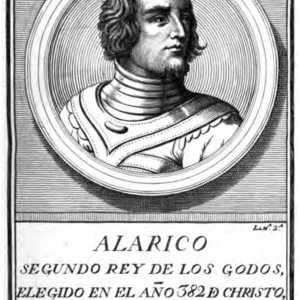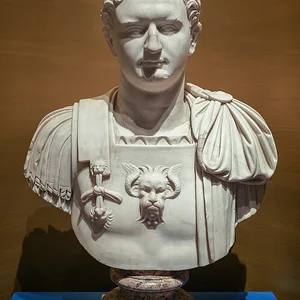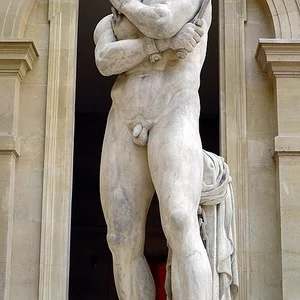

A gladiator of Thracian origin, Spartacus led the Third Servile War against Rome (73–71 BC), commanding an army of rebel slaves that threatened the very existence of the Roman Republic before being defeated by Crassus.
Spartacus(102 av. J.-C. — 70 av. J.-C.)
Spartacus
9 min read
Frequently asked questions
Key Facts
- Around 100 BC: born in Thrace (present-day Bulgaria), enslaved
- 73 BC: escaped from the gladiatorial school at Capua with 70 companions
- 72 BC: the slave army reached between 70,000 and 120,000 men and marched across all of Italy
- 71 BC: defeated and killed in battle against the legions of Crassus in Lucania
- 71 BC: 6,000 slaves crucified along the Appian Way by Crassus
Works & Achievements
The largest slave revolt in Roman history, waged for nearly two years across the Italian peninsula. According to some sources, the rebel army numbered as many as 120,000 fighters and inflicted crushing defeats on the legions of the Republic.
Spartacus structured his forces along the lines of a true Roman army: disciplined infantry, cavalry, and field forges to manufacture weapons. This organizational achievement — accomplished mostly by men with no prior military training — drew the admiration of ancient historians.
Spartacus defeated in succession the armies of both sitting consuls, Lentulus and Gellius — a remarkable feat that forced the Senate to grant Crassus full powers in order to save the Republic.
Spartacus imposed an unprecedented system in his camp: equal division of plunder and a ban on hoarding gold and silver by commanders. This rudimentary form of equality among fighters is highlighted by Plutarch as a sign of remarkable political wisdom.
Anecdotes
In 73 BC, Spartacus escaped from the gladiatorial school at Capua with around sixty companions armed with kitchen utensils stolen from the ludus stores. This modest beginning is remarkable: men in chains and poorly armed managed to rout the guards and reach the slopes of Vesuvius, where thousands of fugitive slaves quickly came to join them.
During the siege of Vesuvius by the praetor Gaius Claudius Glaber, Spartacus had ropes braided from wild vines growing on the volcano's slopes. His men rappelled down the steep cliffs and took the Romans completely by surprise from the rear, routing an entire army — a tactical masterstroke that revealed the extraordinary military gifts of the Thracian leader.
Spartacus imposed a discipline and fairness within his army that were unusual for the time: according to Plutarch, he forbade his lieutenants from keeping gold or silver and ensured that the spoils were shared equally among all fighters. This practice, which stood in stark contrast to Roman customs, earned him fierce loyalty from his troops.
Spartacus's wife, a Thracian prophetess whose name has not come down to us, had been with him since Capua. She reportedly predicted from the moment of his capture that a destiny both glorious and tragic awaited him — a prophecy that Plutarch records as having been fully fulfilled by the rebel leader's meteoric rise and death in battle.
After the final defeat in 71 BC, Crassus had six thousand captured slaves crucified along the entire length of the Via Appia, from Capua to Rome. This collective and spectacular punishment was intended to deter any future slave revolt; the bodies, left on crosses without burial, reminded every traveler of the fate reserved for slaves who dared to rebel.
Primary Sources
Spartacus, a Thracian of the Maedi tribe, was not only endowed with great strength and courage, but surpassed his condition through his intelligence and gentleness, and was more of the Greek than the Barbarian temper.
Spartacus sought to lead his army toward the Alps, judging that from there each man could return to his homeland — Gauls, Germans, and Thracians, each to his own native country.
Spartacus, Crixus, and Oenomaus, having escaped from the gladiatorial school of Lentulus at Capua with some seventy companions, ravaged Italy with such fury that one might regret that such valor had been that of a slave.
The fugitive gladiators, under the command of Spartacus, defeated the praetorian and consular armies on several occasions, forcing the Senate to resort to emergency measures to defend Italy.
The fugitive gladiators, led by Spartacus, first defeated the praetor Varinius Glaber, then the consular armies, and ravaged a large part of Italy for two years.
Key Places
City in Campania where the gladiatorial school of Lentulus Batiatus was located — the starting point of the revolt in 73 BC. Capua was at the time one of the foremost cities in Italy, renowned for its wealthy *ludi gladiatorii*.
The volcano on whose slopes Spartacus and his earliest companions took refuge after the escape. Rappelling down its cliffs to surprise the Roman army of Glaber was the revolt's first great tactical victory.
The southern tip of the Italian peninsula where Spartacus found himself trapped behind Crassus's wall in 71 BC. It was here that he attempted to cross to Sicily with the help of Cilician pirates who betrayed the agreement.
The narrow stretch of water separating Italy from Sicily that Spartacus sought to cross in order to rekindle the revolt on the island, which was rich in agricultural slaves. The betrayal by the Cilician pirates forced him to turn back northward.
The river in Lucania near which the final battle took place in 71 BC. Spartacus died fighting there after attempting to reach Crassus personally; his body was never formally identified.
The great paved Roman road linking Rome to Capua and Brindisi, along which Crassus erected 6,000 crosses after the final defeat. This corridor of death, visible for hundreds of kilometers, was meant to remind everyone of the fate awaiting rebellious slaves.
Typical Objects

A short, double-edged sword and the emblematic weapon of Roman legionaries and many gladiators. Spartacus and his companions quickly seized gladii from defeated Roman soldiers to arm their rapidly growing forces.

A distinctive bronze helmet of the Thracian gladiator type, featuring a curved crest, wide cheek guards, and a protective face grille. Spartacus, trained as a Thracian-style fighter in the arena, most likely wore this type of helmet in combat.

A small round shield used by Thracian-type gladiators, more maneuverable than the large legionary *scutum*. After their first victories, the rebels also equipped themselves with full-sized Roman shields recovered from the battlefield.

A symbol of enslaved existence, iron chains bound gladiators and agricultural slaves in their daily lives. Breaking them was the founding act of the revolt, and Spartacus turned them into a symbol of reclaimed freedom.

The majority of the slaves who joined Spartacus were rural workers who arrived armed with farm tools — sickles, pitchforks, axes — before successive victories made it possible to equip them with proper military weapons.

The slave army lived in mobile military encampments; torches, campfires, and field equipment were essential to the survival and cohesion of troops drawn from vastly different origins and languages.
School Curriculum
Vocabulary & Tags
Key Vocabulary
Daily Life
Morning
Before dawn, Spartacus and his lieutenants held council around the fire to decide the day's movements — march, raid, or defensive positioning. At daybreak, sentinels rotated their watch and the camp blacksmiths resumed hammering metal to repair and forge weapons.
Afternoon
Afternoons were devoted to military training: former gladiators instructed newly recruited slaves in the handling of weapons, combat formations, and the maneuvers of their improvised cavalry. Scouts set out to reconnoiter roads, Roman positions, and estates to be raided.
Evening
In the evenings, the thousands of fighters lit their campfires and cooked provisions plundered from the great *villae* of Campania and Lucania. Amid the polyglot hubbub of the camp — Thracian, Gaulish, Greek, Latin — men shared memories of their lost homelands and of recent victories against Rome.
Food
Their diet relied on resources seized during raids on agricultural estates across southern Italy: wheat, legumes, olive oil, livestock meat, and wine drawn from the landowners' cellars — a commodity normally reserved for free men, which the slaves now drank freely.
Clothing
Spartacus most likely wore composite equipment: a Thracian helmet with a curved crest, small greaves (*ocreae*), a circular shield (*parma*), and pieces of Roman armor recovered from defeated soldiers. Rank-and-file fighters wore coarse wool tunics and makeshift cloaks, supplemented by military equipment seized over the course of battles.
Housing
Spartacus lived in a mobile military camp that moved constantly to avoid encirclement. Each evening, the troops built field fortifications — ditches, wooden palisades, earthen ramparts — following Roman military methods that Spartacus had absorbed, turning the rebel camp into a true city on the march.
Historical Timeline
Period Vocabulary
Visual Style
Un style visuel ancré dans le péplum néoclassique — lumière crue du sud de l'Italie, armures hétéroclites et teintes de terre brûlée, rouge sang et gris fer évoquant l'arène, la révolte et les paysages volcaniques de Campanie.
Sound Ambience
L'ambiance de Spartacus mêle le fracas des armes dans l'arène, le grondement d'une armée en marche sur les voies romaines et le murmure polyglotte des esclaves de toutes origines autour des feux de camp rebelles.
Liens externes & ressources
Références
Œuvres
Troisième guerre servile (73-71 av. J.-C.)
73-71 av. J.-C.
Organisation militaire de l'armée servile
73-71 av. J.-C.
Victoire contre les deux armées consulaires (72 av. J.-C.)
72 av. J.-C.
Politique d'équité et de partage du butin
73-71 av. J.-C.