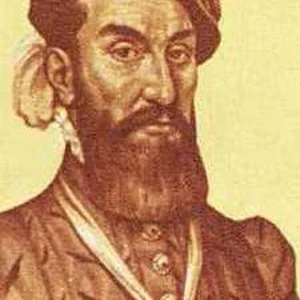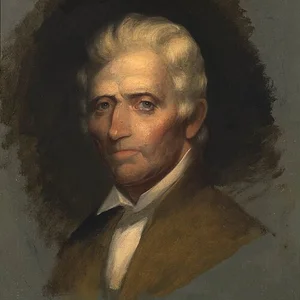

Daniel Boone (1734-1820) was an American pioneer, trapper, and explorer, an iconic figure of the conquest of the West. In 1775 he blazed the Wilderness Road through the Appalachians and founded Boonesborough, in present-day Kentucky.
Daniel Boone(1734 — 1820)
Daniel Boone
États-Unis
6 min read
Frequently asked questions
Key Facts
- Born in 1734 in Pennsylvania into a family of Quaker settlers of English descent.
- In 1775, blazed the Wilderness Road through the Cumberland Gap for the Transylvania Company.
- Founded Boonesborough that same year (1775), one of the first colonial settlements in Kentucky.
- Captured in 1778 by the Shawnee during the War of Independence, he was adopted and then escaped to defend Boonesborough.
- Died in 1820 in Missouri; his legend was popularized during his own lifetime and became an American national myth.
Works & Achievements
Blazing of a trail through the Cumberland Gap connecting Virginia to Kentucky. This route opened the way for hundreds of thousands of settlers heading West.
Establishment of one of the first American settlements in Kentucky, which became an anchor point for the colonization of the region.
Successful resistance against the Shawnee and their British allies over the course of about ten days, saving the settlement during the War of Independence.
Long hunting and scouting expeditions that introduced the fertile lands of Kentucky to settlers in the East.
A first-person narrative, actually written by Filson, which turned Boone into a legendary figure of the American frontier.
Anecdotes
In 1778, Daniel Boone was captured by the Shawnee while gathering salt at Blue Licks. Chief Blackfish adopted him, renamed him "Sheltowee
(Big Turtle)
and brought him into his family. Boone played along for months before escaping
covering nearly 250 km in four days to warn Boonesborough of an imminent attack.
In 1776, his daughter Jemima and two other teenage girls were kidnapped by a band of Shawnee and Cherokee warriors near Boonesborough. Boone led the pursuit and freed them two days later. The episode left such a strong impression that it later inspired a famous scene in James Fenimore Cooper's novel *The Last of the Mohicans*.
Contrary to the image popularized later on, Boone hated the raccoon-skin cap often attributed to him. He preferred to wear a beaver felt hat, which he considered more dignified and more practical. The coonskin cap is an invention of later shows and tales.
Boone's fame exploded in 1784 thanks to John Filson's book, which published a first-person account of his adventures. Heavily romanticized, this text turned the very real frontiersman into an almost legendary national hero, read as far away as Europe.
Toward the end of his life, ruined by improperly recorded land titles in Kentucky, Boone lost most of his property. Disheartened, he settled in Missouri, then a Spanish territory, where he was given a post as a local judge despite his little taste for paperwork.
Primary Sources
“Curiosity is natural to the soul of man, and interesting objects have a powerful influence on our affections.” Written in the first person in Boone's name, the narrative recounts his arrival in Kentucky and the founding of Boonesborough.
Richard Henderson purchases from the Cherokee a vast territory between the Kentucky and Cumberland rivers; Boone is tasked with clearing a road and establishing a settlement there.
A nineteenth-century collection of interviews and documents bringing together the recollections of the Boone family and their contemporaries about life on the Kentucky frontier.
Key Places
Boone's birthplace, within a Quaker community on the colonial frontier.
Natural pass through the Appalachians that Boone used to reach Kentucky; a key point along the Wilderness Road.
Fortified settlement founded by Boone in 1775 on the Kentucky River, besieged by the Shawnee in 1778.
Salt spring where Boone was captured in 1778 and the site of the bloody 1782 battle in which his son Israel was killed.
Region where Boone spent his final years near his family and where he died in 1820.
Typical Objects

A flintlock with a very long barrel and a small bore, accurate at long range, also known as the “Kentucky rifle.” It was the indispensable tool of the hunter and the pioneer.

Jacket, trousers, and moccasins cut from supple deer leather, resistant to brambles and cold. The characteristic garb of longhunters and trappers.

A sturdy blade and a hatchet worn at the belt, used as readily to skin game as to carve wood or defend oneself. Universal tools of frontier life.

A hollowed and stoppered cattle horn that kept black powder dry, paired with a satchel holding lead balls and spare flints. Essential for reloading the rifle.

A metal jaw trap set in rivers to catch beavers and other fur-bearing animals. The fur trade was a major source of income for Boone.

A measuring chain and a compass used to mark out and record parcels of land. Boone worked as a surveyor for the settlement companies of Kentucky.
School Curriculum
Vocabulary & Tags
Key Vocabulary
Tags
Daily Life
Morning
On a hunting expedition, Boone would rise before dawn to check his traps and stalk game while the animals were active. He would inspect his rifle and powder, then move silently through the forest.
Afternoon
The afternoon was spent skinning the animals he had killed, stretching the hides, and preparing them for trade. During settlement periods, he also took part in the work of the fort: felling trees, building palisades, and surveying the land.
Evening
In the evening, around a campfire or inside the cabin, the hides were left to dry, equipment was repaired, and watch was kept in turns. Boone, known as a fine storyteller, would share hunting tales and news from the frontier.
Food
Their diet relied on hunted game (deer, bear, wild turkey), fish, and fruit gathered in the forest. To this were added corn, beans, and cornbread grown in the clearings, as well as salt produced at salt springs.
Clothing
Boone wore deerskin clothing — a hunting shirt, leggings, and moccasins — supple and durable. A belt held his knife and tomahawk, and he preferred a felt hat to the famous fur cap wrongly attributed to him.
Housing
On the frontier, people lived in cabins of hewn logs, with shingled roofs and chimneys of stone and clay. In dangerous areas, these cabins were grouped into fortified “stations” surrounded by palisades to protect against attacks.
Historical Timeline
Period Vocabulary
Liens externes & ressources
Références
Œuvres
Ouverture de la Wilderness Road
1775
Fondation de Boonesborough
1775
Défense du siège de Boonesborough
1778
Exploration et cartographie du Kentucky
1769-1771
Récit autobiographique recueilli par John Filson
1784