 flip
flipShchi with sour cabbage (everyday soup)
Shchi with sour cabbage (everyday soup)
Why this dish? Shchi is THE national Russian soup, eaten daily at every table, from the peasant's izba to the professor's apartment. In Borodin's biography, shchi is explicitly mentioned among his dishes: it was the smell of sour cabbage that floated in his apartment at the Medico-Surgical Academy, where he lived surrounded by his retorts and his guests.
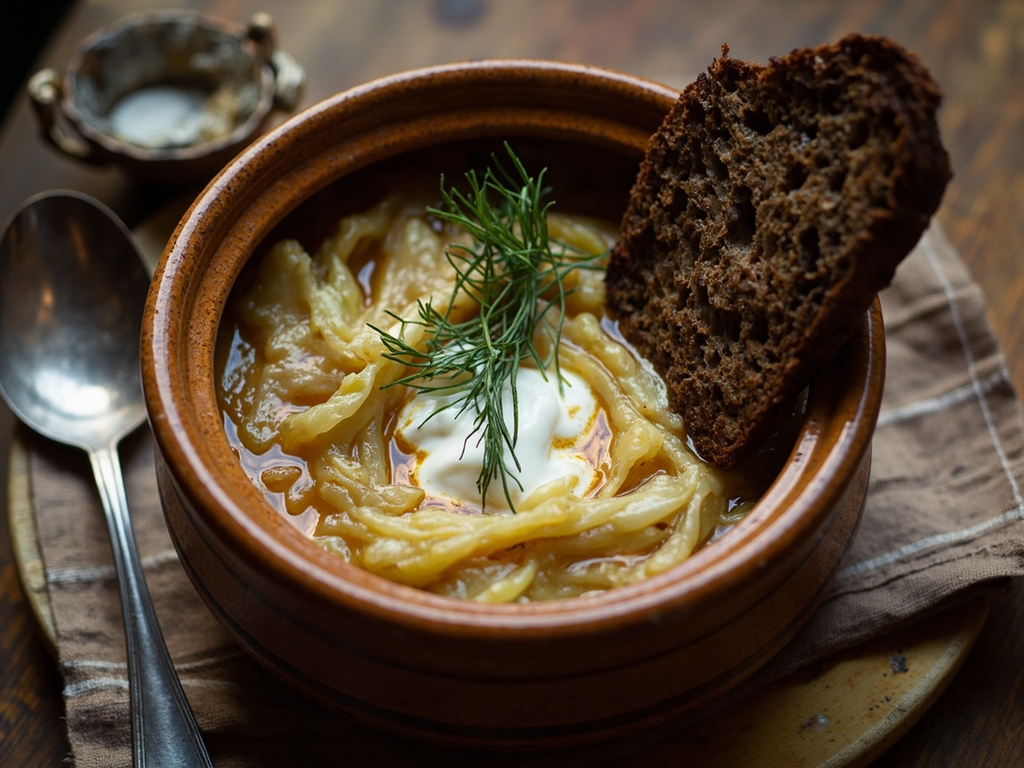
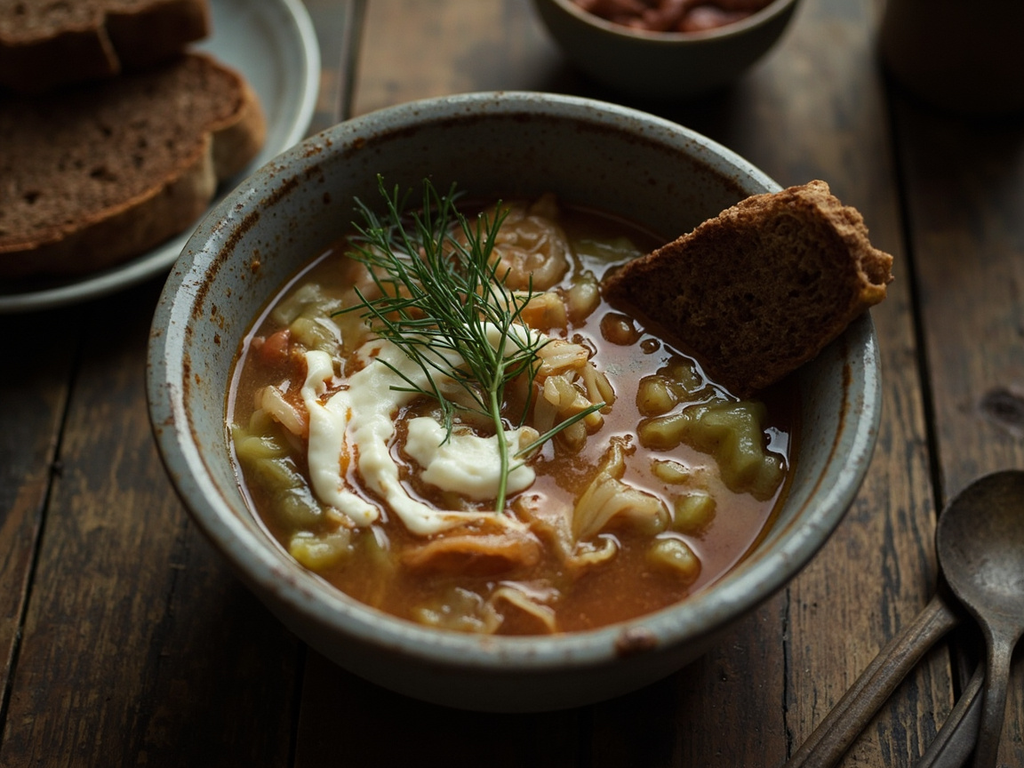
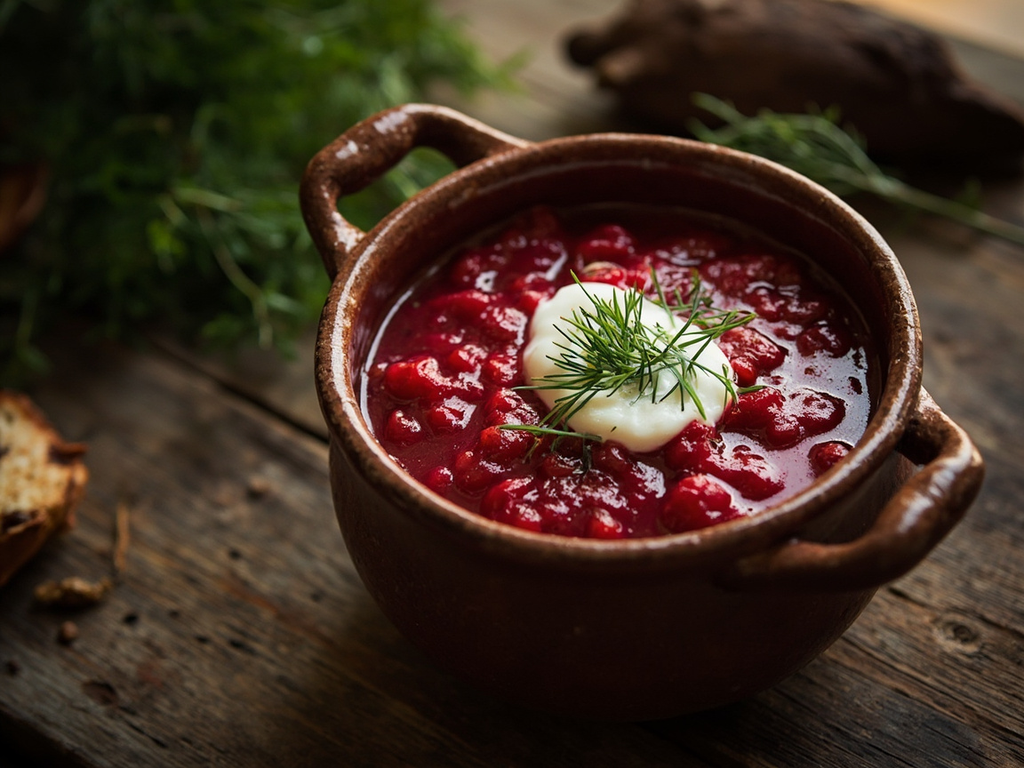
A deep and comforting soup of long-simmered lacto-fermented cabbage, slightly sour, bound with a spoonful of sour cream. The quintessential Russian everyday dish, simple and nourishing.
Come, sit down, don't stand on ceremony! In my house we eat as we work, without fuss — the tureen in the middle and everyone helps themselves. This shchi, my wife and I let it simmer for hours on the stove while I scribble my scores between experiments; sour cabbage needs time, like a fugue. A good spoonful of smetana at the bottom of the bowl, black bread beside it, and you'll be warmed for the whole St. Petersburg winter. Eat, eat, I always have enough for ten more unexpected guests.
- •Lacto-fermented cabbage (kvashenaya kapusta) — a good bowlful (sour and umami base)
- •Beef for boiling — a piece (broth)
- •Onions — a few (aromatic)
- •Carrot and parsley root — as desired (sweetness)
- •Dill and bay leaf — a bunch (flavor)
- •Sour cream (smetana) — for serving (binding)
Shchi with sour cabbage (everyday soup)
A deep and comforting soup of long-simmered lacto-fermented cabbage, slightly sour, bound with a spoonful of sour cream. The quintessential Russian everyday dish, simple and nourishing.
Why this dish? Shchi is THE national Russian soup, eaten daily at every table, from the peasant's izba to the professor's apartment. In Borodin's biography, shchi is explicitly mentioned among his dishes: it was the smell of sour cabbage that floated in his apartment at the Medico-Surgical Academy, where he lived surrounded by his retorts and his guests.
Come, sit down, don't stand on ceremony! In my house we eat as we work, without fuss — the tureen in the middle and everyone helps themselves. This shchi, my wife and I let it simmer for hours on the stove while I scribble my scores between experiments; sour cabbage needs time, like a fugue. A good spoonful of smetana at the bottom of the bowl, black bread beside it, and you'll be warmed for the whole St. Petersburg winter. Eat, eat, I always have enough for ten more unexpected guests.
Ingredients (period version)
- Lacto-fermented cabbage (kvashenaya kapusta) — a good bowlful (sour and umami base)
- Beef for boiling — a piece (broth)
- Onions — a few (aromatic)
- Carrot and parsley root — as desired (sweetness)
- Dill and bay leaf — a bunch (flavor)
- Sour cream (smetana) — for serving (binding)
Ingredients
- Raw sauerkraut (unseasoned) — 400 g, rinsed if too salty (sour and umami base)
- Beef chuck or shank — 500 g (broth)
- Onion — 2 (aromatic)
- Carrot — 1 (sweetness)
- Bay leaf — 2 (flavor)
- Fresh dill — 1 small bunch (final flavor)
- Thick crème fraîche — 4 tablespoons (binding for serving)
- Dark rye bread — for serving (accompaniment)
Method
- Cover the beef with cold water, bring slowly to a simmer, skim, then cook for 1 hour 30 minutes with a whole onion, carrot and bay leaf.
- Meanwhile, sweat the rinsed and squeezed sauerkraut in a little fat over low heat for 30 minutes to soften it.
- Remove the meat, cut into pieces, strain the broth and return the meat and sauerkraut to it.
- Simmer another 30 to 40 minutes over low heat until the soup is mellow and fragrant.
- Adjust salt, add chopped dill off the heat.
- Serve very hot with a spoonful of sour cream in each bowl and black bread.
How it was made : Shchi was cooked in the Russian oven (*pech*), a large brick mass that retained gentle heat all day: the pot was slid in in the morning and the soup slowly confited until evening, giving it its incomparable tenderness. They used to say, “Shchi and kasha are our food.”
The contemporary twist : Serve it “à la Borodin” in bowls placed directly on a sheet of music: a sprig of dill shaped like a treble clef to remind of the composer-chemist.
Sources : Elena Molokhovets, A Gift to Young Housewives (1861) · Pohlebin V., History of Russian Cuisine
Alexander Borodin · Charactorium