 flip
flipBlack Bread Soup (Brotsuppe)
Black Bread Soup (Brotsuppe)
Why this dish? Daughter of an innkeeper near Kassel, Dorothea grew up to the sound of the big pot. In an inn, nothing goes to waste: stale rye bread becomes soup, served to travelers and storytellers alike. It was while stirring this pot that the tales she would later deliver to the Brothers Grimm were told.
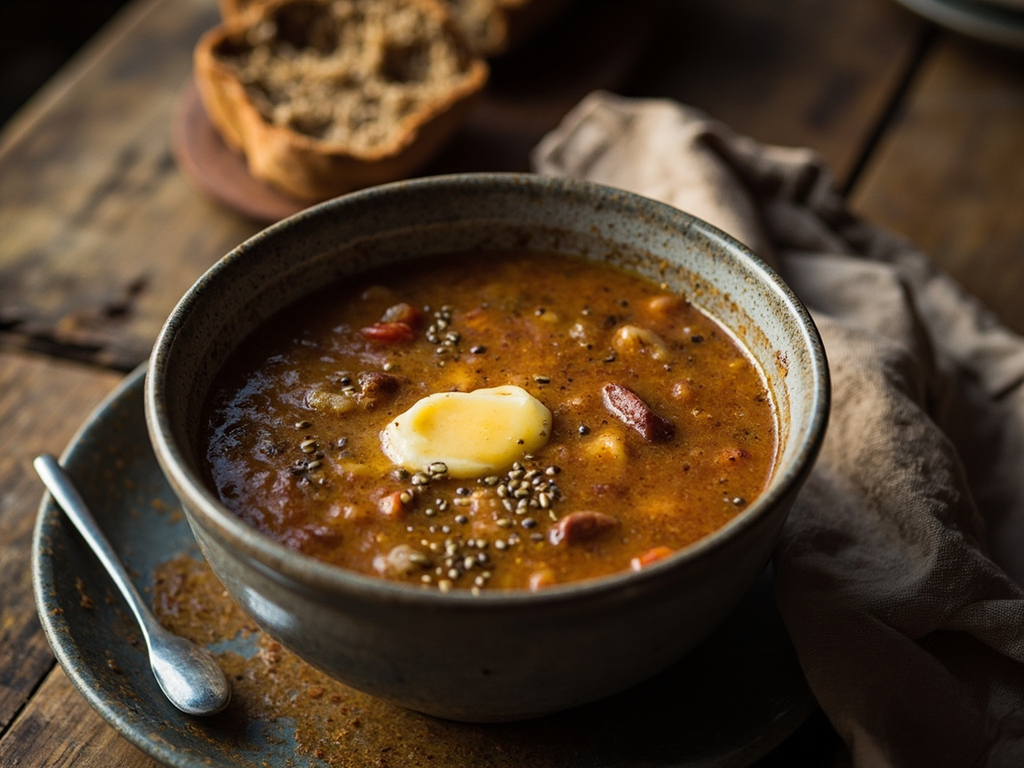
A humble and comforting soup: hard rye bread softened in a broth of garden vegetables, bound with lard and seasoned with caraway. The poor man's dish, but one that warms the long Hessian winters.
Come close to the hearth, little one, and listen to the pot sing. When the rye bread is too hard for the teeth, we do not throw it away — in our house we waste nothing, the good Lord does not like waste. I break it into pieces, pour over it the cabbage broth, a spoonful of goose fat, a pinch of caraway, and there you have something to keep your belly until evening. Many a traveler has warmed himself at this bowl while I told him the story of Faithful John.
- •Stale rye bread — several hard slices (soup base)
- •Vegetable broth or cabbage cooking water — a large pot (liquid)
- •Goose fat or lard — a generous spoonful (fat, flavor)
- •Garden onion — one (aromatic)
- •Caraway seeds — a pinch (signature, digestion)
- •Salt — to taste (seasoning)
Black Bread Soup (Brotsuppe)
A humble and comforting soup: hard rye bread softened in a broth of garden vegetables, bound with lard and seasoned with caraway. The poor man's dish, but one that warms the long Hessian winters.
Why this dish? Daughter of an innkeeper near Kassel, Dorothea grew up to the sound of the big pot. In an inn, nothing goes to waste: stale rye bread becomes soup, served to travelers and storytellers alike. It was while stirring this pot that the tales she would later deliver to the Brothers Grimm were told.
Come close to the hearth, little one, and listen to the pot sing. When the rye bread is too hard for the teeth, we do not throw it away — in our house we waste nothing, the good Lord does not like waste. I break it into pieces, pour over it the cabbage broth, a spoonful of goose fat, a pinch of caraway, and there you have something to keep your belly until evening. Many a traveler has warmed himself at this bowl while I told him the story of Faithful John.
Ingredients (period version)
- Stale rye bread — several hard slices (soup base)
- Vegetable broth or cabbage cooking water — a large pot (liquid)
- Goose fat or lard — a generous spoonful (fat, flavor)
- Garden onion — one (aromatic)
- Caraway seeds — a pinch (signature, digestion)
- Salt — to taste (seasoning)
Ingredients
- Stale whole-grain rye bread — 200 g (base)
- Vegetable broth — 1 liter (liquid)
- Lard or butter — 30 g (fat)
- Onion — 1 large (aromatic)
- Caraway seeds — 1 teaspoon (signature)
- Salt and pepper — to taste (seasoning)
Method
- Finely chop the onion and gently fry it in the lard until golden.
- Cut the rye bread into pieces and add to the pot.
- Pour in the hot broth, add caraway, and season with salt.
- Simmer for 20 to 25 minutes, stirring, until the bread breaks down and thickens the soup.
- Mash roughly with a spoon for a rustic texture. Serve piping hot.
How it was made : In Hessian peasant households, black rye bread was baked once a week or once a month and quickly hardened: bread soups (Brotsuppe, Bröckelsuppe) were the daily way to recycle it. Goose fat replaced butter, which was rarer, especially in an inn where poultry was slaughtered.
The contemporary twist : Serve in a deep bowl with a poached egg in the center and a few rye croutons fried in caraway butter.
Dorothea Viehmann · Charactorium